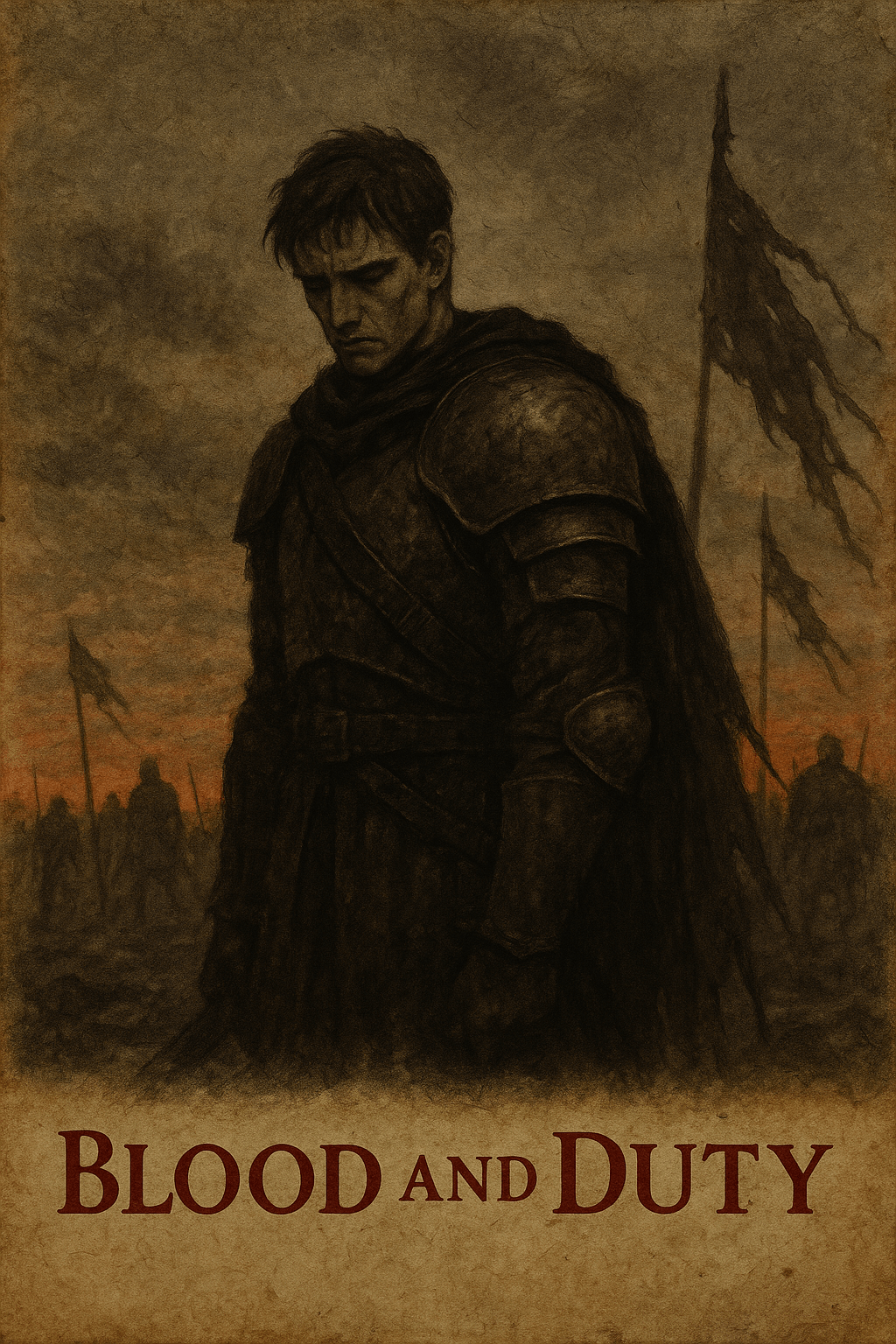
The sun never rose kindly over Kharad’s Pass.
It loomed like a blade carved into the mountainside, a fortress blackened by fire and time. Once built to protect caravans and travelers, it had become a throne of cruelty. Rhalgor the Scourge, tyrant of the deep desert, had seized it years ago—and from its battlements, he had rained misery upon Rakkesh ever since.
Now, it stood as the final bastion.
The last obstacle before the Empire could secure the southern trade routes, establish a protectorate over the fractured frontier villages, and open stable contact with the mysterious Ruh’Rashi clans of the deep sands.
All that stood in the way was stone, blood, and madness.
And Kael Drakar.
Kael stood beside Brak, overlooking the valley from a high ridge. Below, the XIV Legion arranged itself like a living engine—shields, ballistae, tents, rows of disciplined flame-banners.
But the old sergeant looked tired.
His beard, now streaked in white, moved faintly with the dry wind. His eyes were heavier. His shoulders stooped just slightly more than they had the year before.
“You ready for this?” Brak asked, his voice gravel-soft.
Kael didn’t answer immediately. His gaze was fixed on the walls of the Pass—lined with human bodies, civilians chained to stakes, their ragged cries echoing through the canyon.
“They’re using them as shields,” Kael said.
Brak’s jaw tightened. “Cowards always do.”
“We go anyway,” Kael said. “We don’t stop. We don’t flinch.”
Brak turned to him, studying him in silence.
Then: “You speak like a commander.”
Kael looked at him, unblinking. “I act like one, too.”
A long pause.
“I won’t be around forever, Kael,” Brak muttered. “They need someone who knows how to lead men through fire. Not just win battles. Command. Understand?”
Kael did.
And this battle would be the final test.
At dawn, the horns of the XIV howled across the cliffs.
Kael rode at the head of the charge, flanked by his captains. The plan was simple: frontal assault to draw the defenders, followed by a flanking breach through the lower aqueducts to split their forces. Every move was precise. Calculated.
But nothing could prepare them for the brutality waiting inside.
Flaming oil poured from the upper walls. Arrows blackened the sky. And worst of all, civilians—women, elders, children—were tied to the inner barricades, their cries manipulated into weapons of hesitation.
Soldiers faltered.
Kael did not.
He raised his axe and pointed forward. “Advance! Shields up! Break the line!”
“But Captain—!”
“If we hesitate, thousands more will die!” he shouted. “We end this—today.”
His voice, like steel on stone, crushed doubt.
The Legion pushed forward, smashing barricades beneath screams and fire. Kael led from the front, his blade a streak of death through the confusion. He ordered precision shots from his archers—minimizing collateral damage where possible, but never stopping.
Men wept behind their shields.
Kael did not.
Because in his mind, he saw the alternative.
He saw what would happen if Kharad’s Pass remained free.
More villages razed.
More children enslaved.
More chaos. More Rakkesh.
He could not allow it.
Brak fought beside him.
But Kael saw the signs.
The fatigue in his swings. The stiffness in his knees. The pain hidden behind clenched teeth.
During a brief reprieve in the storm, Brak leaned against a shattered column, catching his breath.
“This is your army now, Kael,” he said between coughs. “You know it. I know it. Make sure they survive you.”
Kael only nodded.
Then turned to face the final gate.
With the flanking team inside the walls, Kael gave the order.
A battering ram forged from reinforced siege beams smashed through the last defense.
The inner keep was a hell of screams and flame.
Kael climbed the stairs drenched in blood—his, his enemies’, and others he could no longer name.
He met Rhalgor the Scourge in the highest chamber.
The tyrant wore patchwork armor, and in his eyes burned fanatic fire.
“Is this your order, dog of Caltheria?” Rhalgor hissed. “Murdering children for trade routes and coins?”
Kael struck without answering.
The duel was short.
Not because Rhalgor lacked strength—but because Kael no longer hesitated.
He ended him with a blow to the throat, then to the heart.
And with that, the last gate fell.
By dusk, the banners of the XIV Legion flew atop Kharad’s Pass.
The desert winds scattered ash across the valley.
The bodies were burned.
The civilians were freed—those who survived.
And Kael Drakar stood alone, overlooking the desert that had devoured his youth.
The campaign of Rakkesh was over.
A small part of the desert would remain under Imperial control. Trade routes would be secured. The fractured border settlements would be gathered under the eagle banner as Imperial protectorates. Contact with the Ruh’Rashi tribes would begin—cautious, but open.
But more than that:
A commander had been forged.
Brak approached that night, dragging his wounded leg through the ash.
He handed Kael a sealed letter, marked with the crimson sigil of the War Council.
“You’re not just captain anymore,” he said. “They want you to command the XIV.”
Kael didn’t flinch.
He looked at the stars.
At the smoke curling above the mountains.
At the bodies burned for peace.
Then he said: “Then I will.”
Brak placed a hand on his shoulder—heavy, proud.
“You earned it.”
In the silence that followed, Kael whispered words he once heard as a boy.
But now they no longer felt like a plea.
They felt like truth.
“Peace through strength. Order through sacrifice.”
The borders of Rakkesh had finally been stabilized.
After years of relentless bloodshed, the XIV Legion was granted a rare reprieve. The desert campaign was over. The southern frontier would remain under Imperial watch, and a secure trade route with the Ruh’Rashi clans had been established. The villages along the frontier were now protectorates of Valtheria, governed under the banner of the phoenix.
For the first time in years, the soldiers of the XIV were allowed to return home—if only briefly.
Among them marched Kael Drakar, no longer a nameless recruit, but a captain. A veteran. A man whose skin bore the marks of fire and whose soul carried shadows too deep for healing.
The rhythm of boots on the stone road echoed like memory. Every step closer to home cut through the silence that reigned inside him.
He had vowed never to return to Drak’s Hollow.
And yet there he was—approaching the village not as a son, but as something else.
A hero, they would call him.
But heroes don’t wake up screaming in the night.
As the hills surrounding the village came into view, Kael smelled the old ghosts of home: dry wheat, burned wood, and ash from forgotten hearths. He remembered cold nights, sharing bread with his mother, and mornings filled with his father’s drunken rage.
“This is not my home anymore,” he murmured.
But still, his legs carried him forward.
The moment he entered the village, the crowd erupted in joy.
Improvised banners flapped in the wind. Cheers rose around him.
“Kael has returned! The son of Drak’s Hollow!”
Children who once played barefoot in the fields now stared at him with wide eyes, whispering stories of valor. Elderly faces he barely recognized reached out to touch his armored shoulder.
The phoenix crest of the XIV Legion, emblazoned across his chest, was all they saw—a symbol of glory, of victory.
Not the blood underneath.
Not the ghosts behind his eyes.
Kael tried to smile.
But it felt like a lie.
Then his mother appeared, tears shining in her eyes.
She embraced him fiercely, as if afraid he would vanish again.
Kael stood frozen for a moment before wrapping his arms around her.
“You came back to us,” she whispered.
He didn’t have the heart to tell her he wasn’t sure that was true.
In the days that followed, Kael did what he could.
With the coin earned in blood, he paid off the family’s debts, stocked the pantry for months, and hired workers to repair the cracked roof and crumbling fences.
But there was one problem no gold could fix.
Dren Drakar.
His father hadn’t changed.
Still a bitter, broken man who traded dignity for ale and spent his nights drowning in cards and curses.
When Kael entered the house for the first time, he found Dren at the table, clutching a mug of sour beer.
“So the boy became a soldier,” Dren muttered, not meeting his gaze. “Bet you think you’re better than me now.”
Kael clenched his fists, jaw tight.
He had faced warlords and monsters—but none tested him like the man in front of him.
The tension grew with every day.
Kael tried to ignore him.
Tried to endure.
But each sneer, each slurred insult chipped away at the thin wall holding his rage back.
On the third night, Dren stumbled home drunk, knocking over chairs, spitting venom.
Kael sat at the table, sharpening his axe, silent.
His mother begged him with her eyes.
But Dren stepped forward, eyes glassy and wild.
“You think you saved this house?” he slurred. “You’re just another puppet in armor. You ran away. Left us to rot.”
Kael stood slowly.
Towering now.
“I did what I had to.”
“You gonna kill me too, soldier?” Dren hissed. “Then do it. At least you’ll finally do something useful.”
Kael’s hand struck before he realized it.
The slap echoed through the house like thunder.
His mother cried out.
Kael grabbed Dren by the collar and slammed him against the wall.
“You broke this family,” Kael growled, his voice shaking with grief. “I’ve tried to fix what you ruined. But you—you’re a curse. A dead weight.”
Dren laughed, blood on his lips.
“Then prove it. End it.”
And Kael did.
With one clean twist, he broke the old man’s neck.
A silence deeper than any battlefield filled the house.
His mother collapsed in tears.
Kael backed away, trembling, hands red with patricide.
He buried Dren deep in the forest, beneath roots and stone.
He told his mother the man had left them.
She didn’t ask questions.
She didn’t want answers.
But the guilt followed Kael like a second shadow.
In dreams, Dren laughed from the grave, blood pouring from his mouth.
By day, Kael felt the weight of that death in every breath, every step—a suit of armor that could not be removed.
To survive it, Kael threw himself back into duty.
He left Drak’s Hollow again, without a word.
He would never return.
The words he once whispered had now become a vow:
“Peace through strength. Order through sacrifice.”
It wasn’t just a mantra.
It was all that kept him human.
At dawn, the banners of the XIV Legion fluttered under an autumn sky painted in crimson and flame.
Kael Drakar stood at his window in the fortress barracks, watching the soldiers train.
He was no longer captain.
No longer son of a broken home.
Now, he was Commander of the XIV Legion—the youngest in its history.
But the rise had a cost.
Every step was carved in blood.
Some wounds were visible.
Others would never heal.
He understood now that the greatest war was not against men.
It was against what lived inside you after the fighting stopped.
Soon, he received the summons.
The North awaited.
A wild land untouched by order.
Raiding tribes. Whispered horrors. Frontier towns gripped by fear.
The Empire’s grip was fragile there, symbolic at best.
And Kael had been chosen to change that.
Lord Magistrar Thalorin, chief of imperial strategy, received him in the council chambers.
“The XIV is our most reliable force,” he said. “You are our spear. We need a commander who can bring order to the frost.”
Kael nodded once.
He did not hesitate.
Because he no longer knew how to.
That night, Brak visited one last time.
Older. Slower. But still carved from stone.
“You’re heading for the cold, boy,” he said, with a tired smile. “The North’s no campaign. It’s darkness.”
Kael returned the smile, faint but sincere.
“For you, maybe it’s time for rest.”
Brak nodded. “I won’t die with a sword in my hand. That was never the goal.”
They clasped forearms one final time.
“You were the best soldier I ever trained, Kael. But remember: command isn’t about titles. It’s about men. Every life under you—they walk in your shadow. Never forget what that means.”
Kael didn’t.
He never would.
The journey north began days later.
The XIV Legion marched through winding roads and wary villages, where farmers watched them with fear and hope in equal measure.
Kael led from the front.
Eyes sharp. Jaw set.
He had changed.
But he still remembered the ghosts that brought him this far.
That night, beneath a cold sky, Kael stared into the fire alone.
His father’s laughter. Taren’s last breath. The silence of Kharad’s Pass.
They lived in him still.
“Commander?” came a voice.
Lena Orval, now his most trusted captain.
“The men ask if we move at dawn.”
Kael nodded. “We cross the forest before the cities. We don’t delay.”
Lena vanished into the dark.
Kael looked once more into the flame.
And whispered to himself:
“Peace through strength. Order through sacrifice.”
Chronicles of Astravara
Where gods whisper and empires rot.
 Chronicles of Astravara
Leave a comment