
Where gods whisper and empires rot.
Reading Time:
In the northernmost reaches of Astravara, nestled between cold forests and fog-covered hills, lay a small village named Arvenstead.
It was a place of quiet endurance. The winters were long and the soil hard, but its people were strong — not in sword or spell, but in silence and ritual. The villagers prayed to the gods when the sun rose and when it set. Their homes were built from blackened stone and weathered timber, their windows small to keep the cold out and the shadows in.
Elaria was born in the heart of this forgotten place.
Her mother, Selyne, was a healer — wise in herbs, songs, and the language of dreams. Her father, Tharos Valthorne, had once been a soldier in the southern campaigns, but had returned home with one leg and a haunted gaze. He never spoke of the war, only sharpened his axe each morning and taught Elaria to listen more than she spoke.
She grew up under gray skies and quiet days. She learned to trap snowfoxes, read the runes on old stones, and recognize the cry of crows that meant death was near. She did not know the world beyond the mountains — only its stories, told by firelight, in low voices.
And the stories always ended the same:
“Beware the dark,” her mother would whisper. “It has many faces.”
Arvenstead had few luxuries, but one tradition never faded: the Night of Flame, celebrated each winter solstice.
On that night, bonfires lit every path, and villagers danced with lanterns to drive back the longest night of the year. It was said that on this night, the veil between worlds grew thin, and spirits — both holy and foul — walked among mortals. It was the only time Tharos smiled. Elaria remembered him lifting her into the air as the flames rose, shouting:
“Let the gods see us burn, and know we are not afraid!”
But fear was always there. The North held more than frost and wolves. Travelers spoke of orc tribes growing restless beyond the ridgelands. Of daemon whispers near ruined temples. Of people disappearing without sound or sign.
And still, the villagers stayed.
Because Arvenstead was home. Because the North belonged to those willing to die with it.
Life in Arvenstead was simple, almost cyclical.
Each morning, Elaria rose before the sun, wrapping herself in wool and furs before stepping into the biting air. Her hands knew the cold by touch, not by thought. She helped her mother grind dried roots into powder, gathered frostberries near the treeline, and fed the goats huddled under stone shelters.
She loved the silence. The kind of silence that made footsteps sacred and breath a whisper of life. While her friends carved runes into bone or practiced with slings, Elaria often wandered deeper into the forest trails, speaking softly to the wind, learning the patterns of birds and the warnings of broken branches.
Her father taught her how to survive — how to track without being seen, how to hold a knife without trembling, how to strike with the will to kill if ever needed.
But he also taught her restraint, and respect for life.
“Strength is not in killing, girl,” he would say. “It’s in choosing not to.”
Elaria never imagined a time when that choice would be taken from her.
The day it happened, the air was too still.
Birds had not sung that morning. Dogs barked restlessly. The snow had fallen overnight in perfect silence, blanketing the hills in white purity — a canvas waiting to be stained.
Elaria was returning from the woods with a basket of herbs when she saw the first signs: a column of black smoke rising from the south, beyond the ridge where the old stone watchtower stood.
It was no chimney fire. No hunting accident.
And then the sound came — a deep, guttural horn blast, foreign and foul, echoing across the mountain like a challenge hurled at the gods themselves.
She dropped the basket.
The village erupted in confusion. Farmers ran with their children. The old priest tried to ring the cracked bronze bell. Tharos, with his old leg wrapped in iron, was already at the center of the village, gripping a rusted axe and shouting commands.
But it was too late.
The orcs came like a wave, painted in blood and ash, snarling in a language made to be shouted. Their blades were crude but brutal. They cut through fences, homes, and flesh without pause.
Elaria saw her neighbor Hara fall with her baby still in her arms. She saw the old hunter Larn impaled on his own spear. She saw her father…
“Run!” he shouted to her, blood pouring from his side. “Get to your mother!”
She did.
But when she reached her home, it was already burning.
The scent of lavender and charred wood filled her lungs. She kicked down the door, coughing and calling, until she found her mother — crushed beneath the collapsed beam of the ceiling, her face burned but her hands still clutching the satchel of herbs.
Selyne was dead.
And everything that Elaria had known — everything that had once felt sacred — was ash.
She ran until she couldn’t breathe. Until her legs gave out and the cold kissed her bones like an old friend come to take her away.
But the orcs found her.
They dragged her, screaming, through the snow, chaining her hands. She was thrown in a cage with two other children. One cried. The other didn’t even blink.
From the bars, she looked back one last time toward the smoldering ruins of Arvenstead, where the white snow had turned red.
And something inside her — something silent and gentle — cracked.
The white had turned red.
Where once the snow carried the prints of foxes and deer, now it bore the scars of dragging chains, torn flesh, and burnt ash. Arvenstead was no more — only a smear of smoke curling up from a crater of ruin.
Elaria saw it only once more, from a slope overlooking the village while bound in iron. Her eyes could barely stay open from the smoke and tears, but she memorized what remained: the charred skeletons of houses, a goat with its throat cut, and a shattered lantern still glowing weakly beneath the snow.
The orcs had no need for trophies. Their victory was total.
The warband that took her wore symbols carved in bone and ash — swirling brands over their chests and backs. They chanted “Groth’Kar! Groth’Kar!”, invoking the name of their warlord like a prayer of hate.
Each warrior bore a circular brand scorched into the forehead — a spiral of fire encircling a jagged eye. Their tongues were often forked. Some carried slaves lashed to poles. Others wore necklaces of teeth, both human and beast. They did not kill all — some were kept for sport, some for sacrifice.
And some, like Elaria, were simply marched until they broke.
It was not a journey. It was a sentence.
For four days, the captives were driven across rocky passes and snow-laden valleys. They were given no food, only melting snow to drink when the orcs allowed. The strong carried the weak. The weak collapsed. When they fell behind, the orcs struck them down. Children cried until they had no voices left. Mothers whispered lullabies as they bled.
Elaria walked barefoot. Her lips cracked, her wrists raw from the chains. Her vision blurred more each hour. Her thoughts were fogged with starvation and bruises.
She saw a girl torn apart by two hounds when she tried to run.
She saw an old man stabbed through the stomach for asking for water.
And every night, the orcs laughed around their fires while the prisoners were left to freeze in a pile, sharing what little warmth they could through silent trembling.
The seventh day was colder.
Not colder in weather — colder in meaning. Elaria had stopped registering the pain in her legs. She no longer cried when struck. The world had narrowed to three sensations: the tightness of the chains, the cold of the snow, and the rhythmic pull of breath as if her body had forgotten it could stop.
She was no longer walking. She was enduring.
Each step forward was a decision not made by thought, but by instinct. She could no longer remember what her father’s voice sounded like. Her mother’s face came in flashes, blurred at the edges. The song Selyne used to hum while grinding herbs — Elaria repeated it in her head like a broken wheel:
“Let the wind be quiet, let the roots hold strong…”
But the wind was cruel now. And the roots were gone.
At some point, in the mud beside a ravaged streambed, she found it: a small, curled fragment of birch bark, pale as snow and etched with a faint spiral.
It was nothing. Just rot. Just bark.
But something about it… it felt seen.
She tucked it into the wrappings of her sleeve and held it in her hand when the others couldn’t see. She would run her thumb across its grooves, like feeling the edge of a memory she couldn’t quite reach.
At night, when the cold tried to slip into her lungs, she whispered to it like a charm:
“I’m still here. I’m still here.”
The moon was hidden behind thick storm clouds. Snow fell in slow, wide flakes, muffling the world in stillness.
Elaria sat against a frozen log, her knees to her chest, chained to the corpse of a boy who hadn’t woken up that morning. Her body was feverish. Her breath shallow. She hadn’t eaten in over three days.
She whispered, hoarsely:
“Tianara… Elyonel… anyone. Please.”
“I don’t want to die here.”
“I don’t want to become like them.”
She stared into the woods, expecting nothing. Her faith had become a fading echo — more habit than hope.
But still, she prayed.
That night, she dreamed.
She was standing alone in the middle of Arvenstead — but not as it was, not in ruin. The fires were burning in lanterns, not rooftops. The snow was soft again. Her mother’s voice called her name. Her father was sharpening his axe by the hearth.
But the sky above was wrong.
There was no moon. Only a single star, burning too bright, flickering like it wept.
She looked down, and her hands were not her own. They were older. Calloused. Holding a torch.
The wind whispered a single word — not in any language she knew, and yet it echoed inside her:
“Endure.”
She awoke to frost biting her lip and the press of a foot to her ribs.
And when she reached into her sleeve to feel the birch bark, it was still there.
Still warm.
One of the orcs — a massive brute with a burnt eye socket and a club of spiked iron — grabbed Elaria by the hair and dragged her toward the fire. She did not scream. She did not fight.
She had no strength left.
He showed her to the others like a new toy, laughing in that wet, gurgling way their kind did. One of the orcs spit on her. Another tested her cheek with a dagger’s edge. They argued. She heard only fragments. One of them wanted to keep her for later. Another wanted to kill her for fun.
She closed her eyes.
“Let it end.”
But just as the orc raised his hand again—
A horn echoed through the trees.
Not an orc horn. No guttural cry. This was sharp. Holy. Piercing.
The laughter stopped.
And then came the sound of hooves and steel upon snow.
This was clear. High. Piercing.
Like a blade of sunlight tearing the sky.
The orcs froze.
Then—
steel upon snow, hooves cracking branches, war cries in a language older than conquest.
The world exploded.
Fire bloomed in the treeline as a holy sigil burst into the air — a ring of sunfire, radiant and spinning, blazing above the forest like a second dawn.
The orcs barely had time to draw their crude weapons before the first knight tore through the camp — his blade wreathed in golden flame, splitting a warlord clean in half. Others followed: shields like tower walls, their cloaks white and gold, etched with runes of light and judgment.
The Inquisition of the Divine Flame had come.
Elaria didn’t understand.
She saw the battlefield in disjointed flashes:
A spear impaling an orc mid-charge.
A warhound leaping over the fire, mauling a goblin.
Arrows streaking like comets, searing runes etched into their shafts.
A woman in radiant armor cleaving through a circle of brutes as if dancing.
It was beautiful. Terrible.
A holy storm.
And she was at its heart.
The orc that had grabbed her turned to run — but a lance burst through his chest before he took a step. His blood steamed as it hit the snow.
Elaria collapsed, too weak to stand, too numb to care if she died there.
But then, heavy boots stopped beside her. Someone knelt.
She expected cold iron. Shackles.
Instead — warm gauntlets, gentle.
She was lifted, slowly, reverently, like something fragile and sacred. Her head dropped against a chestplate warm from battle, the sun emblem of Elyonel glowing faintly with residual power.
She smelled steel, oil, and myrrh.
“You’re safe now,” a voice said.
It was deep. Worn. Kind.
“You’re safe, child. The Flame heard you.”
Her lips parted to speak, but no words came.
Only tears.
As she was carried away from the ashes and screams, the light of the fires reflected in her half-open eyes. It didn’t feel real.
And yet, in her palm — still clutched in cracked fingers — was the curled piece of birch bark. Somehow untouched.
Her thumb pressed against it.
It was warm.
It was real.
And as her mind began to drift into unconsciousness, she whispered not with voice, but with thought:
“I endured.”
The ruins of the orc camp burned for a day and a night.
What remained of the captives — broken, half-starved, many too wounded to walk — were loaded onto wagons or carried in arms. Elaria was one of the quiet ones. She said nothing for the first two days. Her eyes followed the smoke curling over the treetops. Her body moved only when guided.
The knights of the Inquisition did not speak much either. Their discipline was monastic. But their eyes were kind, and they worked without rest — tending to wounds, preparing food, shielding the refugees from snow and wind.
Elaria watched everything.
She did not sleep easily. When she did, she clutched the birch bark tightly against her chest.
On the third night, as they camped under a canopy of frozen pine, one of the knights knelt beside her, wrapped her in a second cloak, and whispered:
“You’re strong, little one. The Flame heard you.”
And for the first time since Arvenstead, Elaria nodded.
She did not speak, but she followed.
She walked beside the wagons, her steps light but constant. When a soldier dropped a pouch, she picked it up. When a fire needed more wood, she found branches. When a child cried for their mother, she offered her hand, even though her own had no one left to hold.
The knights noticed.
Especially Captain Kaelthorne.
He was a tall, broad man with weathered eyes and a deep scar along his jaw. He did not speak unnecessarily, but his voice carried calm wherever it went. He was the one who had lifted her from the snow. He never said her name — for he did not know it — but he nodded whenever their eyes met, as if confirming she still lived.
And every time, she repeated in her mind:
The Flame heard me.
As they drew closer to the city of Tarsellan, Elaria’s steps grew firmer.
She began to mimic the knights as they trained. When they practiced sword forms at dusk, she watched from a distance, then traced the motions with a stick. When scouts returned from patrol, she followed them silently and memorized the layout of their maps.
One morning, two riders found her outside the camp perimeter, following bootprints in the snow with surprising accuracy.
Instead of reprimanding her, they invited her along.
By the time they reached Tarsellan’s gates, Elaria walked not with the survivors, but with the vanguard.
Her tattered cloak still hung from her shoulders. Her boots were still torn. But she walked tall. And her eyes, once glassy and lost, now glimmered with quiet fire.
Captain Kaelthorne watched her from the battlements of Tarsellan as she sparred with one of the young squires using wooden sticks. She took the hit, fell, then stood again.
No complaints. No hesitation.
He approached the officer in charge of refugee processing and spoke plainly.
“The girl in the frostcloak. She has no family. No name on our scrolls. But I saw something in her that will not break.”
“You want to enlist her?”
“I want her tested,” he replied. “Send her to Lysara. If she fails, she returns. If she survives—”
He paused, then added:
“She won’t fail.”
That night, Elaria was summoned.
Kaelthorne stood waiting with a parchment in hand. His expression, as always, was stern — but not cold.
“The road ahead is not merciful,” he told her. “But I believe you were meant to walk it.”
He handed her a token: a sunburst carved into iron, marked with the sigil of the Inquisition.
“This will take you to Lysara. There, you will learn to wield what the world gave you.”
Elaria did not cry. She simply bowed her head, clutched the token, and whispered a single word beneath her breath:
“Endure.”
Perched atop the windswept cliffs of the Lysarian Mountains, the Monastery of Lysara resembled more a fortress than a sanctuary. Its stone towers clawed toward the clouds, weathered by centuries of blizzard and battle. Here, the faith of Elyonel was not merely prayed — it was forged in sweat, steel, and discipline.
Elaria arrived under snowfall, her boots soaked, her hair matted beneath a torn hood, her body lean but wiry from months with the Inquisition. In her cloak, tied by a simple leather cord, hung a small curled piece of birch bark — now hardened, weather-worn, and sacred. She wore it like a charm. Her silent vow.
Endure.
Training at Lysara was nothing short of brutal.
Presiding over the regime was Master Inquisitor Harland Vorath, a man carved from stone and ice. Broad-shouldered, bearded, and with eyes like frost-chipped granite, he ruled the courtyard with bellowed commands and thunderous footsteps.
“The enemy forgives no weakness,” he barked during sparring.
“If you fall, you die. If you hesitate, someone else dies because of you.”
Elaria stood out — not because of size or strength, but for her refusal to quit. Smaller than most recruits, she relied on agility and unrelenting will.
During one exercise, she was paired with a larger trainee named Kieran Dorne — affable, easygoing, and clearly amused by the mismatch.
“Don’t want to hurt you, little firefly,” he grinned.
“You won’t,” she replied flatly — and dropped him with a quick feint and disarming pivot.
Harland, watching from the shade of the watchtower, gave the faintest nod.
“Skill. Precision. Control. Good. Continue, Valthorne.”
While Harland shaped their bodies, Sister Calindra Lys shaped their spirits.
Calindra, with silvering hair and a voice like warm wind through stained glass, taught the theology of fire: the role of the Inquisition, the nature of divine justice, the weight of the burden they would carry.
“Elyonel’s light is not passive,” she said one frostbitten morning.
“We are not candles in the dark. We are the swords of sunrise — swift and merciless.”
Elaria absorbed every lesson, every story. But one day, during a lecture, she asked:
“If we are the light… why does the world fear us so deeply?”
Calindra paused. A shadow passed over her face.
“Because light exposes what people want to keep hidden. And sometimes… because even those who carry it forget what it is for.”
Despite the rigor, Elaria found moments of solace — in the snow, in the silence, and especially in the letters from Kaelthorne.
He wrote plainly, never poetically. Yet there was warmth in his words, and clarity in his praise.
“You are growing stronger. I see it from afar.”
“Keep the bark. Keep your name.”
“Do not let them burn the part of you that still loves.”
Elaria kept his letters hidden under her mattress. Re-read them on cold nights. Folded and unfolded them so often the edges frayed.
He became her anchor — a distant sun she could still navigate by.
The Monastery of Lysara did not tolerate weakness — but it welcomed the broken.
Every recruit bore scars: some visible, others whispered in nightmares. Elaria quickly learned that pain was a language spoken by all who trained there. No one asked what you had lost. They assumed the answer was everything.
They did not become friends quickly.
But they became family.
Of all the recruits, Kieran was the one who challenged Elaria most.
Bigger, louder, and always grinning like the gods owed him something, Kieran had the ease of someone who had never had to prove himself — and yet, never stopped trying anyway. He teased Elaria, called her mouse when she was silent, and iron fox when she fought back.
“One day I’ll beat you,” he said after his third sparring defeat.
“You’ll be old and slow by then,” she replied, wiping sweat from her brow.
They bickered during drills, competed in rites, and pushed each other past their limits.
But Kieran was also the first to help her up when she fell.
The first to sit beside her when nightmares made her hands shake.
“We don’t win alone, fox,” he said. “We burn brighter together.”
Elaria’s belief, once fragile, became furnace-hot.
Each prayer, each hymn, was another stone atop the walls she built around her grief.
Every day began before dawn, when the Bell of Rekindling rang through the halls. Recruits lined the courtyard in silence, standing barefoot in the snow, palms raised as they faced east. They chanted:
“Let the flame cleanse our weakness.”
“Let it illuminate what must be done.”
“Let it burn what should not remain.”
Then came the Rite of Ash, where each was marked with a rune across the brow — a symbol of sacrifice, a reminder that the self was no longer sacred.
Elaria embraced it all.
But behind her calm eyes, something darker smoldered.
She remembered the laughter of the orcs as they torched her village. The way the goblins smiled as they struck the chained. She remembered her voice breaking from hunger.
She whispered her mantras with clenched fists.
“They are filth. They are disease. They are what the Flame was made to destroy.”
Though he barked like a storm, Harland Vorath saw more than technique.
He noticed how Elaria studied tactics obsessively. How she overcompensated for her size with creativity. How her eyes didn’t blink at violence — only at mercy.
At night, after the drills, he’d sit by the brazier and roast salted almonds, tossing them into his mouth like stones. Sometimes he’d call Elaria over without warning.
“Still here?”
“Yes, Master.”
“Good. You’re not completely useless.”
(A pause.)
“That was sarcasm, by the way.”
His humor was dry, brittle like the mountain wind — but behind his words was a rare warmth.
He called her “soldierlet.” Never “girl.” Never “child.”
“If you live long enough, I’ll make a killer out of you.”
Meanwhile, Sister Calindra became her spiritual tether.
She smelled of parchment and elderflower. Her fingers were ink-stained, and her laugh was soft and bright. She read the scrolls of the Prophets by candlelight and taught the recruits to question, not just obey.
“Faith without love is fanaticism,” she said.
“Faith without fire is cowardice. We must be both torch and shelter.”
She always made time for Elaria — to answer questions, to listen in silence, to place a hand on her shoulder when she couldn’t speak.
“The Flame heard you, child. But it doesn’t only burn monsters. It can consume you too, if you let it.”
Life in Lysara was more than training. It was a way of being.
The Rite of Silence, practiced every seventh day, required a full cycle without speaking — to teach recruits to listen to the inner voice and silence fear.
The Rite of Binding Flame, held monthly, involved walking a short path of heated stones barefoot, as scripture was read aloud. “Pain cleanses. Pain teaches.”
The Feast of Names, a winter vigil, honored fallen inquisitors by reciting their stories around the Flame-Hearth. Each name spoken became a promise to remember.
These rituals were sacred.
Not superstition. Not performance.
They were what kept the broken together.
Time in Lysara was not marked by seasons.
It was marked by scars, achievements, and absences.
Elaria grew in body and mind — her sword was now an extension of herself, her faith no longer a question, but an oath carved into marrow. But within her, a storm brewed.
She still remembered Arvenstead.
The chains.
The fire.
The snow.
And in the silence between prayers, her memories whispered:
They are not people. They are not kin. They are shadow given form.
Sister Calindra Lys, now well into her twilight years, saw the signs.
She would sit with Elaria in the scriptoria, watching her copy verses with rigid precision. One day, she placed a frail hand over Elaria’s wrist and said:
“Vengeance is easy, child. But love is divine. If you lose your compassion, you may still wear the Flame — but you will no longer carry the Light.”
Elaria did not answer. Her eyes stared at the ink.
But her fingers trembled.
Later that same week, Harland Vorath found her practicing alone, slashing at straw dummies until her arms bled.
“Clemency is for saints,” he said, sitting on the stone ledge nearby.
“And saints die young. Hate keeps us standing when the world wants us buried. Use it. Shape it. Just don’t drown in it.”
His voice was low. Not cruel — just honest.
Elaria didn’t speak. But she nodded.
And continued.
The final year felt like a cage.
She had mastered all forms of combat.
She led mock missions with near-perfect success.
She read every doctrine. Debated every passage. Sparred every night.
But her spirit was hungry.
She watched others leave, already appointed to distant provinces — some to the Great Library, others to desert patrols, coastal embassies, cursed borderlands.
She wanted purpose. Action. Redemption. She wanted to make the monsters afraid.
Kieran noticed.
“You keep pacing like the floor will vanish if you stand still,” he joked, nudging her shoulder.
“Maybe I’m hoping it does,” she replied.
Their rivalry had softened over the years — no less intense, but now tinged with something else. A glance held too long. A breath stolen after a duel. A silence they didn’t dare explore.
“Don’t fall in love with me, fox,” he teased once.
“I’m not the one watching when you train shirtless,” she retorted.
But behind the quips was something unspoken.
A pull neither of them could name — not yet.
Two months before graduation, Calindra died in her sleep, beneath the stars she loved.
The monastery fell into quiet mourning. Recruits offered prayers in the Flame-Hall. The monks embroidered her shroud with golden thread.
Elaria didn’t cry in public.
But that night, she climbed to the highest tower of Lysara and sat alone until dawn, holding the old woman’s pendant in her hands.
“I will not be gentle,” she whispered. “But I will not forget.”
And when she descended, her eyes were steel.
Graduation came with snow on the wind.
Recruits stood in perfect formation in the Grand Courtyard. The Flame burned high above them, roaring with divine intensity as the High Inquisitor blessed each trainee.
When the rites ended, Harland Vorath stood before them one last time — arms crossed, gaze stern.
“My job here is done,” he said. “I’m too old to keep yelling at greenbloods. They’re sending me to the Northern Wall — cold, dull, and quiet. Sounds perfect.”
The recruits chuckled.
“I trained you to survive. To obey. To think. I don’t care if you remember my name. But I expect you to remember what I taught you.”
He turned to Elaria and Kieran at the front of the line.
“And you two— try not to kill each other. Or fall in love. Or both.”
Kieran smirked. Elaria’s ears flushed, but her eyes didn’t break from Harland’s.
“Thank you,” she said, voice low but resolute.
“Don’t thank me,” Harland replied. “Make me proud. Or I’ll come back and slap you.”
They both smiled.
But when he walked away, something tightened in her chest.
The world was changing again.
And this time, it wasn’t waiting.
Elaria stood alone before Calindra’s shrine.
In the dim sanctuary of the Monastery of Lysara, her mentor’s banner hung gently above a tapestry embroidered with the sacred flame of Elyonel. A brass bowl of incense smoldered before her, sending up ribbons of cedar and lavender. In her hand, she held the weathered piece of birch bark — the one she had carried since the ashes of Arvenstead.
She said nothing at first.
Then she knelt, placing the bark beside the ceremonial veil draped over Calindra’s relics.
Her eyes closed.
“You said love would save me. I don’t know if that’s true. But I’ll carry your light as far as I can. For both of us.”
She rose.
And walked away from the place that had forged her.
That final night, Lysara roared with celebration.
Laughter echoed through the stone halls, tankards clashed against wooden tables, and boots stomped to the beat of old soldier’s songs. The beer was bitter and strong, brewed in the shadow of the mountains, and it flowed without restraint.
Elaria felt lighter than she had in years.
No orders. No sermons. No drills.
Just the warmth of comradeship, earned through fire.
Kieran found her near the hearth with two mugs, smiling ear to ear.
“Told you we’d make it,” he said, offering one.
“You said we’d die before year two,” she replied.
“Details.”
Later, under the stars on the north tower, they sat shoulder to shoulder.
Neither spoke for a while. The air was cold, their breath soft mist. When he finally turned to look at her, his expression had none of the mischief — only clarity.
“Out there… you’re the only thing that makes sense.”
“Then don’t get lost,” she said, her voice barely a whisper.
Their kiss was slow. No urgency. No fear.
What followed beneath rough wool and soft linen wasn’t passion or desperation — it was a quiet surrender. Two souls on the edge of something vast, anchoring each other for one final night.
And when sleep took them, curled together on the stone floor of the tower, their hands rested against her chest like a heartbeat.
The assignment came with little ceremony.
A sealed scroll. The red wax of the Inquisition. A list of names.
Among them, two stood together:
Valthorne, Elaria.
Dorne, Kieran.
Their destination: Merathia, the Jewel of the South — or so it was still called, even as its foundation rotted.
They were to travel with a supply convoy, protect emissaries en route, and report to the Southern Command upon arrival. It was, on parchment, a straightforward order.
But Elaria felt the weight of it immediately.
“It’s not Lysara anymore,” she whispered to Kieran as they packed.
“Good,” he said, buckling his harness. “We already burned there. Time to see if we shine anywhere else.”
The journey south stretched for weeks.
They passed through farmland withered by drought and villages clinging to survival. Children watched them with hollow eyes, and mothers with cracked hands offered what little food they had in exchange for blessings.
Elaria would dismount without hesitation. Offer water. Mend small wounds. Whisper prayers.
Kieran followed suit — though with more grumbling.
“You’re going to turn into a walking saint,” he said as she bandaged a child’s foot.
“Then you’d better not sin too loud beside me,” she answered.
But their acts drew sharp warnings from their commanding officer, a severe woman named Inquisitor Malden.
“You are not here to heal peasants. You are not missionaries. Your duty is forward. Every minute wasted puts the mission at risk. We are not saviors. We are fire.”
Elaria bowed her head in silence.
But that night, as the others slept, she and Kieran left scraps of food by the trees, where barefoot families had waited just beyond the road.
“They’ll find it,” she whispered.
“You still think small kindness matters in a world like this?” Kieran asked.
“No,” she said. “I think it matters because the world is like this.”
Merathia appeared over the horizon like a rising beast — towers gleaming in the distance, spires stabbing the clouds, banners fluttering like silk wounds in the wind.
From afar, it looked like civilization incarnate.
Up close, it reeked of rot and perfume.
The convoy passed through the northern gate at dusk. Narrow alleys sprawled like veins from the central road. Beggars clustered near the stone arches, ignored by armored patrols and silken carriages. A merchant whipped a man for stealing a crust of bread. No one intervened.
Elaria’s jaw tightened.
“They don’t even look at him,” she muttered.
“They’d have to acknowledge he exists first,” said Kieran.
Inside the city, life teetered between opulence and suffering. The market squares glowed with amber lanterns and silver flutes, while ten paces away, barefoot children slept in refuse beneath crumbling murals of dead saints.
Their official reception was cold, mechanical.
They were led through the outer barracks, handed scrolls of protocols, and told to stay within assigned sectors. The local commander, a rotund man with sweat-stained robes, offered no welcome — only warnings about “stepping out of place.”
But Elaria barely heard him.
Her eyes were on the people.
The broken, the silent, the unseen.
“We’re going to help them,” she whispered to Kieran that night.
“We’ll try,” he replied. “But we’re not in Lysara anymore.”
She didn’t care. Her conviction burned too bright.
“Then we’ll bring Lysara with us.”
The first month in Merathia shattered her illusions slowly.
At first, it was the small things — requests denied, investigations delayed, petitions ignored. Then it became systemic. A child robbed in front of the chapel? Not their jurisdiction. A widow assaulted by guards? She lacked a witness. A starving camp of refugees outside the gates? “That’s a civic issue,” they said.
Elaria filed reports. She sent letters. She requested audiences.
Nothing changed.
She was summoned instead — not to thank her, but to warn her.
“You are a guest in this city,” said Commander Arven Malden, a bloated man with rings on every finger and no calluses on his hands. “The Inquisition exists to maintain order — not charity.”
“But what is order without justice?” she replied.
He leaned forward.
“If you keep questioning protocol, you will be stripped of your seal. With dishonor. Do I make myself clear, Initiate?”
She said nothing.
Her silence was a wound.
Kieran stood by her side at first.
He confronted officers with her. He argued in meetings. He even skipped protocol once to help her feed a family in the lower districts. But the weeks wore on him — and unlike her, he began to bend.
“They don’t want us to fix the city, El,” he said after a particularly frustrating day.
“They want us to keep it from falling apart entirely.”
“That’s not good enough.”
“It’s not supposed to be.”
She stared at him.
He avoided her eyes.
“We do what we can. Within the lines. Maybe it’s not perfect — but it’s what we signed up for.”
“No. It’s not.”
The silence between them stretched longer each day.
The laughs faded. The shared meals grew cold.
Where once there was fire, now only cinders.
Her days became a march of silence.
Each morning she stood in polished armor, listening to directives from officers who had never walked a muddy street. She nodded when told to ignore the starving girl at the temple steps. She bowed when instructed to turn away from the bleeding thief in the gutters. She wrote her reports. Filed them in triplicate. Signed her name beneath blank lines.
And every time she passed the beggars, they still reached out — with hands like broken roots, with voices hoarse from hunger.
She looked away.
Each time, it was easier.
She did her duty.
She followed the flame.
And it no longer meant anything.
You’re still her, Kieran had said.
She wasn’t sure anymore.
Kieran changed.
He no longer protested when bribes passed hands beneath the chapel. He stopped speaking up when Inquisitors struck beggars in the name of “discipline.” He laughed at their jokes, shared drinks with their commanders, and began using the phrase:
“That’s just how things work here.”
At first, Elaria tried to argue.
She reminded him of Lysara, of Harland’s warnings, of Calindra’s gentleness.
But Kieran just sighed.
“You think those lessons matter here?”
“Yes,” she insisted. “They have to.”
“No, El. What matters is keeping your place. Keeping your sword clean and your boots shinier than the man above you.”
He spoke with calm certainty — like someone who had decided long ago to survive instead of believe.
And slowly, he stopped calling her by her name.
She became “Sister Valthorne.”
And she stopped correcting him.
The rot sank into her bones.
Guilt gnawed at her. She began skipping training, missing prayers, drinking too much during night patrols. When civilians shouted for help, she barked at them to shut up. One boy spilled her wine in a tavern — she struck him. Not hard. Not enough to draw blood. But the sound of his body hitting the floor haunted her.
She apologized. He ran.
The next day, she vomited in her room and didn’t leave for hours.
The nightmares returned.
She saw Arvenstead burning again, but this time, she stood beside the orcs, clad in Inquisitor’s red, holding the torch. The birch bark crumbled in her fingers, turning to ash.
The Flame Heard You, it whispered.
And left you to burn.
The turning point came during a sanitation mission in the lower district.
The order was simple: quarantine a plague-stricken sector. Seal it. Prevent spread. She followed the protocol. Barricaded the gates. Kept the people inside. Just like she was told.
Three days later, the screams began.
Not from sickness. From fire.
One of the senior Inquisitors, under the guise of purification, had torched the entire block. Women, children, elders — all dead. The rot didn’t matter. The order had been given. And Elaria had helped execute it.
She saw the flames rise.
She saw a girl, just like she had once been, pounding against the locked gates.
And she saw herself — on the other side.
She vomited behind the chapel.
That night, she found Kieran in the barracks courtyard, sharpening his blade.
“You knew,” she said.
He didn’t look at her. Just kept grinding the whetstone.
“I suspected. So what?”
“So we murdered them.”
“We followed orders. If we hadn’t, the disease would’ve reached the merchant ward. Hundreds more—”
“You’re repeating them,” she snapped. “Like a damn parchment. You used to care.”
He stood, finally meeting her gaze.
“I still care. About the uniform. The order. The Empire. You want to play savior in a city like this, fine — but don’t drag me into your guilt.”
“You think they’re lucky to have us?” she asked, voice trembling.
“They are,” he said. “Ungrateful wretches. Half of them would be dead without us.”
Those words struck deeper than any blade.
They echoed too closely to what she once heard from her captors, from the orcs who dragged her across the snow laughing as she begged for mercy.
And for a moment, she didn’t see Kieran.
She saw another monster in a red cloak.
“We’re done,” she whispered.
He didn’t protest.
He didn’t call her back.
He just turned away.
And Elaria stood there, broken — but free.
She spent three nights wandering the slums after the fire.
No words. No prayers. Just smoke and silence.
When she finally returned to her assigned quarters, her armor lay untouched. Her blade, still coated in soot. She sat for hours in the chapel alone, staring at the flame, seeing only flickers of the faces she had sealed behind the gates.
That night, she dreamed not of Elyonel — but of Kaelthorne.
Her old commander, the one who had pulled her from the snow with arms of iron and a voice that felt like home. He was not speaking in the dream, only watching her, as if waiting.
When she woke, her choice was already made.
The next morning, she presented herself at the Merathian Citadel.
She requested transfer to The Northern Wall — a frozen post on the edge of civilization, where aging veterans and political inconveniences went to disappear.
The clerk blinked at her, confused.
He called for a superior.
Then another.
Until at last, she stood before Inquisitor-General Aeran Rauk, a man with a thin moustache, silk gloves, and the cruelty of a man who never had to raise a sword himself.
“You must be joking,” he said, barely glancing at her form.
“I am not.”
“Sister Valthorne, the Wall is a tomb. No advancement. No salary for months. No contact. No influence. You might as well be asking for exile.”
“So be it.”
He leaned forward, intrigued now.
“Why? You wish to be forgotten?”
She stared at him — a long, empty gaze.
The kind a storm gives before it strikes.
“Because if I stay here,” she said quietly, “I’ll start killing the wrong people.”
That made him pause.
He chuckled, but the sound was nervous.
There was something in her eyes — something cracked and deep and lethal.
“You’ve become quite dramatic, Sister. I should strip your seal entirely.”
“Then do it. Or sign the transfer. But do not waste my time.”
He studied her a moment longer.
Then, with a sigh, signed the parchment.
“You’ll report to the Northern Wall. Effective immediately. You’ll retain your armor, but you’re demoted to Field Initiate. You’ll sleep in the frost with the rest of the ghosts.”
“Good,” she replied. “They’re harder to disappoint.”
She left Merathia at dawn.
No ceremony. No farewells. No escorts.
Her horse was old. Her gear, worn. Her rank, erased.
But for the first time in years, her hands didn’t tremble when she strapped on her sword.
The wind felt cleaner the farther she rode.
And somewhere deep inside — beneath the ash and bile — the birch bark still rested, inside her heart.
A relic. A promise.
She did not look back.
Never again, she swore. Never again will I be consumed by their filth.
The city of rot faded behind her.
And the North, wide and cold, welcomed her like a blade welcomes the whetstone.
It was on the fourth morning of her journey that she found fresh tracks in the snow.
Elk, maybe. Or wolf. Or both. Her senses, honed by grief and training, pulled her off the path and deep into the woods. She was tired, silent, wrapped in her own storm.
That’s when she heard laughter.
Not cruel. Not mocking. Just… careless. Human.
She crept forward through the pines, hand on her sword, until she spotted a man sitting on a rock beside a campfire — poking at something on a stick. He wore a travel-worn cloak and a crest she barely recognized: a variant of the Inquisition sun, altered with a crescent and star. Around him lounged five more figures, armored and alert but visibly at ease.
The man turned and saw her. Instead of reaching for a weapon, he grinned.
“If you’re here to rob us, you’re several meals too late,” he said. “But we’ve got coffee. Poisonous coffee, mind you. I make it myself.”
Elaria stepped into view, cautious. “Who are you?”
He stood, not too fast, not too slow. “Commander Aldric Vael. Expeditionary Force — North. And you, by that look, are very lost or very determined.”
“Sister Elaria Valthorne,” she replied. “Newly reassigned. And not lost.”
Aldric studied her for a beat, then chuckled. “Of course not. You just happened to wander into our camp like a wolf sniffing out a lie.”
She declined the coffee.
They shared fire and silence until Aldric invited her to ride with them toward the Wall. At first, she kept her distance. His easy tone and frequent jokes made her suspicious. Merathia had taught her to fear charm — it usually meant rot.
But the longer they traveled together, the more she noticed the respect in the eyes of his men. They called him names behind his back — Old Owl, Ghost Beard, Map-Bastard — but every insult dripped with affection.
And when night came, and the scouts returned bloody from an ambush, Aldric was the first to stitch wounds and the last to sleep.
“You’re not what I expected,” she told him one evening.
“And you expected what?”
“Another liar. Another coward.”
He just smiled and sipped his foul coffee.
“You’ll find those too. But not in this company.”
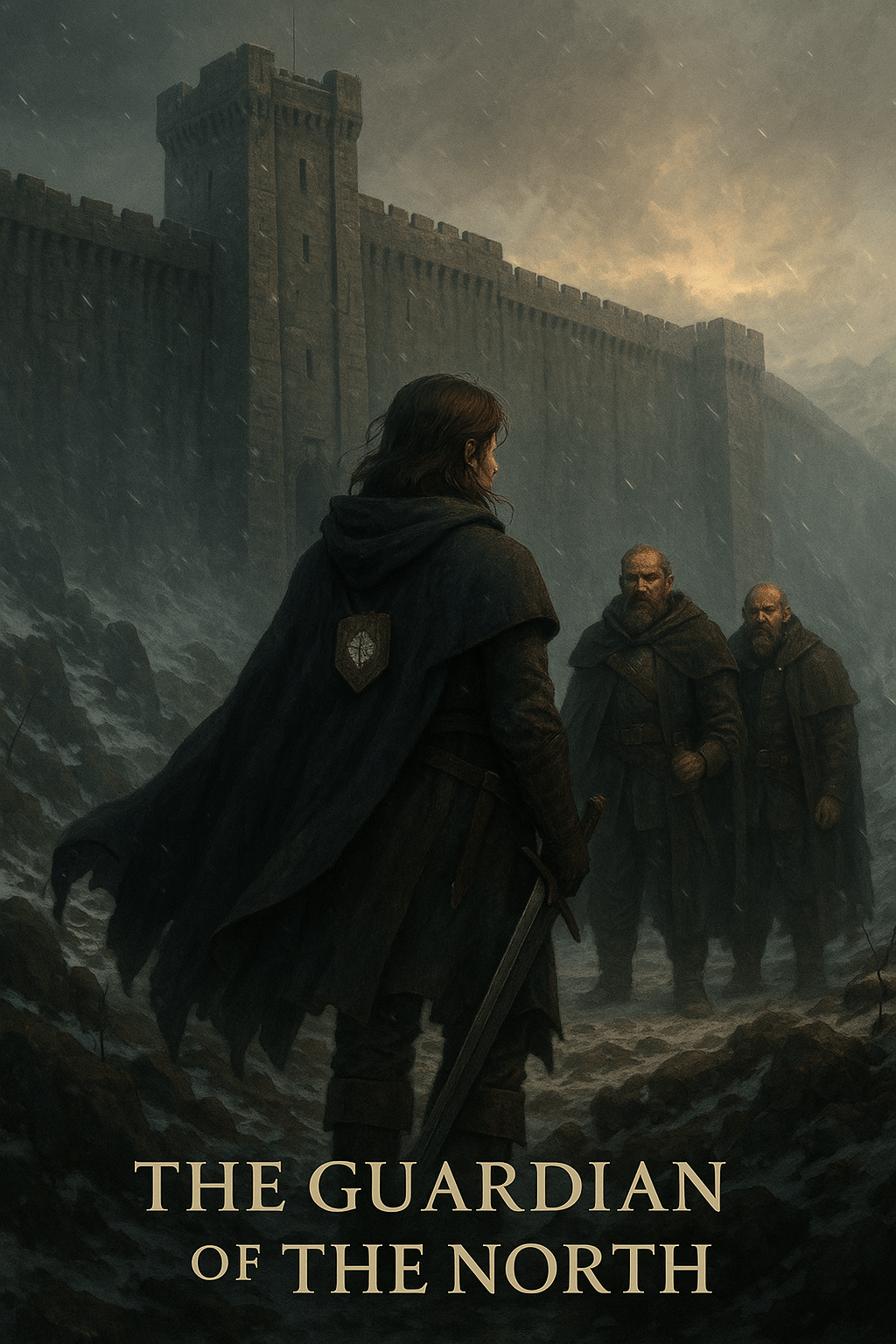
By the time they reached the lower ridge that overlooked the Northern Wall — The Last Vigil — she was already riding at the center of the column, not the edges. Her sword had drawn blood twice in those weeks. She’d saved one scout from a freezing river and another from a shadowbeast with glassy skin and a smile stitched shut.
They had stopped calling her “the quiet one.”
Instead, they began calling her “Ashbrand.”
A name she did not yet understand.
But accepted.
The snow broke open before them as they crested the ridge, and there it stood:
The Great Northern Wall. The Last Vigil.
A monolith of ancient stone, jagged and frost-slicked, rising like the spine of a dead god across the mountains. It coiled and twisted with the peaks, its towers lost in the mist, black banners whipping against the wind. Cold iron. Burned granite. Silent torches that had not been lit in years.
It was older than empires. Older than calendars.
And it commanded silence.
Elaria, though hardened by fire and failure, felt her knees weaken.
“I’ve never seen anything like it,” she whispered.
Aldric only smirked. “Good. That means it still works.”
As they descended toward the gates, figures emerged from the mist. Sentinels in dark blue cloaks. Eyes like ice. Weathered armor, marked by centuries of rust and rune.
At their head stood a broad-shouldered man with a thick grey beard and eyes sharp as obsidian.
“By the flames, is that you, Vael?” he bellowed, voice echoing off the stones.
“Unless I’ve been replaced by a more charming version,” Aldric replied.
The two clasped arms like brothers. Elaria watched, startled — then recognized the voice, the posture, the gravel-lined laugh.
“You’re still alive,” she said, stunned.
“And you’re still too lean for this weather,” Harland grunted, eyeing her from head to toe. “But I’ll take what I get.”
They shared a nod. Not warmth, not comfort — but respect. The bond of forged iron, not silk.
“She’s yours again,” Aldric said.
“And I’ll fix what Merathia tried to break,” Harland replied.
The Wall wasn’t just stone. It was a crucible.
Elaria’s days began with wind-burned marches across the top battlements. Her lungs froze before dawn. Her legs stiffened in armor not made for comfort, but for survival.
Training was brutal. No rituals. No sermons. Just blade, grit, and the ghost of death watching from beyond the frost.
“This is the last light,” Harland said one morning as she staggered through a sparring match. “No cities beyond. No laws. Just them. If we fall here, they don’t stop at the gates. They take the world.”
It was here that her pain turned back into purpose.
Each breath in the frozen air was a step away from Merathia.
Each night she stood watch was a prayer whispered in silence.
Life on the Wall followed a rhythm colder than any bell.
There were no dawn prayers. No processions. No banners fluttering above marble courtyards.
There was ice, and stone, and watchfulness.
Every morning, Elaria woke before the sun, when the stars still clung to the black sky like frozen scars. She donned her armor in silence, shared stiff bread and blackroot tea with the other sentinels, and climbed the eastern stair to her post. The wind at the top sliced like glass across her face. She did not flinch.
She was one of the youngest on the Wall — and it showed.
Many of the others bore white in their beards, or else burns where helmets had once failed them. They moved slower but struck harder. Men and women of the Wall were not beautiful. They were not clean. But they stood tall, like statues carved from the very stone beneath their feet.
And Elaria began to find herself among them.
Each shift passed in cold silence, broken only by the whumph of falling snow or the distant cry of something not quite bird, not quite beast. And every night, she trained — with Harland when he was sober, or with herself when he wasn’t. She ran until her legs burned, sparred until her muscles screamed, and prayed no longer to Elyonel, but to discipline itself.
Slowly, her posture straightened. Her eyes hardened.
And respect returned — not from others first, but from within.
Most days passed without incident.
But when the wind changed, the Wall awakened.
Small bands of orcs tested the defenses. Not full assaults, but scouting packs — wiry and hungry, dressed in hides stitched from human skin and bone. Sometimes, corrupted beasts clawed at the base of the Wall, bleeding shadow. Once, a flying daemon shrieked overhead and dropped a soldier from a hundred feet above the snow.
And each time, Elaria was ready.
She became known for her speed with a blade, her refusal to retreat, and her calm precision. She didn’t roar in battle — she moved like frost on steel, silent and sure.
But what caught her attention most were the men of the outer force.
The Expeditionary Force — Aldric’s mad bastards — were not like the sentinels.
They didn’t guard. They hunted.
Whenever a report came of movement beyond the ice fields, or whispers of daemon activity, Aldric and his handpicked unit rode out through the Iron Gate and disappeared for days. Sometimes weeks. Sometimes… forever.
“They’re ghosts,” one of the veterans muttered. “Half-cursed, half-mad.”
And yet, morale never faltered.
When they returned — covered in filth and frostbite, dragging heads or corpses behind them — there was always laughter. A grim joy. They toasted the dead with black liquor and threw knives at the wall in their name.
“What drives them?” Elaria asked Harland once.
The old man chewed a strip of jerky, stared across the courtyard, and said:
“Some do it for glory. Most for guilt. But all of us—”
“All of us stay,” he added, “because it’s the only place left where our sins are outweighed by our usefulness.”
But even in the discipline, cracks began to show.
One night, returning early from patrol, Elaria passed Aldric and Harland speaking low in the armory. Their voices were hushed, their eyes tense.
“Movement’s increasing. Five groups in ten days. Organized. Patterns.”
“Scouts say they’re marking the ice. Banners. Rituals. It’s not just orcs anymore.”
“And still no reinforcements?”
“No. The Inquisition says we’re exaggerating. That it’s the wind playing tricks.”
“Or maybe they don’t want to believe what we’re seeing.”
Elaria froze in the shadows, her breath tight.
She had heard these tones before — the sound of men trying to reason with dread.
Later that night, she wrote in her journal:
The Wall is still strong. But something out there is pressing harder. And they are pretending not to notice. Or perhaps they want it to fall.
Despite it all, Elaria did not break.
She grew sharper. Colder. But beneath that, something warm remained.
Not hope. Not faith.
Just resolve.
She did not wear her Inquisitor seal like a badge anymore — she wore it like a chain, a reminder. She was not here to rise in rank. She was not here for glory. She was here to be the final line.
And if the storm came — if the dark beyond the Wall rose in full strength — she would be the blade that answered.
No more speeches.
No more mercy.
Only the work.
The horn blew three times.
That meant an outbound mission. Large scale. High risk.
For weeks, scouts had reported growing clusters of Orc movement—small warbands merging into something larger. Symbols carved into ice. Fire pits that burned black. A chieftain rumored to wear bones not just as armor, but as language, a walking altar.
The Council at the Wall could no longer ignore it.
A full-scale response was assembled: thirty soldiers, two expeditionary clerics, three scouts, and Aldric himself at the helm.
Elaria was called at dawn.
“You’ll ride north-east with the third unit,” Harland said, sliding her orders across the stone desk.
“You’ve earned your place. Don’t lose it to doubt.”
She nodded, quiet. She was tense, but she didn’t flinch.
“I’m ready.”
And she was. Ready to step beyond the Wall not as a victim, not as a tool—but as a weapon honed by solitude and fire.
Two days into the march, the snow changed.
It grew thin. Greasy. Grey as ash and bitter to the tongue.
The sky darkened, though no clouds covered it. The wind whispered through holes in the world, carrying with it the smell of meat and copper and rot.
“Is this all frozen land?” Elaria asked Aldric one evening, huddled near the only fire allowed.
He leaned on a flat stone beside her, nursing a dented flask of burner’s tea.
“Not all. There’s corrupted soil down south too. Near the Black Coast. Even a second wall.”
She blinked. “There’s a Southern Wall?”
“Oh, yes,” he said. “Less dramatic, more sun. They even get sand between their toes before the orcs come screaming over the dunes.”
He smirked. “Always wanted to see it. Maybe lie on the beach. Get a tan. Ask the orcs if they drink coconut water.”
She raised a brow. “You’re joking.”
“I joke because if I don’t, I scream.”
They sat in silence a moment longer, the laughter fading. Around them, the snow did not melt, but dissolved. The trees curled backward. Some bled when struck.
Elaria gripped her sword tighter. “It’s worse than I imagined.”
“It’s worse than they let you imagine,” Aldric muttered. “Corruption is not just a stain. It’s a hunger. This land was once forest and river. It remembers what it was. That’s what makes it dangerous.”
“Because it wants to forget?” she asked.
“Because it wants to bring you with it.”
By the fourth night, they found their first ruin.
A village — or what had once been one. Burnt frames of houses buried in black frost. Skeletons still chained inside. The walls were painted with sigils in blood, curling and pulsing faintly under moonlight.
The clerics whispered prayers. One wept openly.
Elaria said nothing. But she felt her stomach twist.
This was not war. This was desecration.
They continued. For every league, more signs. Pikes of human heads. Skinned beasts crucified to frozen trees. A deep pit that steamed in the night, lined with broken weapons and the bones of Inquisitors long dead.
She recognized some of the armor.
Not by name. But by make.
From Lysara.
“They were graduates,” she whispered.
No one responded.
Even Aldric, for once, had no joke.
They reached the ridge by mid-afternoon. Snow crackled underfoot like old parchment. The scouts ahead had gone quiet.
Aldric called a halt.
Just as he did, a shriek echoed through the frozen gulch below.
Not beast. Not Orc.
Human. Female. Terrified.
Elaria and two others moved first, cresting the slope to find a sight none were prepared for.
Civilians. Half-naked. Shackled to frost-covered altars carved from stone and bone. Around them, humans in black robes, hands raised to the sky, chanting in a guttural tongue warped by madness and magic.
And among them, Orcs stood guard, calm and coordinated. Waiting.
“They knew we were coming,” Aldric growled. “This is a lure.”
But it was too late. One of the clerics charged ahead, screaming to save the prisoners.
The mages turned.
One raised his hand—and a circle of fire twisted with voidlight erupted at the cliffside, blowing the cleric apart.
Then the ambush began.
It was chaos.
Orcs poured from the tree line, guided by heretical spells. Black fire, chains of ice, necrotic illusions — sorcery meant to break minds as much as flesh. Elaria drew both her blades — a short curved dagger for inside the guard, and a lightweight longsword for cutting precision. Her armor, dyed frost-grey, let her move between lines with speed.
She found her first opponent — a heretic wielding a staff made of carved femurs — and dropped him with a feint and stab beneath the ribs.
Another lunged at her. She rolled, slashed, and moved again.
Every inch of ground was purchased with blood and bone.
Aldric rallied the rear. His voice cut through the panic.
“Circle the altars! We hold this line or die feeding it!”
And they did.
By the end of the battle, ten of them were dead.
Two prisoners were saved.
But five more had been sacrificed during the ambush — their hearts torn free, their blood fed to glyphs that pulsed on the stones like open eyes.
That night, the survivors buried the bodies beneath shallow snow mounds. No fire. No prayers. Only silence.
Elaria cleaned her blades slowly. Her fingers trembled.
Aldric sat beside her, holding his side — bruised from a blast.
“You did well,” he said, half-conscious. “For a girl who once thought I drank coconut water.”
She didn’t laugh. She just nodded.
“They were waiting,” she said. “They knew our route.”
“Aye,” he muttered. “Same as the others. The graduates from Lysara… They weren’t ambushed. They were baited. Like us.”
He looked at the snow, where the glyphs still glowed faintly.
“This was a test.”
“For what?”
“To see what we’d send. What we’d risk to answer.”
In the days that followed, Elaria became a shadow beside Aldric’s shoulder.
She slept beside the scouts, ate little, spoke less. But when it was time to fight, she moved like a silver flame.
Orc hunting parties. Spell wards in old ruins. Abandoned Inquisitor camps warped into shrines. Each encounter drained them. Each cost them lives. But Elaria no longer questioned. She simply fought.
One of Aldric’s veterans, a weathered woman named Broen, clasped her shoulder after a skirmish.
“You fight like you’ve been with us for years,” she said.
“Feels like I’ve been dying with you for years,” Elaria replied.
They laughed. And from that night on, Ashbrand was not a nickname.
It was her place in the unit.
The expedition had started with thirty. By the second week, they were seventeen.
Some fell to blades. Others vanished in the night, taken by shadows or lured by phantom voices.
Elaria began to count them in silence. Not names. Just shapes. Faces she saw in the snow.
We were sent to end a threat, she thought.
But we are walking into its mouth.
And yet she did not waver.
She had no faith in the gods anymore.
But she had a duty to the dead.
They found the survivor two days after the altar ambush.
A boy, barely older than sixteen, hidden beneath a pile of corpses. His skin was blue from the cold. His mind—fractured. He had the brand of a reconnaissance unit from Durath’Khar, one that had gone missing months ago.
They thawed his limbs by the fire. Gave him broth. He barely swallowed.
“He’s not going to last,” said Aldric, kneeling beside him.
But the boy clutched Elaria’s arm.
His voice cracked like burnt paper.
“He spoke to me. In the dark. With no mouth.”
“Who?” she asked.
“The one who walks behind the blood,” he muttered. “The one the war will carry. A black crown… a tongue of iron… He said the Emissary has been chosen.”
“Daemon,” Aldric muttered under his breath. “Has to be.”
The boy convulsed that night. And died with black veins pulsing across his throat.
On the fourth day of the march back, they spotted them.
Another band of Inquisitors.
Their armor bore the crest of the Order of the Sacred Brand — a unit Elaria had never seen on deployment this far north. Still, they spoke the right codes. Carried the right banners. Looked like them.
And yet…
Something felt wrong.
Their posture was too perfect. Their eyes too flat. Their commander — a bald man with a hawk’s nose and silk-lined gloves — smiled too easily.
Behind them stood civilians in chains. Among them, to Elaria’s shock, were half-orcs. Children and women. Beaten. Broken.
Aldric dismounted and greeted the captain.
“Didn’t know Brand units were posted this far. What brings you to the ice?”
“A special mission,” said the man with a practiced grin. “Cleansing rites.”
Elaria froze.
Cleansing rites were not used in current doctrine. Not since the reformation. Only the oldest, most fanatic Inquisitors still practiced and used that term.
Something’s wrong.
She drifted through the ranks, unnoticed. Circled behind the false Inquisitors.
And there—on the belt of one of the soldiers—she saw it:
A dagger etched in Daemon runes.
A small vial filled with sacrificial black blood.
A whispering charm used by cultists of Thanarok.
She turned.
“Aldric!” she hissed. “They’re not ours!”
The lie shattered in a breath.
Aldric’s mace came free. Elaria’s blades flicked to her hands. The false Inquisitors screamed words not in any human tongue — and the trees trembled as something unseen surged in the air.
The two groups clashed in the snow-choked glade.
Steel rang. Magic burned.
One of the corrupted unleashed a gust of black flame, incinerating two of Aldric’s scouts. Another pulled a hidden whip tipped with bone hooks, rending open a soldier’s face.
Elaria moved like lightning.
She disabled a false inquisitor with a stab through the calf, spun behind another, and gutted him before he could raise a glyph-bound relic. But it wasn’t enough.
One by one, her companions fell.
Broen — her shoulder pierced with a spear.
Garrin — crushed beneath a corrupted knight’s warhammer.
Aldric — bleeding from three wounds, still barking orders.
They fought not to win, but to survive.
At last, only the enemy leader remained — wounded, cornered, one arm shattered by Aldric’s mace.
He laughed.
Blood poured from his mouth. His teeth were black. His eyes—pupils vertical like a beast’s.
“You think this is a victory?” he coughed.
“You butchered your own,” Elaria snarled. “You wear the flame and spread rot.”
“Because it is not the flame that matters. It is the strength it once held. And that strength need to return.”
He grinned wider.
“The God of War awakens.”
“The Emissary will burn the heavens.”
“And you—you children of ashes—you will beg to kneel when he raises the black crown.”
Elaria silenced him with a blade to the throat.
His body fell. But the echo of his voice clung to the wind.
Only twelve survived the encounter.
They freed the prisoners — humans, half-orcs, and even a dwarven scout. Their wounds were deep, but their words deeper.
They spoke of rituals, forced conversions, sacrifices made to something they called “the Iron Flame.”
Aldric, pale and coughing blood, led the remnants back toward the Wall.
Elaria walked beside him. Her hands were stained red. Her body broken.
But her resolve had never been stronger.
They would return.
They would tell the truth.
And if the Inquisition tried to bury it—
She would dig it up with fire.
They emerged from the cursed woods bruised, bloodied, and broken — but alive.
The Wall welcomed them like a wounded god: silent, watchful, colder than they remembered. The gates groaned open. The sentinels saluted.
No one asked questions.
Because when so few return from the frost, the truth is always worse than anyone imagines.
That night, in the underchambers below the garrison, Aldric, Harland, and Elaria gathered by torchlight. Maps sprawled across the stone table. The prisoners rested nearby, under heavy watch.
“We lost eighteen,” Aldric said quietly, his arm still bound. “But what we saw… the traitors, the rituals, that prophecy—”
“The Emissary,” Elaria whispered. “And the return of the God of War.”
Harland remained silent for a long time.
“You can’t write that in a letter,” he finally muttered. “Not just because they won’t believe it. Because we don’t know who’s reading them.”
“The Inquisition already ignores our calls for reinforcements,” Aldric added. “We’ve sent seven urgent dispatches. Seven. No reply. Either they don’t care, or someone doesn’t want them to.”
The room went cold.
“Then we bring the truth ourselves,” Elaria said.
The two older men looked at her.
“I’ll go,” she said. “To the southern kingdoms. To the High Courts. To the Free Cities and even the elven enclaves if I must.”
Harland’s brow furrowed. “You’re not a diplomat.”
“No,” she said. “But I’m a soldier. A witness. And if I must die screaming in their halls to make them listen, I’ll do it.”
Aldric said nothing.
He simply nodded.
“We need you here,” she added. “If you leave, the Wall collapses. The men only hold because you stand.”
Aldric chuckled darkly. “That’s a poor foundation.”
“It’s the only one we have.”
Harland stood. His old bones cracked as he crossed the chamber and unlocked a small iron box.
From within, wrapped in red wax and bound with five seals, he withdrew a letter black as ash, etched in silver thread.
“This hasn’t been used in over a century,” he said. “But it was once given to lone envoys of the High Flame.”
He placed it into her hand.
“It grants you right of travel, audience with rulers, and sanctuary in any allied realm. If you invoke it, they must listen.”
Elaria took it with reverence. Her fingers trembled slightly.
“You’re sure about this?” Harland asked.
“If we wait, we die,” she answered. “And the world forgets we ever stood.”
As dawn broke, Elaria stood at the gate.
Clad not in ceremonial robes, but in worn travel armor. Her blades at her side.
A small satchel. A warhorse. A road that stretched through frost and empire.
The gates opened.
The wind howled. The frost bit.
Snow drifted sideways in thick sheets, stinging skin and muting sound. The great gates of the Last Vigil stood open — wide enough for one horse, one rider, and the burden of a continent.
Elaria adjusted the straps of her saddle. Her cloak whipped behind her, frayed at the edges. The barklike-charm shimmered at her throat, a dull talisman of all she had endured.
Behind her stood the handful of companions who had become more than brothers and sisters in arms. They were the last fire in a world growing colder.
Aldric Vael approached first, his breath a plume of mist.
He didn’t speak immediately.
“So,” he finally muttered, “we send the greenest of us to deal with kings and councils.”
Elaria gave a tired smile. “They won’t see the Inquisition. They’ll see a girl.”
“You are the Inquisition,” he replied, quieter. “The part we still believe in.”
He pressed a worn patch of cloth into her hand — the standard of their expedition. Burnt. Torn. But whole.
“Bring it back. Even if we don’t make it, they need to know we were here.”
Harland stood beside him. No armor. Just a heavy coat and his usual scowl softened by pride.
“If they doubt you, tell them Harland Break-Knees said to go to hell.”
She chuckled. Then hugged him. A tight, brief thing neither commented on.
“The dwarves,” she said. “They’re my first stop.”
They both looked surprised.
“They remember the First Daemon War. They bled first. Lost first. They’ll understand before anyone else. And… they’re closest.”
She didn’t finish the other thought.
Before the Wall falls.
The remaining expedition stood silently by the gate. Some saluted. Others bowed their heads. One of the younger recruits, barely sixteen, wiped his nose on his sleeve and whispered, “Endure.”
Elaria swung into the saddle.
She looked down once more.
“I don’t know how long I’ll be gone,” she said. “I don’t know if I’ll be fast enough. But I promise you—”
Her voice cracked, just for a moment.
“—I’ll make them listen.”
The horn at the gate blew once. Low. Mourning.
Elaria Valthorne turned her horse, heels brushing flank. And without another word, she rode into the white.
 Chronicles of Astravara
Leave a comment