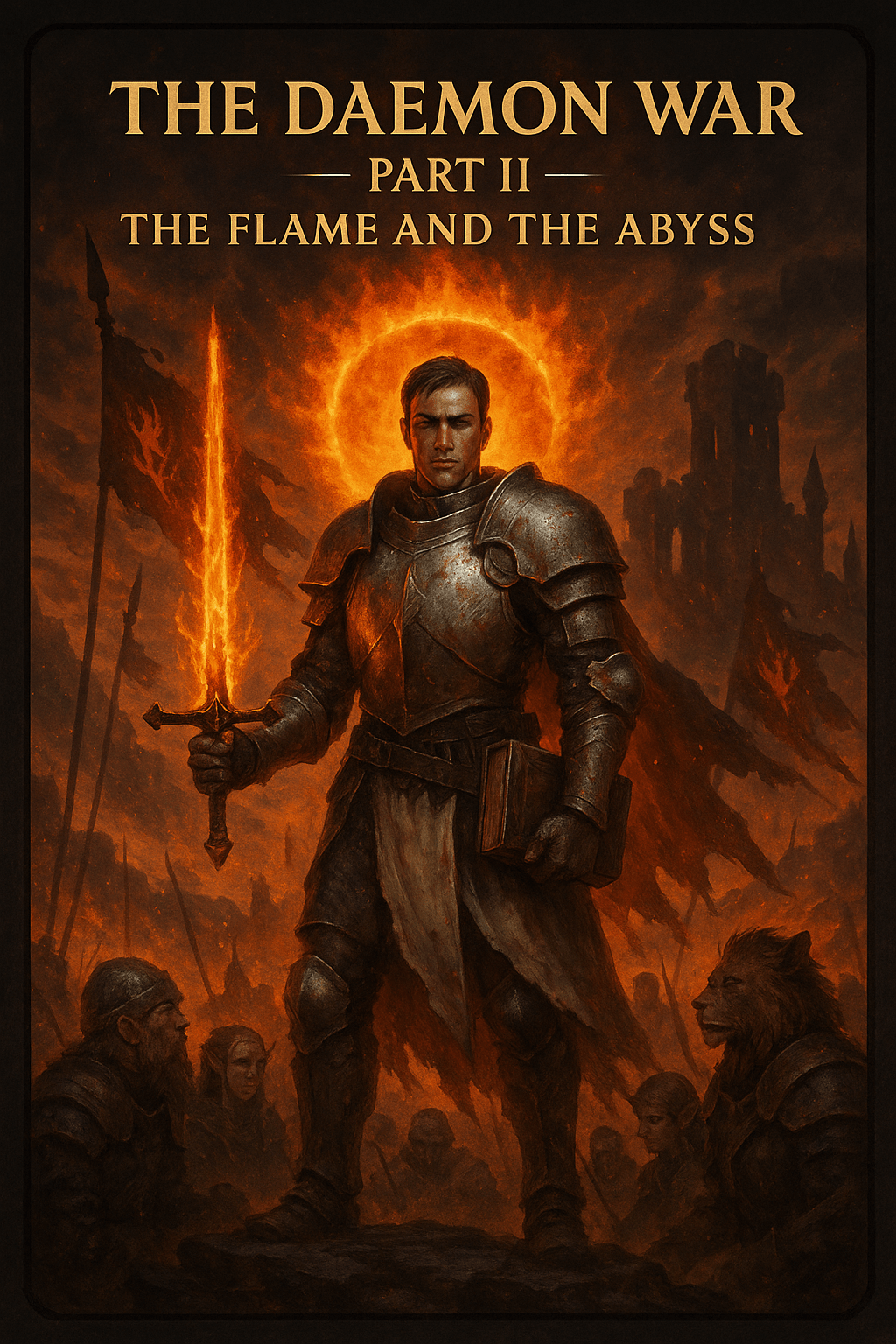

Where gods whisper and empires rot.

Reading Time:
The Inquisition
The mountains and valleys of Astravara still burned under the growing threat of the Daemon horde. The smoke of Ghor’Nazruk still clung to the wind when the messengers departed from Durath’Khar. They rode through mountain passes and river valleys, across forests scorched by war and through skies darkened by storm, bearing a single truth:
The daemons had come.
And they would not stop at stone.
Wound-Eye—once Thargrim, now broken, now bound by oath alone—had placed the Hammer of Vulkanar at the heart of the Council of Kings, alongside Reikal’s final letter. His voice, hoarse with grief, had cut through tradition like an axe through rot.
“They took our sons,” he had said. “And they turned them into weapons.”
“We stood proud. Alone. And the mountain fell.”
Now, from the throne-halls of Durath’Khar, a call was sent to every free people of Astravara—not for allegiance to the dwarves, but for war against the darkness.
The response was not swift. Nor united.
The humans of Eldoria, ever pragmatic and newly shaken by tales of undead rising in northern provinces, were the first to answer. King Caelric II dispatched legions and supplies within days, naming the cause a divine war in service of Elyonel. But beneath their generosity lingered ambition, and mistrust between dwarves and men—never forgotten since the Black Treaty—resurfaced like rusted chains.
From the green vastness of Viridiana came only silence at first. When emissaries finally arrived, they spoke for the forest elves with voices calm and eyes cold. Their leader, Lytheris Alavien, archer-mage and ward of the Emerald Court, bore a single demand:
“The roots of our groves are older than your cities. If your war scorches them, we will fight you before we fight the Daemons.”
The gnomes of Ravelspire responded with tempered urgency. Ardo Vixwin, High Executor of Arcane Logistics, sent clockwork couriers and arcane supplies, offering strategy, devices, and magical transport networks. But no gnomish battalions marched. “Precision is our weapon,” he wrote, “not blood.”
Halfling representatives from the Westfold—led by Eldora Swiftstep, a healer whose hands had saved hundreds during the refugee waves—offered scouts, medics, and supply caravans. They spoke little in council, but where others brought banners, the halflings brought bread. And bandages. And quiet resolve.
But it was the Ruh’Rashi who posed the greatest challenge.
Beast-blooded and fiercely territorial, the southern clans were fractured even among themselves. Some tribes—lion-born, hyena-born, jackal-born—rejected the summons entirely, guarding their lands with suspicion sharpened by centuries of disdain from the other races. Others, led by Karnak the Loyal, tiger-born champion of the eastern plains, answered the call in small bands—silent, lethal, unyielding—but refused to serve under a united command.
“We do not bow to councils of stone and law,” Karnak growled before the High Table. “But we have seen the sky blacken. And when the storm comes, even the wild must bare its fangs.”
The council chamber of Durath’Khar became a crucible of tempers and grief. There, beneath the golden firelight of Vulkanar’s Flame, the leaders of the free races gathered not in friendship, but in fear.
Old wounds bled anew.
The elves recalled betrayals at the Siege of Myrrhfen. The dwarves spoke bitterly of human merchants who broke mountain trade accords. The Ruh’Rashi named the centuries of enslavement under northern kings. Even the halflings, peaceful by nature, whispered of burned villages left to die when the last war turned south.
Only Wound-Eye stood without nation, without title. He wore no crest. No colors. Just blackened mail and the weight of a kingdom buried.
“Unity is not a gift,” he told them. “It is a grave you climb from together, or not at all.”
“The Daemons do not care whose forest grows tallest. They will burn it.”
“They do not care what crest you wear. They will twist it.”
“They have already taken a fifth of the continent. How many sons must scream before you answer?”
Some were moved. Others not. But war had already arrived.
From the east came reports of entire villages drowned in black swamp. From the north, towns where the dead walked beside the living. Orcish warbands surged across the central steppe, guided by unholy brands and voices in the blood-mist. Thanarok’s corruption spread like a plague of the soil. Nothing grew where it touched.
And so, after endless debate and bitter silence, the Sacrosanct Inquisition of Divine Flame was born.
Its name was spoken first not by kings, but by a boy-priest who had seen his temple turned to ash and his brothers raised in chains. “We need a fire that does not fade,” he said. “One not tied to nation, but to survival.”
The Hammer of Vulkanar became the symbol of the order. Its flame, the banner. Its mission: to lead the war against the Daemons and purge the corruption that crept through the veins of the world.
 Chronicles of Astravara