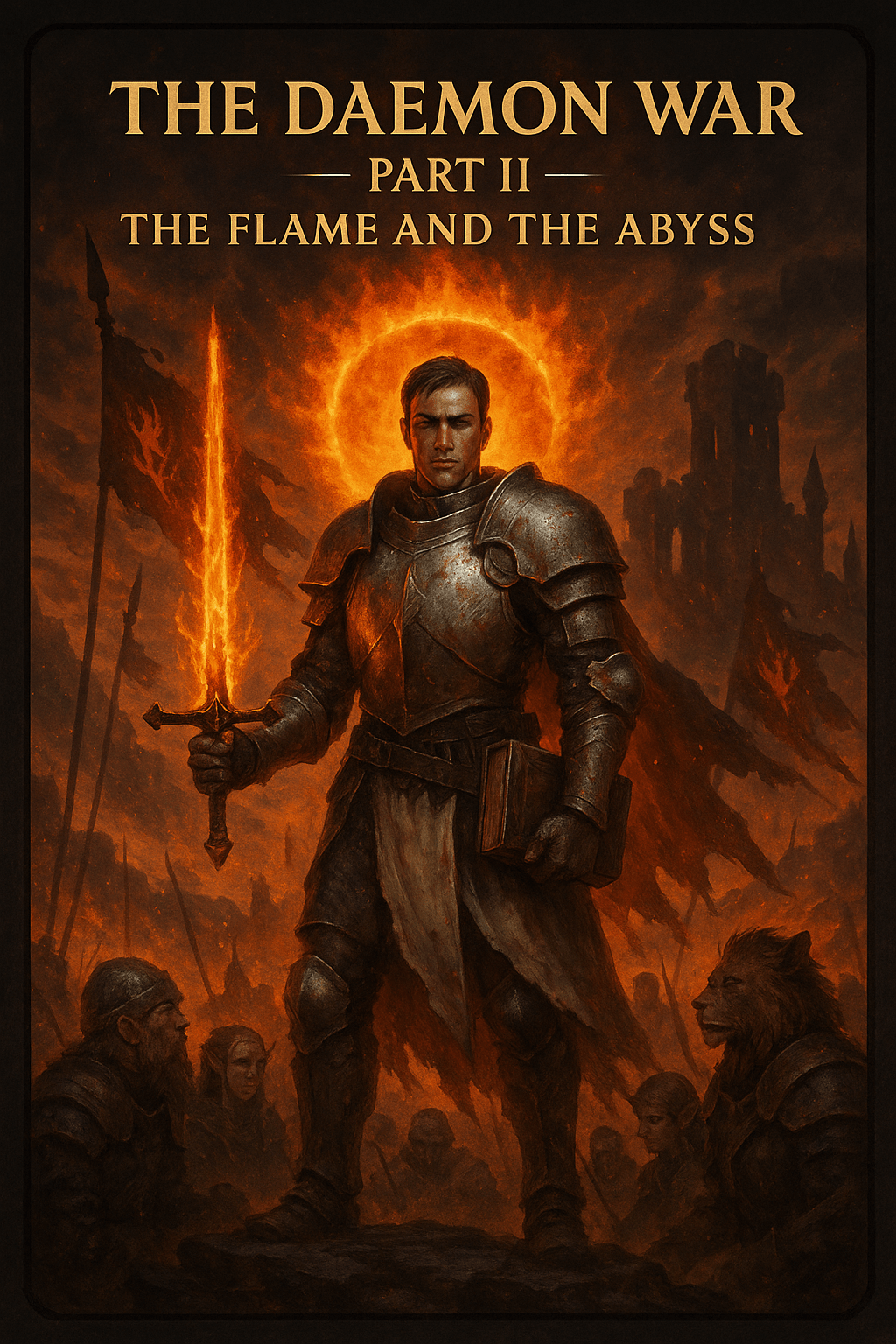
The war began not with victory—but with failure.
In the early years of the Inquisition, the armies of the free races marched beneath one banner but fought as strangers. Each battle was a chorus of clashing tongues, of mismatched tactics and mutual suspicion.
The elves refused to take orders from human generals.
The Ruh’Rashi answered only to their own.
The dwarves demanded fortified positions, while the gnomes sought mobility.
The halflings served quietly—resentful of being treated as mere auxiliaries.
Even within the human legions, rivalries between northern and southern banners festered like old wounds.
And the Daemons saw it all.
They struck with precision, exploiting every hesitation.
At the Battle of Falmer’s Gate, a coordinated defense collapsed when an elven archmage refused to reinforce a human flank, citing a breach of agreed territory. The result: a full encirclement and the slaughter of over three thousand.
In the wetlands of Sarn Hollow, a Ruh’Rashi raiding party withdrew mid-engagement, refusing to support gnome engineers under siege. “We warned them,” Karnak said later. “They entered cursed ground without honoring its spirits.” None of the engineers survived.
In the Ironfields, a dwarven artillery column mistook a halfling advance unit for daemon thralls—triggering a bombardment that killed nearly a hundred scouts and shattered the alliance between the Westfold and Durath’Khar for over a year.
These were not isolated tragedies. They were omens.
The Daemons, led by Mordhekan’s warlocks and Thanarok’s rot-priests, advanced as one. Unified. Unrelenting. Their armies did not argue. Their warbeasts did not falter. Their tactics were brutal and sacrificial, yes—but effective. They would flood a region with corruption, raise the dead from its soil, then unleash the horde upon those still mourning.
Entire cities were consumed in nights.
Villages vanished, their names scratched off maps.
Hope burned by inches.
And yet—
Even fractured, the Inquisition did not break.
The elves, when fighting on their own terms, repelled the first incursions into Viridiana’s sacred groves. Lytheris Alavien, bow in hand, led kill-squads deep into daemon-infested wilds, purging blighted trees with spells drawn from the Root-Song—ancient magics the world had not heard in centuries.
The dwarves, entrenched in stone bastions across the mountains, held fast against the siege-beasts of Mordhekan, their cannons roaring with holy fire. Wound-Eye himself reappeared at key fronts—never leading, but always present, an omen of bitter victory.
The Ruh’Rashi excelled in skirmishes, their war-claws slashing through orcish ranks under moonlit ambushes. Though they refused to fight beside many allies, their brutal efficiency made them indispensable.
The gnomes rebuilt what others destroyed. They crafted new weapons—runebound artillery, arcane sappers, rapid-deploy barricades. Their machines turned failing lines into last stands. Their enchantments slowed Thanarok’s creeping decay.
And the halflings, underestimated as ever, became the lifeblood of the resistance. Their scouts charted the daemon advance. Their healers rebuilt shattered companies. And when all else failed, their food kept starving armies alive.
But it was the humans, more than any, who bled.
Caelric II, King of Eldoria, poured men into the war like water into a leaking basin. Holy knights marched under the banners of Elyonel, chanting psalms as daemon flame scorched their armor. Town after town, they died holding lines no one else would.
It was chaos. It was failure.
But it slowed the enemy.
By the end of the third year, the daemon conquest had stalled. Not ended. Not reversed. But stalled. From one-fifth of the continent, they now controlled little more than a quarter.
And yet, the cost was staggering.
Over a three hundred thousand dead.
Millions displaced.
Ten major cities lost—including Myrdral, the last northern capital.
Forests corrupted. Rivers poisoned. Trade routes shattered. Faith fractured.
The Inquisition called it a holding action.
Others called it the beginning of the end.
There came a time when fire no longer purified.
When spells burned through flesh but left the rot untouched.
When the very act of casting became a gamble between salvation and collapse.
This was the age of Unraveling—the fourth year of the war—when the Daemons turned not only steel against the Inquisition, but the arcane itself.
In the southern vale of Maren’Vaal, three gnomish arcitects had built a miracle: the Crystal Network, a web of resonant pylons meant to stabilize leyline disruption and cleanse corrupted zones. It hummed with harmonious energy, a song of geometry and light.
It lasted thirteen days.
On the fourteenth, Thanarok’s priests sent a blight-wave through the aether. The pylons shattered in unison. The ground ruptured. The arcitects vanished—disintegrated or inverted, no one knew.
Across the continent, magical backlash bloomed like poison.
In Ravelspire, the gnome capital, ritual circles cracked. Skyglass towers imploded. Runes turned inside out. And the minds of those who had shaped wonders for centuries began to break.
Their greatest strength had become a door—opened too far.
By the end of the fifth year, over ninety percent of the gnomish race was gone.
Some had fled underground. Some wandered mad. Some simply vanished into the veins of wild magic they once understood.
The survivors—less than two thousand—retreated into sealed vaults beneath the earth. Ardo Vixwin was last seen blindfolded, his skin inscribed with protective glyphs carved into flesh, whispering equations to no one.
They were not dead.
But they were no longer part of the war.
And the halflings—
The halflings broke.
Not in body, but in soul.
It began quietly.
Healers in the field developed tremors in their hands. Scouts reported hearing voices in the trees, whispering in the tones of lost loved ones. The magic the halflings drew from the world—once joyful, vibrant, anchored in harmony—now answered with hunger.
The corruption had learned their names.
Some began to glow faintly green while praying. Others wept sap from their eyes. Still others sang old harvest hymns that twisted mid-verse into dirges for the dead.
Entire battalions were withdrawn after a healer accidentally resurrected a fallen warrior—wrong.
By year six, no halfling was permitted to serve on the front lines.
They remained in the rear, tending to the wounded, farming holy soil, guarding children. But none crossed the veil again.
“We are keepers now,” Eldora Swiftstep declared. “Not warriors. Not anymore.”
But even behind the lines, the rot crept.
Villages went silent. Lanterns flickered. Priests spoke of dreams where the soil begged to be buried again. And in some refugee camps, halfling children were born with flickers of green fire in their eyes.
The battle between magic and rot was no longer waged by mortals alone.
It was etched into the land.
Every spell cast pulled from a well grown shallow.
Every enchantment risked drawing too deep.
And sometimes, the enemy whispered back.
In desperation, the Inquisition began using scorched-earth tactics. Entire forests were razed to halt corruption. Rivers were diverted. Magical wells sealed. One by one, ancient wonders were sacrificed to stop the spread.
In the region once called Ithrenmoor, an entire daemon host was lured into a rune-bounded basin—then detonated with a sequence of gnomefire and celestial sigils so potent it turned the valley into glass.
Thirty thousand daemon-thralls were destroyed.
So were seven thousand soldiers.
None of their names were recovered.
At Duskvale, an elven enclave held against the undead for ninety-one days without rest. When the barricades finally broke, the defenders ignited their own grove’s Heartseed Tree—a source of life older than human civilization.
The resulting explosion left a crater twenty leagues wide.
Even Viridiana wept.
The war had become an act of erasure. Not only of enemies—but of beauty, of memory, of balance.
And Still, the Enemy Came
Mordhekan’s champions no longer marched—they glided on bone chariots across poisoned skies, their weapons forged from languages best left unspoken. Thanarok’s rot spilled beneath mountains, birthing warbeasts whose veins pulsed with sap and blood.
At night, entire companies vanished.
At dawn, only their armor remained.
Hope grew thin.
And in its place, something older returned.
Not strategy.
Not unity.
Faith.
 Chronicles of Astravara