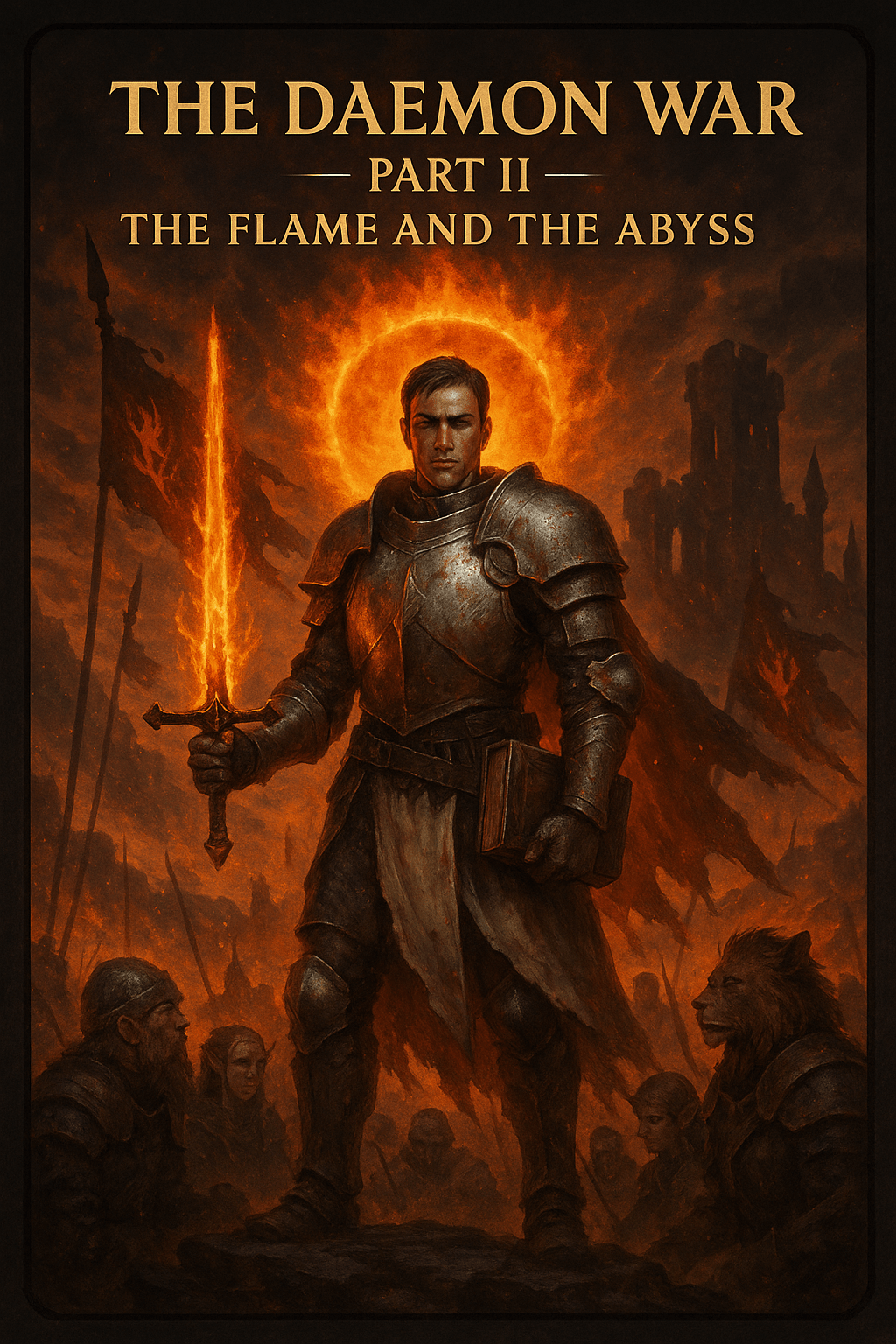
When magic failed, they turned to fire.
When fire failed, they turned to gods.
And when the gods were silent—they invented miracles.
In the seventh year of the war, the continent of Astravara burned beneath a sky without stars. The Daemons had not won—but they had infected everything. Hope was rare. Victory, impossible. Cities rationed light. Villages held midnight vigils in silence.
Among the living, something began to crack—not just in bodies, but in the spirit.
The elves grew hollow. No longer the serene guardians of Viridiana, they wore grief like armor. Some turned to old, forbidden rites—summoning spirits that had once been banished, calling on the Wildsong to break the laws of balance.
The dwarves turned inward. Fewer and fewer answered Durath’Khar’s calls for aid. Among the Ironholds, black-helmed priests began preaching that Vulkanar had withdrawn his flame, and only through sacrifice could it be rekindled.
The Ruh’Rashi tribes grew silent. Some retreated fully from the alliance, returning to the deep jungles and storm-choked highlands. Others whispered of ancient rites to awaken the “True Beasts,” primordial spirits untouched by the war of men and gods alike.
Even among the humans, temples once dedicated to knowledge and justice were repurposed into sanctuaries of desperation. Factions splintered. Cults rose—some worshipping the Daemons as harbingers of a necessary cleansing. Others followed warlords who promised blood for peace.
But one name began to rise from the ashes. One flame flickered brighter than the rest:
Elyonel.
The First-Born Flame.
The God Who Bled.
His image spread first among the refugees. Carved into ruined walls, sewn into blankets passed from camp to camp, whispered in the lullabies of starving mothers. His priests walked barefoot among the dying—not to preach, but to listen. And where they listened, hope returned.
In Eldoria, King Caelric II declared Elyonel the “Beacon of the Unified Flame,” and transformed the capital into the spiritual heart of the resistance. Temples were converted into hospitals, then into armories, then into schools of war and prayer alike.
And from these schools came something new.
The Paladins of the Inquisition
They were not many. But they were enough.
Forged in silence, trained not by doctrine but by suffering, the Paladins of the Inquisition were unlike any force Astravara had ever seen. Each bore a shard of the old world and the fire of the new.
Their teachers were not only human. Dwarven tacticians taught them endurance. Elven rangers taught perception and silence. Gnome artificers—those few who remained sane—granted relics of focus and shielding. Ruh’Rashi hunters trained them to move like predators, to read the air before the kill. And halfling healers etched wards upon their armor, blessings of resistance and memory.
They were trained for six years in total isolation.
They took no titles. Swore no oaths to kingdoms.
Only to the Flame.
And when they returned to the battlefield—the war shifted.
In the Battle of Dargan’s Spine, twelve paladins held a mountain pass against a legion of orcs and corpse-born beasts. None fell. The pass never broke.
At the Siege of Selmora, a city corrupted beyond saving, five paladins led the purge—descending into the daemon-wells beneath the earth and emerging scarred, but triumphant.
Their numbers remained small—fewer than five hundred at their peak—but their effect was seismic. They were walking banners. Living proof that the darkness could be resisted.
And so the people responded.
Alistment surged. Songs were written. Hope, once a whisper, became a cry.
Some called them saints. Others, martyrs in waiting. But among the Inquisition, they were known by one word:
Fulgari.
The Burning Ones.
And among them, one name echoed more loudly than the rest.
Not a general. Not a king.
A soldier.
A man.
A paladin.
Alaric Dalthar.
There are names that inspire fear.
There are names that summon reverence.
And then, there are names that silence a battlefield.
Alaric Dalthar was such a name.
He came not from nobility, nor prophecy. He was born in the storm-lands of southern Eldoria, the son of a mason and a war widow. He enlisted young. Fought in mud before he held steel. Lost two brothers before his sixteenth winter.
When the war called for paladins, he did not seek glory.
He simply walked into the fire and never turned back.
Alaric rose within the Fulgari not by title, but by presence. He was always the first to charge and the last to retreat. When his men fell, he carried them. When villagers wept, he knelt. When the starving came, he gave them his own rations.
He refused banners. Refused medals. Refused land.
“A sword cannot own a field,” he once said. “It can only keep it safe.”
His blade, Dawnlight, was a relic of the early Inquisition—blessed by all surviving races. It shimmered not with flame, but with the hue of morning, soft gold pierced by threads of silver. It was said to hum in the presence of daemonspawn, and to burn brighter when Alaric prayed silently.
And still he bled.
Still he grieved.
Still he smiled.
The soldiers called him the Last to Fall.
The refugees, Saint of the Wounded Road.
Among the halflings, he was Kindsteel.
Among the elves, He-Who-Stands.
Even among the Ruh’Rashi, some whispered his Ruh-name: Ghar’Kaath, “Claw Without Chains.”
But the name that endured was the one he never claimed:
The Flame That Walks.
Under Alaric’s leadership, the Fulgari expanded. No longer mere shock troops, they became symbols—mobile sanctuaries of discipline, mercy, and divine wrath. Their armor was plain, marked only by a burning sunburst upon the breast. Their presence steadied terrified conscripts and sent daemonspawn scattering.
Where human battalions broke, Fulgari regrouped.
Where siege lines crumbled, they charged.
They still died. Often. But they died on their feet.
And unlike the other races, the humans replenished their numbers.
Children became squires. Squires became bearers of light. Their temples became training halls. Every village burned by Thanarok gave rise to two more willing to die for Elyonel.
Among the dwarves, some resented Alaric’s growing fame. They saw in him echoes of old human ambition—kings who claimed divine right through sacrifice. Yet many others, especially those who remembered Reikal Thrun and the fall of Ghor’Nazruk, saw in Alaric a kindred fire. Some even whispered that Vulkanar had passed the flame to Elyonel.
Among the elves, reactions were more divided. The older circles viewed Alaric’s rise with deep unease. They had seen “chosen ones” before—and watched them fall to madness, or worse. But among younger warriors and displaced clans, his story resonated. Elven archers began etching the sunburst onto their arrows. Some even prayed to Elyonel before battle—quietly.
Among the Ruh’Rashi, trust remained cautious. But respect had taken root. Alaric never ordered them. He fought beside them. When a Ruh’Rashi band was nearly wiped out in the Black Tundra, it was Alaric who stayed behind to bury the bodies, claw-marked and frostbitten, by hand. Since then, more Ruh’Rashi joined the Fulgari—not as converts, but as allies in flame.
The halflings, more than any, began to revere him. His visits to the rear lines were rare but sacred. He never passed through a halfling village without blessing the soil or helping rebuild. In their tales, he became a figure of almost mythic kindness—a protector of the small, the broken, the forgotten.
Even the remnants of the gnomes, hidden and fragmented, began to leave messages for Alaric—etched in runes he could not read, but always in the same shape: a flame within a circle, crowned with seven stars.
But with reverence came power.
And with power, fear.
Within the Inquisition, the human clergy of Elyonel began to assert greater influence. Councils shifted from consensus to majority. Policies grew more aligned with doctrine. Faith became law in some regions—and Elyonel’s flame became both salvation and standard.
Other races noticed.
Some warned of soft conquest—not by blade, but by creed.
Others accepted it, bitterly, as the cost of survival.
And still, Alaric refused the crown they tried to build for him.
“I serve a light I did not invent,” he told the High Flamekeeper of Eldoria.
“Let others speak my name. I have work to do.”
He returned to the front.
He always returned to the front.
But whispers grew.
“Alaric is more than a man.”
“He is Elyonel’s chosen.”
“A saint made flesh.”
And in the ninth year of the war, a new prophecy began to circulate. Not written, not sanctioned—just passed from voice to voice among the desperate.
“When the stars fall and the rot sings, the last flame shall walk—
and by his hand, the sky shall burn clean again.”
But as the human influence in the Inquisition deepened, the geography of power shifted.
Eldoria, blood-weary and hollowed by years of conflict, could no longer support the logistics of command. Its northern regions lay in ruins. Refugees flooded its cities, draining what strength remained.
And so, the Inquisition established its new seat in the southernmost region—Alaric’s birthplace. A land of stormy cliffs, deep valleys, and old temples carved into stone.
They called it Caltheron.
At first, it was merely a practical move—safer, more fertile, strategically distant from the corrupted front. But within months, Caltheron was transformed. The Flame Cathedral was erected at its center—taller than any tower in Eldoria, crowned with obsidian spires and golden flameglass. Temples of Elyonel multiplied. Coin, policy, military command—everything began to flow from this new heart.
And though Alaric never sought it, the city bore his image. His banner. His myth.
The people believed Caltheron rose by his will.
But Alaric knew otherwise.
He saw the bureaucracy growing fat on faith. The priests feasting while the front bled. The prophets selling relics forged in back-alley forges.
He returned from war to find children reciting hymns that depicted him as divine.
“I am no god,” he whispered, watching the firelight flicker across the stone of his boyhood home.
“And they will kill me to make me one.”
He began to challenge the Council more openly.
He refused to bless troops who executed prisoners.
He denounced the sealing of trade routes to elven cities.
He demanded that Inquisition forces be dispatched to Kael’Zirith, the dark elven capital, when it sent word of an approaching daemon tide.
The Council delayed. “Strategic complications,” they claimed.
No troops came.
Kael’Zirith fell.
Black spires crumbled. Wards failed. Thousands of dark elves died in the streets while waiting for help that never came.
The survivors were few.
And bitter.
For centuries, the dark elves had walked a narrow line—neither trusted by the humans nor accepted fully by the surface folk. Their worship of balance and shadow, their insular traditions, and their refusal to bow to any god but their own ancestral spirits had always made them suspect.
But they had fought.
And bled.
And died.
Now, when they needed the Inquisition most, it turned away.
Worse, rumors began to spread in Caltheron and beyond: that Kael’Zirith had fallen not because it was abandoned—but because its own leaders had secretly allied with the Daemons. That the dark elves had betrayed the war effort. That they had always served Tenebris Noctian, the Night God, and now simply returned to his fold.
Alaric tried to speak out. He called for an investigation, for justice, for truth.
The High Cleric ignored him.
And the Council passed a decree:
“Let none speak in defense of the traitors.”
So the dark elves left.
They withdrew from the Inquisition.
Tore down the sunburst banners from their towers.
Burned the flame-script from their tomes.
They would stand alone.
And the rest of Astravara would remember them not as abandoned,
but as betrayers.
The lie held.
The war moved on.
But something vital had been broken.
Yet in battle, the Inquisition began to win.
With the Fulgari leading, with Caltheron’s forges burning day and night, with Elyonel’s name shouted from every rampart, the Daemon advance was slowed.
Then stopped.
Then reversed.
Selhadrim was reclaimed.
Tor’nadur was purified by fire and prayer.
The warbeasts of Thanarok were trapped in the salt flats and burned by dawnfire enchantments.
The world, blood-soaked and fractured, turned its face toward hope.
And always, at the front, stood Alaric—silent, weary, and burning.
The war had burned so long that the people forgot what peace looked like.
Borders had become memories. Maps were useless. Even the sky seemed scarred—ashen by day, blood-red by dusk. Children no longer asked when the war would end. They asked only who would still be alive when it did.
Within the Inquisition, the alliance still held—barely. The threads of unity frayed with each passing month. The dwarves withdrew more frequently into their mountain keeps. The elves turned insular, warding their sacred groves and letting few outsiders pass. The halflings remained in their rear sanctuaries, their magic too unstable for the front. The Ruh’Rashi had become silent shadows, operating in their own codes of loyalty and survival.
Only one thing held the alliance together.
Alaric.
He was no longer simply respected—he was trusted, even by those who distrusted everyone else.
Because Alaric never lied.
Because Alaric never chose sides.
Because Alaric showed up—everywhere.
When dwarves refused to send steel, Alaric arrived alone at their gates, bearing a list of names of dwarven warriors who had died under his command—and a promise to return their weapons to kin.
When elven archmages questioned the human clergy’s motives, Alaric met them barefoot in their sacred glades, speaking of flame and balance, not dominance.
When Ruh’Rashi elders called a private moot in the snow-blind north, it was Alaric who sat cross-legged by their fires, saying nothing for three days until they chose to speak.
He became the last bridge—not because he claimed it, but because no one else was willing to carry it.
His presence postponed collapse.
But even a bridge can be burned.
The Church of Elyonel knew the war was nearing its end.
The Daemons had lost ground. The tide had turned. But victory was not enough—not for the clergy, who had used the war to build their empire.
They needed more than triumph.
They needed a myth.
And Alaric had become too powerful to control in life.
He was revered by all. He spoke against greed. He questioned authority. He refused coronation. He refused to kneel.
To the Church, this was dangerous.
But a martyr?
A fallen saint?
A fire extinguished at the moment of victory?
That was eternal.
 Chronicles of Astravara