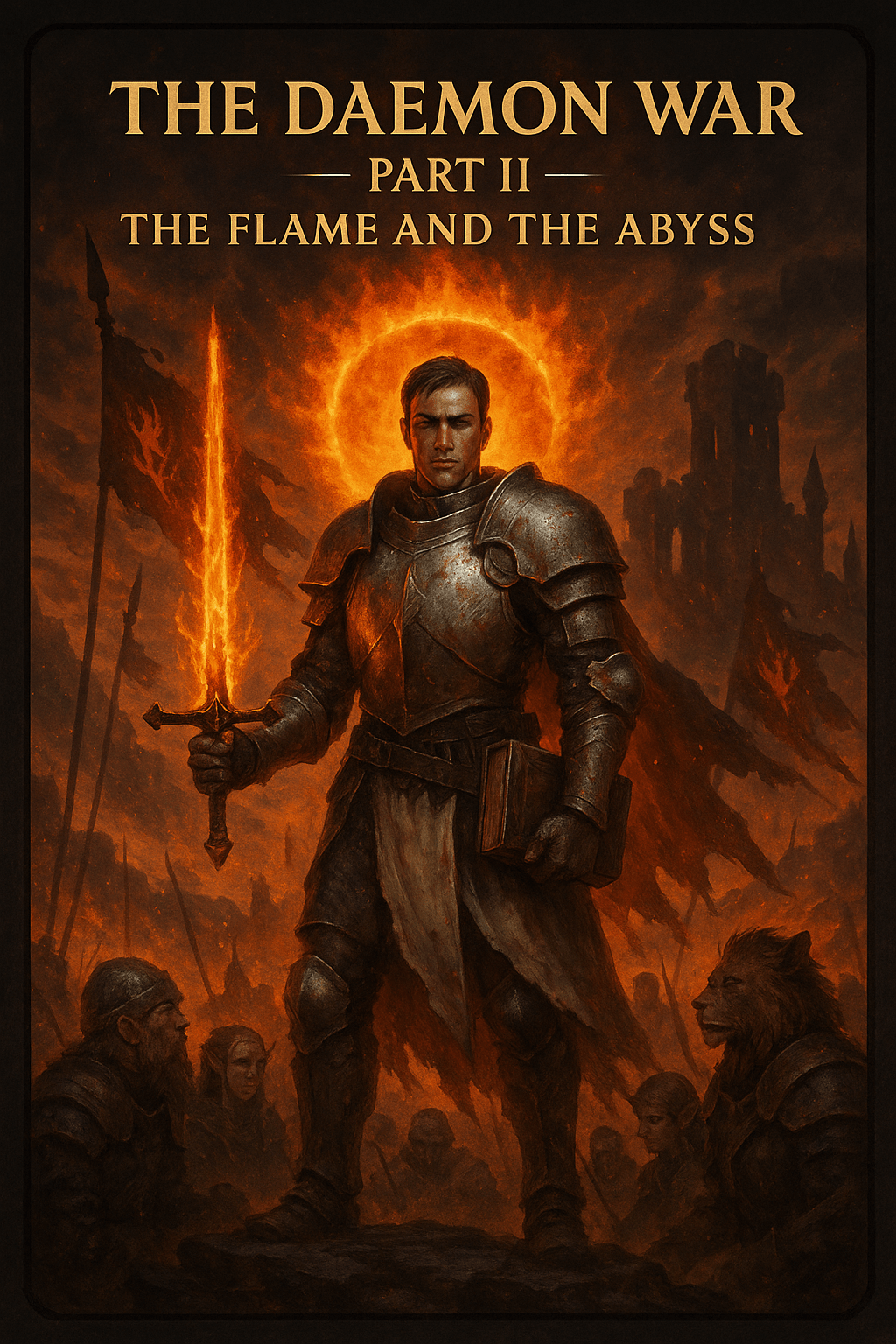
Two of the Daemon generals remained:
- Thanarok’s Emissary, master of rot and decay, entrenched in the southeast.
- Mordhekan’s Emissary, a creature of destruction, leading the final army in the volcanic ruins of Vharkharan.
The Inquisition convened its highest council.
Officially, it was decided that a dual assault would be launched—one force against each Emissary, to end the war in one synchronized strike.
Privately, orders were altered.
Mordhekan’s front, the more dangerous and fortified, would be engaged first—with Alaric and the Fulgari leading the charge.
The southern front would wait—days, under logistical excuses—until the outcome of Alaric’s battle was determined.
The unspoken goal:
Let Alaric bleed the demon army dry.
Let him die a glorious death, alone but remembered.
Let his sacrifice solidify the Church’s eternal claim to victory.
The orders were sealed. The plan was in motion.
The army encamped in the scorched plains north of Vharkharan—where once lay fields of obsidian wheat, now only black sand and bone. Ash drifted across the tents like slow snow. No birds sang. The air tasted of iron.
Alaric stood before the campfire, his armor unpolished, his blade in hand.
He had read the orders.
He knew the timeframes.
He did not protest.
Instead, he spent the evening walking through the camp.
He knelt beside the youngest squire and fixed her straps.
He poured wine with the Ruh’Rashi scouts.
He clasped arms with dwarven shieldbearers.
He sat in silence with elven rangers, each burning a strand of their hair as a vow.
He laughed once.
Only once.
When a halfling bard asked him what he’d do after the war.
“Sleep,” he said. “And grow old in a world worth guarding.”
That night, as the Fulgari gathered for final rites, Alaric said little.
He simply raised Dawnlight to the sky.
And the clouds parted—for a moment.
Just long enough for the stars to return.
Alaric did not sleep.
He sat alone inside the command tent, candlelight flickering across maps inked in soot and blood. His armor, plain but scarred, leaned against a wooden post. The sword Dawnlight rested across his knees, humming with a faint warmth—like breath on cold stone.
From the outside came the murmurs of soldiers praying, oiling blades, preparing pyres for the fallen yet to die.
Alaric took a scrap of parchment. His hands, so sure in war, trembled slightly.
He wrote slowly, deliberately.
To the One Who Finds This,
If you read these words, I did not return.
Do not mourn me. I have seen too much to believe death is the end.
Know that I did not fear battle. I feared what would become of us if we won without honor.
If the fire becomes a throne, and mercy a weakness, then I have failed.
But if there is still one soul who chooses light over power, then perhaps I did not burn in vain.
Take this letter to the Halftree of Saedrun. Bury it there. Beneath the oldest root.
And tell the world I was not a hero.
I was simply a man who refused to leave the line.
– A.D.
He sealed the letter with wax. No sigil. Only the imprint of his palm.
Then he stood, donned his armor, and stepped into history.
The air before battle is never silent.
It sings in whispers.
Among the dwarves, the Fulgari kin stood grim and ready. “We follow the one flame,” they said. Not Elyonel. Not Vulkanar. The flame that walks beside us.
Among the elves, old divisions stirred. Some stayed distant, viewing Alaric’s legend as a veil over clerical control. But others had joined the Fulgari in secret, calling him Calarel’eth — “Hope that Binds.”
The Ruh’Rashi warriors sharpened their blades in ritual silence. Their war leader, Karnak, left a claw-marked stone at Alaric’s tent. A silent vow: We die beside you.
Among the halflings, few had made the march. But those who had gathered herbs, salves, and prayers into pouches bound with silk thread. Each pouch was sewn with a single word: Return.
Even some gnome artificers, thought lost, emerged for this final war—bringing devices powered by fusing light with sound, their last innovations gifted to Alaric without ceremony.
Each race brought what they could.
Not because they trusted the Inquisition.
But because they trusted him.
Just before dawn, he stood before the army.
No throne. No altar. Just a broken stone.
He held his sword high. His voice did not thunder—it rang like steel on stone.
“This is the end of what we have been.”
“The Daemons think we are beasts ruled by fear. They see our fractures. Our doubts. Our grief.”
“Let them.”
“Because we march not to die—but to show them that even broken, we burn.”
“We are not born of one god, or one creed. We are born of the earth that bleeds beneath our feet.”
“And if we fall—may our bones become the wall that stands between them and the world.”“You are not soldiers. You are the light. And today, we do not ask the gods to save us.”
“We show them how.”
He said no more.
The Fulgari roared—dwarven voices like drums, elven cries like wind, human shouts like thunder, and the growl of Ruh’Rashi like stone breaking open.
The last march began.
Vharkharan was a place of ash and fire.
The plains surrounding the ruined city were black, the ground cracked from centuries of heat. Volcanoes lined the horizon like jagged fangs, and in the center stood the Emissary of Mordhekan—a titan of molten armor and bone, flanked by legions of orcs, warbeasts, and daemonspawn corrupted beyond recognition.
The battle began before the banners fell.
A wave of shrieking wretches surged forward—once-men and demon-kin, mouths split open, limbs twisted by rot.
The Fulgari met them with steel and silence.
Elven arrows fell like rain. Dwarven hammers shattered bone. Ruh’Rashi claws ripped through the swarm. Gnome arc-torches lit the battlefield with blinding bursts. Human paladins, blades alight with flame, carved a path through the chaos.
But they were outnumbered ten to one.
The front lines buckled.
Screams echoed through the fire. Smoke blinded the rear guard. Siege beasts—flesh grafted to stone—trampled ranks and crushed towers.
Alaric led the center—always the center—deflecting blows that would have shattered men, dragging wounded from the line, pressing forward step by step.
They did not break.
They did not fall back.
They advanced.
It was not glorious. It was not clean. It was mud, blood, flame, and agony. Every inch of ground was paid in friends and fire.
By midday, they had pierced the outer formation.
The titan still stood at the heart.
Watching.
Waiting.
Alaric did not stop.
His armor was cracked. His arms burned. But Dawnlight still sang.
And behind him, the Fulgari followed.
The earth split beneath them.
The sky wept fire.
The final battlefield was not a place—it was a judgment.
The Fulgari did not sing songs. They had none left.
But as they advanced through corpses and flame, a rhythm began. A beat made of grit and pain. Of words not meant for beauty, but for endurance:
Step. Strike. Breathe. Hold.
Step. Strike. Breathe. Hold.We bleed. We break. We burn. We rise.
We bleed. We break. We burn. We rise.
Each unit echoed the cadence like a funeral drum.
Dwarves stomped it into the black sand.
Elves whispered it as arrows hissed from their strings.
Halfling medics tapped it on their satchels while binding torn limbs.
Ruh’Rashi howled it, deep and low, as they tore through daemon flesh.
And Alaric?
He walked at the center of it all.
Each footfall an answer.
Each step a vow.
The Fulgari pushed through the final ring of daemonspawn—but at cost.
A gnome artificer known only as Inkspur charged a cluster of siege beasts with a solar torch core strapped to his chest. He laughed as he vanished in white flame, buying seconds.
Two halfling priests, overrun and wounded, muttered an ancestral prayer to stabilize the front—and triggered a radiant pulse that tore their bodies apart but cleansed the rot around them.
Karnak, the Ruh’Rashi war-leader, refused retreat even after losing a leg. He threw his entire weight into the flank of a tower-sized warbeast, dragging it down with his claws locked in its throat. His final roar still echoed.
They gave their lives not for victory.
But so Alaric could reach the gate.
And there it stood.
The black coliseum.
The crater-pit of Vharkharan.
In its center, clad in ruin and flame, waited the Emissary of Mordhekan—a beast of living obsidian, three heads crowned in molten bone, and a war axe the size of siege towers.
Its army was broken. But it had not moved.
Until now.
With a scream that shattered the bones of the dead, it stepped forward.
The heat melted weapons still held in the hands of corpses.
Alaric looked behind him.
Dozens remained.
From thousands.
A dwarven shield-maiden wept, still standing.
A blinded elven archer knocked a final arrow.
Two humans propped each other up, no longer able to walk.
And in the dirt, the flag of the Fulgari was half-buried—but upright.
He felt the tremor in the air. The weight of the axe lifted.
He had no time.
He strode forward.
The beast roared, and the sky cracked.
The ground split.
But Alaric did not flinch.
Dawnlight flared in his hand, a pale sun in a black world.
“You are not the end,” he said.
“You are a shadow that mistook itself for truth.”
The Emissary charged.
The impact blew fire and stone across the battlefield.
A crater formed from the clash—light and darkness colliding like starfall.
Alaric flew back, striking the earth, bones cracking. But he rose. Blood ran down his face, steam hissing from his armor. His hand did not leave the sword.
He met the next blow. And the next. And the next.
Around him, the last defenders held the line. Barely.
But the tide was turning again.
His allies were dying. One by one.
The rhythm had broken.
No more chants. No more drums. Only ash.
And still—
Alaric stood.
Not for the Inquisition.
Not for the Church.
Not for honor.
But for them.
For the dwarf who sang to his children in battle.
For the halfling who forgave the men who abandoned her.
For the elf who buried his gods and still chose to fight.
For the Ruh’Rashi who clawed salvation into the mud.
“I do not believe in the Inquisition,” he whispered through cracked lips.
“I believe in them.”
He knew now.
He had always known.
They would not send reinforcements.
He would die here.
That was the plan.
And still—
He raised his sword.
The duel raged across the ruins of Vharkharan like a storm trapped in a cage.
Steel met darkness.
Faith met fury.
And the earth cracked beneath their fury.
But even the greatest will begins to fray.
Alaric was faltering.
His arms moved slower.
His breath came ragged.
Dawnlight—once blinding—now flickered with each parried blow.
The Emissary of Mordhekan laughed. A hollow, grinding thing.
“You break,” it growled. “Like the rest. Come—be ash with them.”
The next strike shattered Alaric’s shoulder guard. He stumbled. Blood soaked his tunic. His leg buckled. The sword shook in his hand.
And still, no help came.
Alaric knelt in the dust, the blade tip buried in scorched soil.
He was alone.
The clergy had abandoned him.
The Church had written his death.
Even the light seemed to waver now.
But the faces returned to him—
The dwarf boy who called him brother.
The elven archer who never missed.
The halfling healer who kissed her holy charm before battle.
The Ruh’Rashi warrior who died on his feet to hold the line.
And all who marched with him.
He clenched his jaw, raised his face to the scorched sky.
“Elyonel,” he gasped, “I do not beg for my life. I do not ask for mercy.”
“Take me. Use me. For them. For Astravara.”
“I offer myself—not to be saved, but to save.”
There was silence.
And then—
The air cracked.
The sky split.
And the sun—blotted for weeks—returned.
A light fell upon the battlefield.
Not golden. Not white. But pure.
The kind of light that makes shadows weep.
It struck Alaric like a hammer of dawn.
The Emissary raised its axe to strike him down—
But Alaric rose.
Not slowly.
He rose like the sun breaks the horizon.
His wounds sealed in fire. His armor burned away, replaced by robes of living light. From his back erupted wings—vast, radiant, and crowned with flame.
His eyes blazed with the power of a god.
No longer just a man.
He was now the Emissary of Elyonel.
The demon roared in rage, striking first.
Its axe descended like judgment.
But Alaric caught the blade in one hand.
And it shattered.
The backlash cracked the battlefield open. The winds howled. Mountains trembled.
Alaric raised Dawnlight—now burning with divine fire. His voice echoed like the voice of the world reborn:
“You sought to break us with death.”
“But death is not the end.”
“We are the light that will not die.”
He brought the blade down.
The strike split the air.
The sky flared as bright as noon.
The battlefield became a sea of fire and purity.
The Emissary of Mordhekan did not scream.
It unmade, like shadow fleeing sunrise.
And the corruption that soaked the earth—
The rot, the plague, the daemon’s stain—
Was burned away.
For miles around, ash became grass.
Scorched stone bloomed into wildflowers.
The curse lifted.
Alaric fell to his knees.
The light consumed him now. His body cracked, glowed, dissolved.
His final breath left his lips—
“Let me not be remembered…
…but let them live.”
And then—
He was gone.
There was no sound for several moments. Only the wind.
Then one soldier shouted.
Then another.
And another.
A cry rose across the field—part mourning, part triumph:
“Alaric! Alaric! Alaric!”
Some fell to their knees, weeping.
Others raised broken blades.
Some sang in foreign tongues, prayers and elegies.
But all knew:
They had witnessed a miracle.
And they had lost their saint.
The silence after Alaric’s sacrifice stretched like the shadow of a broken star.
The emissaries of Mordhekan and Thanarok were gone. Their armies scattered, their rot weakened. No longer did skies bleed fire, nor did the ground moan with their hunger. The free peoples had endured, bloodied and hollow—but they had endured.
The Daemon War was over.
Where Alaric fell, grass returned to scorched earth.
The wind that passed through the shattered coliseum carried no ash, only the scent of lilies—though none grew there. Survivors of the final battle raised a ring of stone around the site, not as a fortress, but as a vow.
“Here gave his light he who asked not to be remembered—
So the world remembers him.”
This sacred place became known as the Sanctum of Vharkharan, or simply Lightfall. No blade may be drawn upon its grounds. No oath of war may be sworn within its borders. Even beasts approach it in silence.
Pilgrims report strange visions: of warmth in cold nights, of voices in the wind, of a man in robes of fire who says nothing—but watches.
The war was won, but the wounds were deep and lasting.
The Church of Elyonel, now beyond question, canonized Alaric as The Last Flame. His image adorned every temple. His words were carved into stone. But the ideals he lived by—mercy, humility, unity—were gradually reshaped into doctrine, used to consolidate power.
The Inquisition, once a shared cause of survival, was reforged into a permanent institution, dominated by humans and driven by the clergy.
But Eldoria, Alaric’s fractured homeland, did not fall.
Though weakened, the kingdom transformed into a bastion of discipline and containment. After the magical catastrophes and unstable relics left in the wake of the war, Eldoria became the world’s first line of defense against rogue magic. There, the Order of the Flamebound Paladins was formalized—trained not only to battle daemons, but to hunt corrupted sorcery and forbidden relics.
Eldoria stood, bruised but eternal. And behind its walls, faith and flame became law.
The gnomes were not so fortunate.
Of their once brilliant cities and gleaming sky-chambers, only ruins remain—some say swallowed by the mountains themselves, others buried beneath cursed sands. Their legacy exists now only in relics and memory.
The halflings, haunted by the war’s moral and magical horrors, retreated to their ancestral island.
They wove enchantments around its shores, veiling it from eyes both mortal and divine. Few now remember its name, and fewer still can find it.
They trust no one. Neither daemon, nor man, nor god.
But not all lands could be reclaimed.
To the far east of the continent, the soil still oozed black blood. The forests whispered in daemon-tongue. Cities that once stood proud now walked on legs of bone.
These lands became known as the Profane Region.
Nothing could cleanse them.
And so two vast constructions were begun—not to keep enemies out, but to keep corruption in:
- The Northern Wall, built through abandoned human kingdoms, watched over by the elite Silver Guard—paladins chosen from all surviving races, sworn to a duty beyond politics.
- The Southern Wall, anchored by dwarven stonework and arcane pylons, warded by flame and faith.
These walls stretch for hundreds of miles, cutting off the Profane Expanse from the rest of the world.
Within, the banished orcs—bound to the bloodline of Thanarok—now exist in bitter isolation. Many resist the rot. Others do not.
The Daemon War had ended.
But no one crossed the Eastern Walls.
Peace returned, but it was fragile.
The elves, disgusted by betrayal and the silencing of the darkblooded among them, withdrew into deeper groves. Their songs turned sorrowful. Their envoys became ghosts.
The Ruh’Rashi, once proud warriors of the front, turned inward. They refused all future pacts, focusing instead on ancestral rites and guarding their hidden valleys from both man and daemon.
The halflings vanished.
The gnomes, silenced.
The humans, now dominant, rebuilt—not in unity, but in certainty. The Caltheron Empire grew from Alaric’s birthplace, backed by the Church and reinforced by the myth they forged from his bones.
But among the veterans…
Among those who fought beside him…
Among those who heard his real words…
There remained a flicker of unrest.
“Alaric did not die for crowns.”
“He died for us.”
No era ends cleanly.
No victory is without poison.
The Inquisition became law.
Elyonel’s name became gospel.
But the world remembered what it chose. And what it forgot.
In the east, the Profane Expanse broods.
In the west, new powers stir.
And in the heart of Astravara, between wall and temple, forest and flame—
Pilgrims still walk to the Sanctum of Vharkharan.
They do not go for miracles.
They go to stand in silence.
To remember a man who chose to burn for others.
And sometimes, when the wind is right—
They hear a voice not in words, but in warmth.
“I did not die to be remembered.
But for all could live.”
 Chronicles of Astravara
Leave a comment