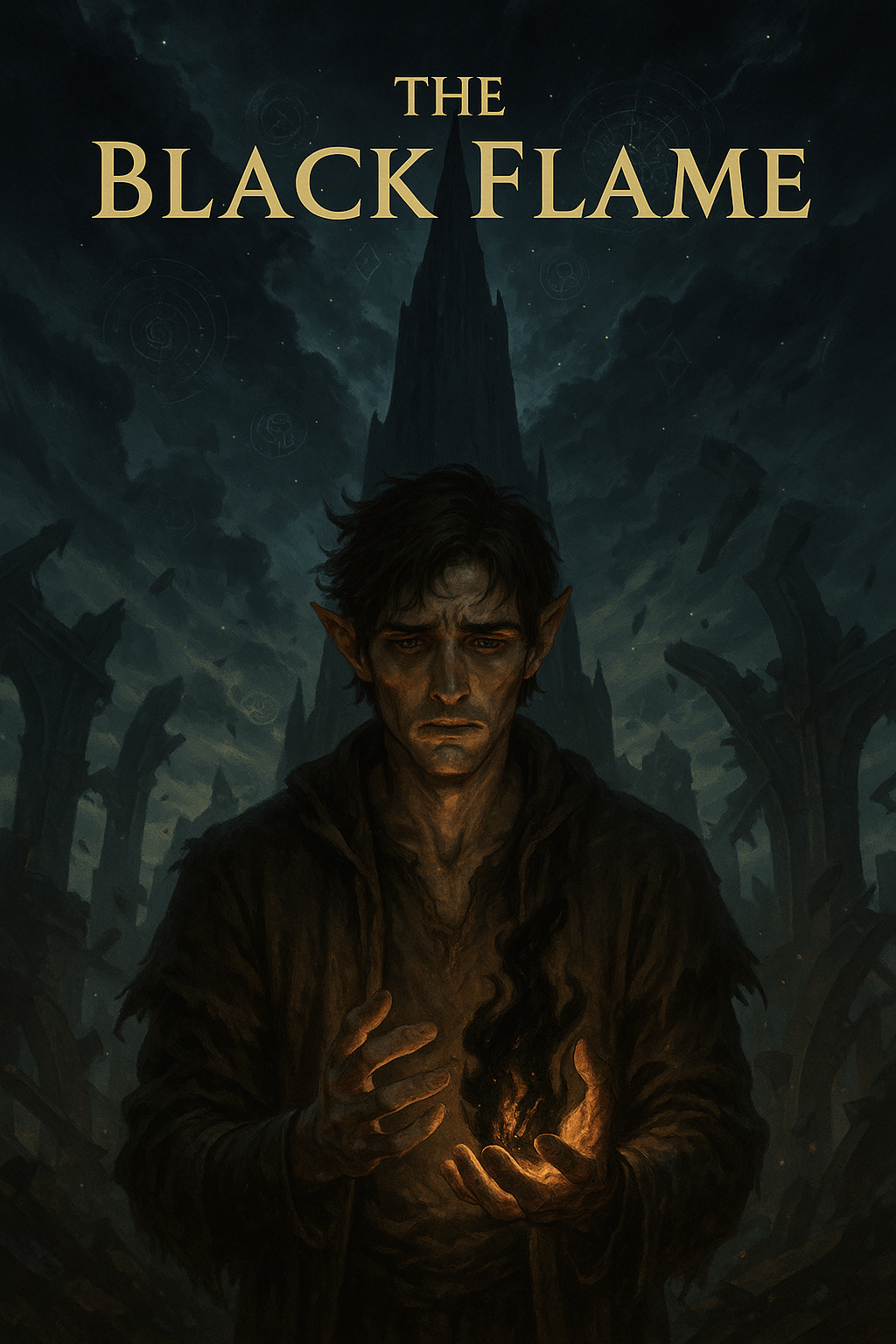
He didn’t remember falling—only the stillness after.
The alleys of Lowtown welcomed him not with arms, but with mud and silence. Eldorath’s lower quarter was a graveyard of forgotten stones and nameless faces, where smoke stained the sky and even the rats seemed to whisper. Here, no one looked twice at a man who moved like a shadow and never spoke.
Altharion drifted through those streets with no direction, a hollow man wrapped in a tattered cloak and grief too large to carry.
He did not speak. He did not eat unless he found bread left out for birds. He slept beneath broken arches and in ruined chapels, his dreams filled with Meridan’s final words — and his scream as the pyres took him.
It had been Altharion’s fault.
His magic. His arrogance. His presence.
Altharion had fled. He should have stayed.
Some nights, he thought of letting the Inquisitors find him. Let them burn him too. Let the world be rid of another cursed mage.
But the fire never came.
And the world… kept breaking.
He saw it in the boy beaten for stealing bread. In the old woman whose son had vanished in the night. In the teenager who bore scars not from battle, but from chains.
He didn’t plan to help. At first, he just… reacted.
A spark of light to blind a guard. A silent breeze to scatter wanted posters. A whisper of shadow to guide children down the safest alleys.
No one thanked him. No one knew his name.
But they stopped looking at him like a stranger.
And he stopped seeing only ghosts.
One night, a girl with soot on her cheeks pressed a crude carving into his hand — a piece of driftwood shaped into a mage’s silhouette.
“They say he comes when we need him,” she said. “Mama says he’s just a story. But I think stories come from somewhere.”
He tried to give it back. She had already vanished into the crowd.
He never gave a name.
He never asked for praise.
But still… stories formed.
He became a shape in the fog. A rumor whispered between crumbling rooftops and sewer tunnels. A protector not of cities, but of their broken edges.
The Black Mage.
Altharion hated the name. Hated what it implied. Hated the hope it gave.
He was no hero.
Only a man too broken to die, and too dangerous to be near the light.
The whispers came first.
“He saved a child from the fire.”
“He blinded a patrol with mist and vanished into the night.”
“They say he walks through walls… or into shadows.”
In the streets of Lowtown, The Black Mage became myth. In markets and shanties, over cracked cups of wine and beside flickering hearths, his stories were told with reverence and fear. The children carved charms in his image. The elders left candles on their doorsteps.
But for Altharion, each story was a wound.
He had never asked for this.
He had never wanted to be a symbol.
As his acts of resistance grew — helping magi escape, shielding beggars from patrols, sabotaging prison carts — so did the response.
The Inquisition turned its gaze fully to the gutters of Eldorath.
What came was not precision, but punishment.
To find one shadow, they cast a thousand.
The curfews began first. Bell towers sounded thrice at sundown — all doors locked, all windows shuttered. Anyone seen after was a suspect.
Then the searches. Homes were turned inside out. The cries of children and smashed relics echoed through the alleys.
Then the burnings.
They claimed they were cleansing the corruption. But everyone knew. They were desperate.
Still, the people whispered his name.
Still, they hid him.
And Altharion hated himself more with every life lost for his sake.
It was supposed to be a victory.
A family of underground herbalists, accused of harboring unregistered magi, had begged Altharion to help smuggle them out — a mother, two sons, and a mute apprentice girl barely old enough to cast sparks.
He led them through the catacombs, paid smugglers in stolen coin, covered their tracks with illusions.
He watched them disappear into the woods.
He felt hope.
Two nights later, while foraging for herbs, he saw the glow.
It wasn’t the sunrise.
It was the Pira Sancta, the pyre of execution, built in the center of Eldorath’s plaza.
Bound and weeping, the same mages screamed as fire rose around them. The girl’s eyes searched the crowd until they found him — hidden in a shadowed alley, watching helplessly.
Beside the pyre, four more bodies hung from gallows — the family that had helped them.
Above them all, banners of the Inquisition of Elyonel snapped in the breeze.
“The price of heresy is shared.”
That was the inscription carved into the base of the pyre.
Altharion fell to his knees in the mud.
Something inside him cracked.
The Inquisition sent their best — Inquisitor Vaeren, known as The Hound of the Flame.
A paladin without remorse. A tracker without failure.
Vaeren didn’t terrorize — he calculated.
He moved through the slums with authority and cold focus, interviewing, threatening, never losing composure.
Altharion felt the noose draw tighter with each day.
Old safehouses vanished.
Allies were arrested.
Even silence had become suspicious.
Vaeren never stopped.
Even without magic, Altharion could feel the man’s presence stalking him through the stone veins of Eldorath.
Altharion stopped sleeping.
His meals went untouched.
The voices returned — clearer, louder.
“They will burn because of you.”
“Leave. Run. Vanish.”
“No. Fight. You are their hope.”
He buried the grimoire in old cisterns. He tried to hide the shadows. But every time he looked in the mirror, he saw their faces.
Kaela.
Meridan.
The professor’s daughter.
Velroth.
The children on the pyre.
And now, more — too many to name.
He stood at the edge of a rooftop, watching a patrol drag a boy screaming from a bakery.
He wanted to scream back.
Instead, he clenched his fists and whispered:
“I was supposed to protect them.”
The shadows trembled around him.
It was supposed to be a simple passage.
Three children and their mentor, cloaked and silent, slipped through the abandoned aqueducts beneath Eldorath. The city above roared with unrest — another fire, another raid — and the guards were elsewhere. Altharion had walked this route before. He knew the turns, the echoes, the scent of moss-covered stone.
But when he reached the last gate… it was already open.
And lit with torches.
Six armored inquisitors waited in silence, flanked by black-cloaked judges bearing the insignia of the Flame.
At their center stood a tall, composed figure draped in crimson-trimmed robes. His face was carved from marble — serene, unreadable. His eyes held no rage. Only inevitability.
Vaeren. The Hound of Flame.
“Altharion Velarys,” the man said, his voice like an ember caught in ice. “At last.”
The children froze. The mentor trembled.
Altharion stepped forward slowly, hands raised, heart already bracing for violence. “Let them go. They’re just children.”
Vaeren did not blink. “And you are just a myth.”
He gestured to his soldiers.
“Let them pass.”
The inquisitors parted. The mentor hesitated, but Altharion nodded. “Run. Now.”
They fled into the tunnels, the mentor offering a final, frightened glance back.
Vaeren watched them disappear, expression unmoved. “There. That should ease your conscience a little.”
“…Why?” Altharion asked, wary. “You don’t let witnesses go.”
“Because I want you lucid. And guilt sharpens clarity.”
He stepped forward slowly, like a man observing a painting — hands behind his back, gaze dissecting.
“I’ve read your record. The top of your class in three disciplines. Instructor’s aide in magical ethics. Sponsored by Meridan Thalnos himself.”
He paused.
“And yet, none of that appears in the Inquisition’s final report.”
Altharion stiffened. “What report?”
“The one I wasn’t allowed to read,” Vaeren said calmly. “Only fragments. Coded. Censored. An internal investigation filed months before Meridan’s death. It named you, but not for a crime. Not clearly. Just a designation.”
He met Altharion’s gaze.
“‘Unresolved anomaly.’”
Silence.
“You see,” Vaeren continued, walking in slow arcs, “we are not so different. You were once what I might have been — a tool forged for control. But something went wrong. You slipped the leash.”
“I never asked for any of this.”
“No,” Vaeren agreed. “But you kept walking.”
He stopped before him, voice softening into a whisper that cut sharper than steel. “And now people die in your name. Children believe in your ghost. Lowtown bleeds while you hide behind noble guilt.”
Altharion turned away, but Vaeren followed his movements.
“I wonder,” he mused aloud, “what would your old friend Kaela say if she knew she was being watched? Or your friends in the academy who helped you hide your talents. Do you think the Inquisition forgets faces? That mercy comes without ledger?”
Altharion clenched his jaw.
“You’re bluffing.”
“No.” Vaeren tilted his head. “I’m offering.”
He raised a scroll — sealed with the sigil of the High Flame. “Your capture was to be public. Punishment severe. But I requested discretion. I still believe in function over spectacle.”
Vaeren extended the scroll.
“A deal. Your surrender — willingly and without resistance. In return, the lockdowns on Lowtown will end. The patrols will pull back. Your… friends will receive clemency. Officially unconnected. Free to vanish.”
Altharion stared at the parchment but did not take it.
“And what happens to me?”
“You are taken into custody. Interrogated, of course. But you will not be executed. Not immediately. That is my word.”
Altharion’s hands trembled.
“You want to break me.”
“No,” Vaeren said gently. “You’re already broken. I simply want to make your ruin… useful.”
The torches hissed.
Altharion stood alone in the archway, shadows curling at his feet like waiting chains. His breath caught in his chest. The weight of every choice, every death, every life spared at a cost too high pressed against his ribs.
Was it enough?
Could one last surrender balance the ledger?
He took the scroll.
“Spare them,” he said.
Vaeren nodded once. “You have my word.”
The inquisitors stepped forward. Iron cuffs sealed around Altharion’s wrists, cold and final.
He said nothing as they led him away.
Not even when the children’s carving — the one shaped like a mage — slipped from his pocket and broke on the stones
Arkhelum, the obsidian tower did not forget.
Built into the heart of a dead volcano, Arkhelum was a fortress turned prison, its halls veined with obsidian and forged with old runes that suffocated magic at its source. Here, spells unraveled before they could form, and even thoughts felt muffled, like voices beneath ice.
Altharion had not spoken in months.
The days blurred into each other. Meals came and went with no names. No sun marked time, only the flicker of enchanted torches that refused to warm the stone. Most of the other prisoners never spoke. Some had gone mad. Others had accepted their fate long ago.
But Altharion remained somewhere between.
He was not broken. Not yet.
The walls of his cell were unbroken. The stone floor, once stained with dried blood from his arrival, had long since faded into cold indifference. The runes etched into the walls still hummed faintly, draining away even the echo of magic that had once been his lifeblood.
For eight long years, he had not felt a whisper of power.
No shadow obeyed. No vision flickered.
The connection was severed.
He dreamt only of emptiness.
Of fire.
Of Kaela’s silence.
Of Meridan’s last words.
Of the faces he failed to save, and the ones he failed to spare.
The boy who once challenged gods now struggled to remember his own name.
Her voice was the first new sound in years.
“Altharion?”
Soft. Calm. Unexpected.
He lifted his head slowly, blinking against the sudden presence. Standing beyond the warded bars, she wore a scholar’s robe — simple, tailored, of dark blue silk with silver embroidery at the cuffs. Not extravagant, but undeniably noble. Her hair was braided neatly, and she carried with her a satchel of scrolls and a soft leather-bound journal.
Hair like woven moonlight.
Eyes like quiet frost.
“I am Lady Seraphina Elvane,” she said. “Advisor to the Council. Mage. Scholar. Diplomatic parasite, depending on who you ask.”
Altharion didn’t answer.
“I came to hear your story,” she added. “The real one.”
Still, he said nothing.
For three visits, he refused her. On the fourth, he whispered:
“Did they send you to break me?”
She didn’t flinch.
“I came to understand you. Not judge you.”
The guards called her “the envoy.”
She did not bow. She did not explain. She stood just outside the enchanted bars and regarded him as though studying a book long overdue.
“You’ve been here eight years. No parole, no trial. A cell with no light and no sentence. Does that not strike you as… interesting?”
He lifted his eyes, voice hoarse from disuse.
“Nothing here is interesting. That’s the point.”
She smiled — not with amusement, but with recognition. “I suppose that’s true.”
She returned the next day.
She asked questions, carefully measured but never cruel. About his time at the Academy. His views on magic. His understanding of the Daemon War. Always polite, always poised — but never probing too deeply. And never once did she name herself.
“I study systems,” she said once. “And the people that systems fear.”
He squinted. “You sound like a politician.”
She looked away at that. “I prefer books to councils.”
Another time, she brought a parchment of verses. Poetry from the northern borderlands — the kind once sung by wandering bards before the Purge of Fire. She said she found it “curiously comforting.”
He asked, “Why are you here?”
“To listen.”
He didn’t trust it. But part of him — the part that still remembered stars and wind — wanted to believe it.
Over months, the silence cracked.
Their conversations started like winter storms — slow, sharp, cautious. But she never raised her voice. Never mocked. Never recoiled when he spoke of shadows, of the voices, of the blood. She questioned everything, not to condemn — but to comprehend.
He distrusted her.
Thought she might be another mask, another leash. But Seraphina never asked him to repent. She asked only what he believed in.
And he… didn’t know anymore.
One day, after a long silence, she said:
“You know, the people still talk about you. In whispers, yes — but with hope. You were the first to stand against them. Some call you a villain. Others, the only mage who ever mattered.”
Altharion scoffed.
“They don’t know me.”
“I think they do,” she replied gently. “The part of you that still aches. That still dreams.”
In his ninth year of silence, on a day that might have been his birthday — had he bothered to remember it — she returned with a box.
“I know you don’t celebrate,” she said. “But… indulge me.”
He opened it with trembling hands.
Inside was a small obsidian pendant, carved in the shape of a broken eye. On its surface, runes flickered with barely visible light — not enough to trigger the wards. Just enough to whisper of power remembered.
“It’s not magical,” she lied poorly.
“It’s just… a reminder. That someone still believes in you.”
For the first time in nine years, Altharion felt something stir.
A heat.
A hunger.
A heartbeat beneath the cold.
Nine years in Arkhelum had turned Altharion into something half-shadow, half-memory. His bones had learned the shape of chains, and the silence of obsidian had nested itself behind his eyes.
Until her.
Seraphina Elvane — Lady, Mage, Scholar, Parasite — had become the only rhythm that broke the stillness of his soul.
Their visits had grown longer. Less interrogative. More human.
Some days they debated obscure schools of transmutation, or read ancient parables about stars devoured by pride. Other days they sat in silence, content to share breath in a place where breath was often the only proof of life.
But something had begun to shift.
It started with his voice. Stronger. More certain.
Then came the dreams. Not the old nightmares of fire and betrayal — but visions of green things, of warmth, of light falling through leaves like spells too ancient for words.
And, stranger still… a tingling in his fingers.
Faint. Like pins of warmth beneath the skin. Harmless — at first. He assumed it was memory. Or delusion.
But it persisted.
A Spark Rekindled
He did not tell her at first.
But she noticed.
“You’ve stopped shivering,” she remarked one day, handing him a folded parchment of poetry.
“You used to shake between syllables.”
He gave a shrug. “Maybe I’ve grown duller. Or maybe your presence numbs me.”
“I’ll take that as flattery,” she replied with a sly smile. Then added:
“Though I wonder… Is it really dullness? Or have you remembered how to feel?”
That made him flinch — and she saw it.
She didn’t press.
Instead, she sang. Not with voice, but with ink. She brought books, devices, puzzles. Questions disguised as games. And though she never said the words, her eyes said everything.
I see you.
You are not gone.
Not yet.
And that terrified him more than the obsidian walls.
But not all eyes in Arkhelum were kind.
Warden Ilvareth, ever vigilant, had begun to take notice.
He saw it in the way the guards grew more severe. In the additional prayers spoken over his food. In the silence of other prisoners, who had once shared glances and now avoided his gaze entirely.
He wasn’t sure when the “extra” wards had been added to his cell.
But he felt them. Like a tightening of air, a noose made of sanctified dread.
And one evening, when Seraphina had just left, a guard with an unfamiliar face passed by his cell, leaned in, and whispered:
“She’s making a mistake. And you… you won’t survive her mercy.”
That night, Altharion did not sleep.
The warmth in his fingers surged once — sharp, painful, real. And when he placed his palm against the wall, just for a moment, the stone trembled.
It shouldn’t have. It was sacred obsidian. It shouldn’t react.
But it had.
And across the prison, in the chapel of flame where Matriarch Ilvareth knelt each dusk before the burning sigils, a candle flickered blue.
She stood slowly.
“This cell is no longer neutral,” she said to her attending acolyte.
“The heresy grows again. Prepare the rites. Send the request. We purge the heresy.”
As the weeks passed, Altharion grew stronger — not in body, but in presence. His eyes no longer stared blankly. His voice returned. He began to pace, to dream.
And then, one night, Seraphina arrived with panic in her voice.
“They’re moving against you.”
“Who?”
“The new High Inquisitor — Vaeren’s successor. He sees you as a risk. He doesn’t care about justice or redemption. He says… it’s better to preserve the lie than risk the truth.”
“When?”
“Tomorrow. Dawn.”
Altharion sat in silence.
She stepped closer to the bars.
“You have to run.”
“I can’t,” he whispered. “There’s no power left.”
But as he closed his eyes, something different answered.
Not a voice.
A presence.
The pendant around his neck began to burn.
Shadows in the corners of the cell flickered.
And a whisper filled the air.
Two voices, as always.
“You are the storm waiting to return.”
“You are the failure chained by guilt.”
“You are what they fear.”
“You are what they made.”
Altharion stood, the darkness wrapping around his limbs like an old friend.
For the first time in years… the shadows listened.
He turned to Seraphina.
“If I must be a monster,” he said, voice like thunder behind stone,
“then I will be a monster they never forget.”
 Chronicles of Astravara
Leave a comment