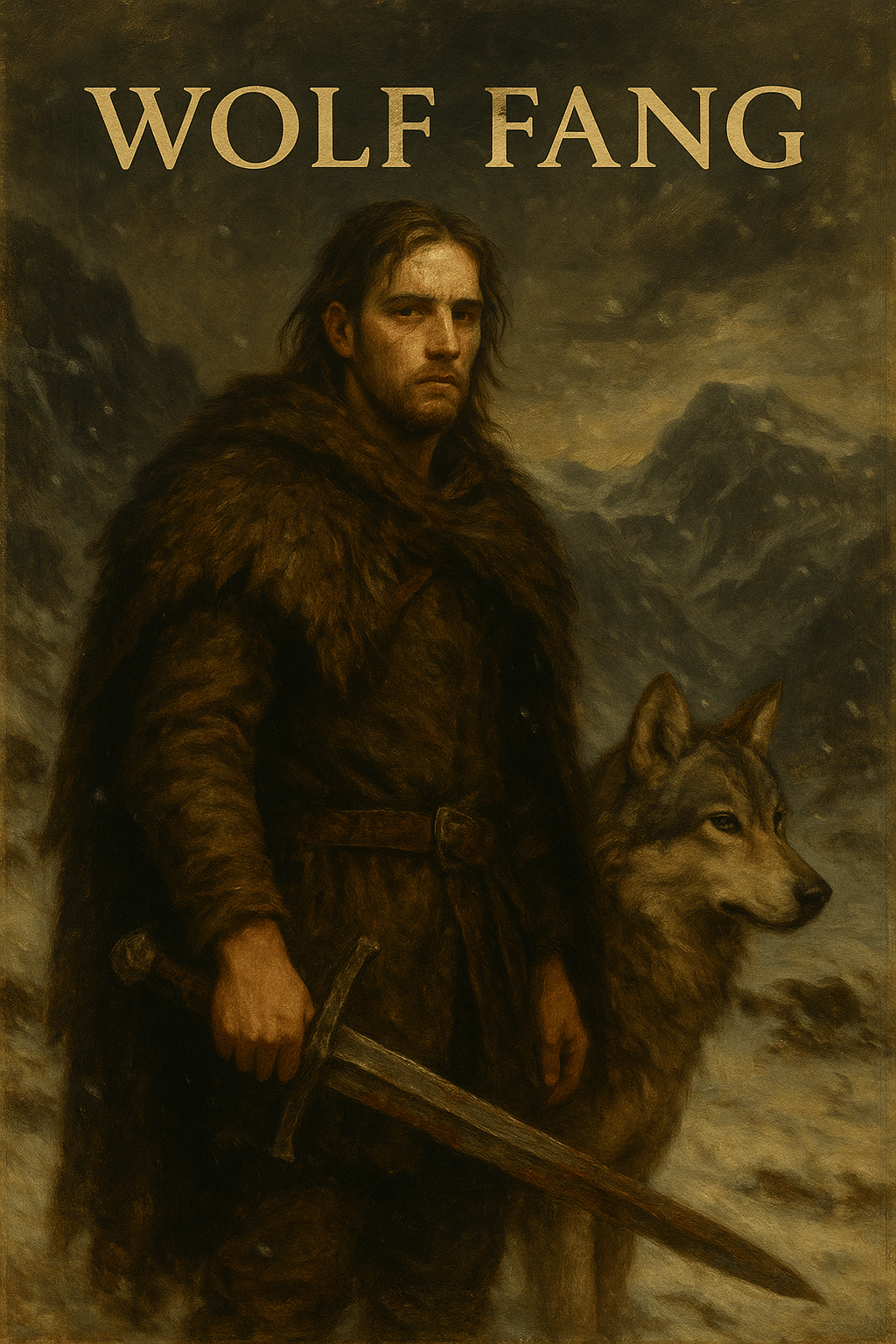

Where gods whisper and empires rot.

Reading Time:
The winds of Norvhar cut like invisible daggers through skin and bone.
To Eirik Skallheim, the cold was not merely a sensation — it was an enemy, a constant, suffocating force that clung to his breath and burrowed into his bones. At sixteen, he was one among countless orphans left behind by families too poor to feed another mouth.
The village where he grew up was little more than a scatter of soot-darkened huts huddled along a frozen bay where the ice never melted. His parents, hardened fishermen, had vanished during a sea storm when he was just twelve. Since then, Eirik survived as he could — hunting small game, stealing fish from neighbors’ hooks, and sleeping in a shelter he built from driftwood and stolen cloth.
“The cold isn’t your enemy, boy,” an old man from the village had once told him. “It’s what keeps us alive. Respect it, or it’ll bury you.”
But Eirik had never seen the cold as a friend. To him, it was a prison — a wall that kept Norvhar isolated from the world, dooming its people to rot in silence.
The winds of Norvhar whispered like old spirits, slipping through the cracked bones of the land. Each step was a conversation with the cold — and the cold spoke of death.
At sixteen, Eirik Skallheim was no longer a child, but not yet a man. His frame was lean from hunger, his spirit shaped by grief. He had grown up counting losses like others counted winters. When he was ten, his elder brother succumbed to fever in a storm-wracked hut, his body buried under stone and silence. Two years later, their parents vanished into the sea during a violent squall — swallowed by waves while fishing beyond the cliffs. He never saw their bodies. Just the empty boat, carried back by the tide.
But it was at fourteen that the last ember of his childhood was extinguished. His younger brother died during a frostbite outbreak that swept through the village. The healers said it was quick. Eirik knew better. The boy had cried for hours before sleep took him.
And then there was his sister.
She had been the only one who still laughed. A gentle soul in a place where softness froze. Two winters before the sea took their parents, she was sold to a distant trader family — a deal struck quietly in the night for dried cod, grain, and a promise that was never kept. His mother didn’t cry. His father simply stared at the fire.
That night, Eirik punched the wall until his knuckles split. After that, he stopped speaking unless necessary.
The village of his birth was no cradle of kinship. It was survival carved into black wood and colder stone — a clutch of wind-battered huts trapped between glacier and sea. The elders left offerings to the storm gods and whispered that Norvhar made strong men. But Eirik had seen it made only graves.
No one stopped him when he left. Not even the elders. Not even the drunk old fisherman who once taught him to gut a seal. Eirik took only what he could carry: a stitched sack of pelts, a hunting knife, and a shortbow bought with stolen coins.
He didn’t say goodbye.
The journey south was a passage through desolation. Tundra stretched endlessly, broken only by the skeletons of trees and frozen rivers that glistened like glass veins. At night, he dreamed of wolves gnawing at his bones. During the day, he saw nothing but white and shadow. Loneliness pressed on him like a second skin.
On the fourth night, a sudden blizzard descended — a white wall of shrieking wind and ice. He took shelter beneath a jagged outcrop, limbs curling into himself as the snow swallowed the world. His teeth chattered, his breath shallow and sharp.
“Is this what’s left of me?” he thought. “A whisper in the snow? Like them?”
He remembered the shape of the boat drifting back without his parents. The silence after his brother’s last breath. The sound of the door closing when his sister was led away.
But he did not die.
At dawn, he crawled from the stone’s embrace, crusted with frost but breathing. He walked without thought, fueled by instinct and spite. The village elder’s words echoed faintly: “The cold keeps us alive, boy. Or it buries us.”
He wasn’t sure anymore which one he deserved.
When the walls of Frosthavn appeared days later, they shimmered through the haze like a mirage — towers of black stone wrapped in steel and smoke. Eirik stumbled through the gates like a half-dead fox. No one looked at him. No one cared.
The city smelled of fish oil, soot, and salt. The alleys hissed with secrets. The poor slept in barrels, their breath clouding the night air. Above them, noble estates glowed with firelight and excess.
But for a boy with frost in his lungs and a scream sealed in his chest, it was still a beginning.
Arriving at Frosthavn was a harsh awakening. He had expected a place of promise. Instead, he found a brutal city, where the wealth of nobles towered above the misery of the ice-crusted slums. The markets reeked of rot and fish oil, and every alley held the stench of desperation.
The city was a jagged mouth — stone teeth, smoke-veined breath, and alleys that bit with frost. No one asked his name. No one offered a hand. In the slums of the outer ring, children died of cold with snow still dusting their eyelashes.
Eirik watched. And learned.
He slept in the cracks between buildings, under carts, and once inside a butcher’s refuse barrel. He stole bread and dried roots, chewed leather and scavenged meat left for dogs. His hands grew calloused. His stomach forgot what warmth felt like. But he did not beg. He never would.
Each time he passed a shivering beggar, whispering for coin beneath a frozen shrine, his lips twisted into quiet contempt.
“Weakness is a choice,” he told himself. “And choice is survival.”
In the temple squares, he saw people crying before statues — desperate sobs echoing off the stone faces of forgotten gods. He felt nothing for them. They prayed, and still starved. They wept, and still froze. The gods were as useless as the elders of his village.
He remembered his sister’s pleading eyes the night she was sold. His father’s silence. His mother’s numb acceptance. They gave up, he realized. They let life take them.
And so, a thought took root — one that never left:
“The weak die. The strong endure. The rest is just noise.”
As weeks passed, he began to see people differently — not as people, but as measures of strength. The drunkards sprawled in gutters. The orphans too soft to steal. The women wailing outside brothels. The priests with soft hands and softer spines.
All of them were fading things, waiting to vanish.
Eirik hardened.
He trained his body in secret — climbing rooftops at night, leaping over gutters, scaling the cold iron ribs of the city’s abandoned bell towers. He hunted rats with bare hands in the market refusing to sell their pelts. He carried stones up frost-bitten stairways just to feel pain in his arms. Not for pride. For proof.
Proof that he was still becoming. That he hadn’t decayed like them.
He stopped speaking unless necessary. His eyes, already grey, took on the sheen of steel left too long in snow.
One night, while raiding a storage shed behind a tannery, he caught sight of his reflection in a sheet of frozen glass. He stared.
Not at a boy.
At something colder.
A shadow with hunger in its eyes.
The streets began to whisper about a feral youth with a wolf’s gaze and a hunter’s silence. Shopkeepers watched their stalls when he passed. The city guards began to take note.
But it was not fear he desired — not yet. It was distance.
A wall between himself and everything that reeked of pity.
Sometimes, he’d see a child crying in the snow and feel a flicker of something — a memory, maybe. But he’d crush it quickly. If they’re too weak to fight, let the frost take them, he’d think. The snow is honest.
One winter morning, as he passed through a narrow alley, he saw a man collapse, coughing blood onto the stone. People stepped around him. One woman crossed herself. Eirik paused, watched.
Then walked away.
“Mercy makes corpses.”
That was the day he stopped flinching at suffering.
That was the day the cold inside him stopped being a shield — and became a weapon.
One gray morning, Eirik tried to snatch a merchant’s coin pouch and was caught. The guard who seized him was massive, with a beard like a tangled flame.
“You think you can steal from us, vermin?” the man growled, slamming Eirik against a wall.
The blow knocked the air from his lungs, but Eirik didn’t cry out. When the guard lifted him by the collar and punched him hard in the face, he spat blood on the snow and met the man’s eyes, blazing with silent defiance.
“Hit me all you like,” he hissed, teeth red with blood. “I won’t kneel.”
His defiance only fueled the guard’s fury. He threw Eirik to the ground and began to kick him, each strike a wave of agony. Still, Eirik never screamed. With every blow, something hardened in him — a will he didn’t know he had.
Then a voice cut through the chaos, firm and cold as the air.
“That’s enough.”
The guard froze. The speaker was a man of presence — a weathered veteran in a dark fur cloak. It was Commander Rorik Thaldran, a legend among Norvhar’s legions.
He looked down at Eirik, bleeding in the snow, with quiet interest.
“Get up,” he said.
Eirik obeyed, barely standing.
“You have fire in your eyes,” Rorik said. “That’s rare around here. Maybe you’re more than just a street rat. Tell me, boy — ever thought about serving the kingdom?”
Eirik hesitated, his lip split and still bleeding, one eye swelling shut. The snow beneath him was stained red, and yet… he stood.
The word “kingdom” tasted foreign in his mouth. A concept wrapped in banners and thrones — things that had never fed him, clothed him, or saved his family. But the weight in Rorik’s voice was different. It wasn’t a sermon. It was a challenge.
“I’ve thought about surviving,” Eirik muttered, teeth gritted. “If that’s what serving means… then maybe.”
Rorik’s smile didn’t reach his eyes. “It’s a start.”
He was taken not to a barracks, but to a stone courtyard behind the local garrison — little more than a patch of ice and gravel surrounded by weather-worn training dummies and racks of splintered weapons. There were no welcoming speeches. No congratulations. Just a command:
“Train until your body remembers what your mind refuses to learn.”
Rorik oversaw everything.
Mornings began before dawn, with Eirik forced to plunge into a half-frozen trough and scrub himself raw. Then came sprints through thigh-deep snow. Lifting stones heavier than his own body. Swinging a wooden blade until his palms split and bled. Again. And again. And again.
“Discipline is colder than Norvhar,” Rorik said one morning. “But it cuts deeper when you lack it.”
Eirik never complained. He’d already mastered pain. What tested him was structure — the repetition, the rules, the brutal honesty of the drills. Here, he couldn’t lie. Not to others, not to himself.
But what began as contempt shifted into obsession. With each passing day, his strikes grew sharper. His breathing steadier. His wounds slower to appear — and faster to heal.
Rorik watched.
“You’re learning,” he said once. “But strength without purpose rots into cruelty.”
Eirik didn’t answer. Deep down, he still believed most people weren’t worth saving.
He trained with other recruits only when forced to. Most avoided him, wary of the boy with the scarred face and silent stare. A few tried to provoke him — all of them regretted it. Eirik fought like a starving wolf, not for victory, but domination.
In private, he still repeated the mantra he’d forged alone in Frosthavn’s streets:
“Weakness is a disease. I won’t catch it.”
Yet Rorik saw the cracks.
One evening, after a day of blade drills, the commander handed him a dull dagger and gestured to a frozen stump nearby. “Cut that knot.”
Eirik struck it — once, twice, a dozen times — until the wood split.
“Now tell me what you saw.”
“A flaw,” Eirik answered. “The crack beneath the surface.”
“And what would’ve happened if you struck blindly?”
“The dagger would break.”
Rorik nodded. “That’s strength, boy. Knowing where to strike. When to hold. What not to destroy.”
That night, Eirik sat alone in the snow, eyes closed, the dagger still in his lap. The cold didn’t bother him anymore. What bothered him… was that he hadn’t thought of that on his own.
They began watching him in silence.
At first, the other recruits mocked him — the pale-eyed boy who never spoke unless necessary, who trained alone long after the drills had ended. But soon, curiosity replaced mockery. Then wariness. Then something closer to awe.
Eirik didn’t try to lead. He didn’t speak to them. Didn’t offer advice. He ran alone. Ate alone. Fought alone. And yet… every morning, when he rose before the sun, they began rising too. When he filled buckets with ice to soak his bruises, they did the same. When he spent hours striking the training post until the wood split or his hands bled — they followed, copying his rhythm from a distance.
They called him Skallheim the Silent. The Wolf Pup. Never to his face.
One recruit, a broad-shouldered boy named Vorn, once approached during sparring drills. “Teach me that last feint,” he muttered, hopeful.
Eirik didn’t answer. He turned, struck Vorn in the ribs hard enough to drop him, then waited as the boy staggered up — only to knock him down again. And again.
“You want to learn?” Eirik rasped, voice hoarse. “Then stop asking. Prove it.”
Vorn never asked again.
Nor did the others.
But they kept watching.
Eirik failed often.
There were days when the snow blurred his vision and his fingers trembled too violently to hold a blade. Days when his body collapsed during drills, convulsing in the cold, and he’d vomit from sheer exhaustion. One night, his legs gave out mid-sprint, and he struck his head on the stone barracks wall — blood froze instantly on his temple.
Rorik found him hours later, unconscious in the snow.
The commander didn’t scold him. Only ordered the healers to tend to the worst wounds.
When Eirik woke, he asked only one thing:
“Did I finish the run?”
Rorik didn’t answer.
By the next dusk, Eirik was back on his feet — limping, coughing, but moving.
And the recruits… they watched that too.
They began following him from a distance on the running tracks. Matching his weight drills. Even mimicking the rhythm of his breathing exercises — sharp inhale, longer exhale, just as Rorik had taught.
But when one of them tried to run beside him, Eirik elbowed him off the path. Another tried to spar; Eirik broke the boy’s stance with a vicious sweep and left him gasping in the mud.
It wasn’t cruelty. Eirik didn’t sneer, didn’t boast, didn’t taunt. He simply didn’t tolerate weakness in his space — not even shadows of it.
That was what made him dangerous.
And Rorik observed all of it.
From the ramparts. From the mess hall. From the frost-covered benches near the training yard.
He watched the bruises that never healed. The nights Eirik didn’t sleep, pacing alone. The eyes that never softened — even when the boy’s body was breaking.
“You’re not forging him,” the healer whispered once. “You’re letting the ice shape him.”
Rorik said nothing.
But at night, when the wind howled across the compound like a mourning wolf, he sometimes lingered outside Eirik’s quarters — just to be sure the boy still breathed.
 Chronicles of Astravara