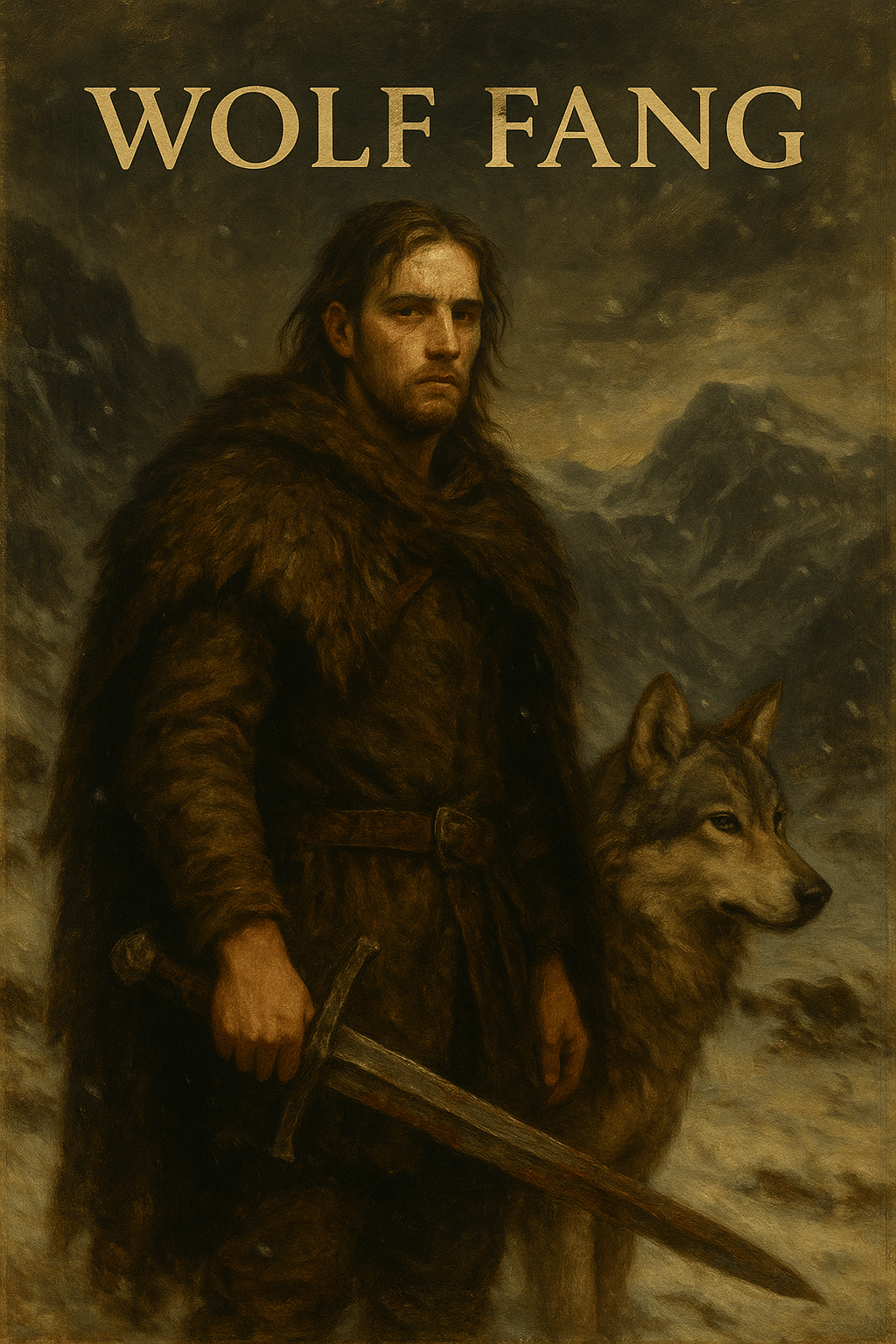
The snow fell in fine, whispering sheets outside the barracks. Inside, the glow of the hearth cast long shadows on stone walls, where boots thudded and armor clanked with the dull rhythm of discipline.
Eirik sat alone in the farthest corner of the infirmary, his shirt torn open, chest rising and falling with sharp, controlled breaths. Blood welled from a deep cut along his ribs — a training spear had slipped in the mud and found its mark. He hadn’t made a sound when it struck.
Now, alone, he worked the needle through his own skin.
The thread trembled once, twice, then held steady. Each stitch was deliberate, mechanical, unflinching. He bit into a strip of leather to stop his jaw from clenching too hard and finished the job with a strip of torn linen he’d boiled himself.
No healer had been called. He hadn’t asked.
When it was done, he tied the bandage with one hand, dropped the bloody rags into the fire, and leaned back against the wall. His breath fogged in the cold air. His eyes stared through the stones, unblinking.
There was no pride. No pain. Only necessity.
On the rampart above, Commander Rorik stood watching the yard below, arms crossed. The torchlight flickered against the fur-lined mantle on his shoulders. Beside him stood Captain Verdan, his second-in-command — an older man with a scar across one eye and a voice like gravel.
“You should stop him,” Verdan said, glancing toward the barracks. “The boy’s pushing too far. He’ll snap something loose — in the body or the mind.”
Rorik didn’t answer immediately. His gaze remained fixed on the snow-covered yard where the training dummies stood, half-buried in ice.
“He reminds me of someone,” Rorik finally muttered.
Verdan scoffed. “Don’t say it. You’re not grooming another ghost.”
“This isn’t grooming,” Rorik replied quietly. “It’s containment.”
“You think you can shape that rage into discipline?” Verdan asked. “You think it’s loyalty he’s learning down there?”
“No,” Rorik said. “But I think he’ll survive.”
Verdan spat over the wall. “A boy who survives like that doesn’t become a soldier. He becomes something else.”
Rorik finally turned away from the yard. “Then let’s pray, for Norvhar’s sake, that we never stand on the other side of whatever he becomes.”
The next morning, the recruits lined up for sparring. Eirik arrived limping slightly, a faded bloodstain on his tunic.
No one asked why.
And when the drills began, he fought as if his wound didn’t exist — his blows hard, his footwork sharper than ever. One recruit tried to mimic his rhythm and failed. Another tried to match his pace and collapsed from exhaustion.
They kept watching.
And he kept bleeding.
But he never stopped.
The snow no longer spoke to Eirik. It listened.
After eighteen months under Rorik’s eye, the boy that had once bled alone in a barracks corner had become something different — harder, quieter, colder. The other recruits had long stopped trying to befriend him. Instead, they mimicked him from a distance: in posture, in routine, in silence.
He had become a mirror they feared to look into too closely.
They called him The Wolf Without a Howl.
He never corrected them.
“Skallheim,” Rorik said one morning, summoning Eirik to the command tent. The wind outside howled like a dying god.
Eirik entered without saluting. He stood there, pale and silent, his eyes as grey and unforgiving as the sky.
Rorik studied him for a moment. “There’s nothing more I can teach you behind walls.”
A map was unrolled across the table. A red mark circled a region near the dead forests of the south tundra.
“A pack of dire wolves has been harassing the outer villages. They’ve taken down soldiers, horses, even tore through barricades. This isn’t a patrol.”
Eirik didn’t blink.
“This is your final test. Alone. No rescue if you fail.”
Still no reaction.
Rorik stepped closer, his voice low.
“Bring back a trophy. Something no one can deny. If you die, the snow will remember you. If you live… perhaps so will Norvhar.”
The barracks was filled with whispers that night.
“He’s going into the wolflands… alone?”
“Commander Rorik didn’t even flinch. Just pointed and said go.”
“They say he’s never slept. Just stands there in the dark.”
“I saw him once… after drills. He was punching the wall until his knuckles turned black.”
“He doesn’t bleed anymore. The ice took his blood.”
Eirik did not say goodbye. He packed his bow, a coil of leather cord, dried meat, and a single waterskin. Then, with no ceremony, no words, he stepped into the storm.
No one dared follow him past the gates.
The journey began like a slow death.
Wind peeled the skin from his fingers. His boots froze to his feet each morning. On the third night, he bled from the nose until the frost turned it black. But he did not cry out. He did not speak
Crossing the frozen rivers meant stripping half-naked to dive beneath thin ice, holding his breath as the water stabbed at his lungs. His boots froze solid every morning. He fought the snow not by resisting it — but by matching its rhythm.
He hunted small game to stay warm. But his true target revealed itself only on the fourth day: a trail of crimson in the snow, massive paw prints, and bones shattered by something with a jaw like a steel trap.
The wolves of Norvhar were not mere beasts. They were shadows given hunger, with fur like midnight and eyes that glowed like coals from ancient fires.
On the fifth day, they found him.
The first wolf came at night — silent, calculated, alone.
It bit deep into his shoulder before he could draw his blade. The snow drank the blood with greed. They fought in silence, tooth and steel, until Eirik drove his dagger into the beast’s neck and felt the warm spray across his chest.
But the howl came after.
It echoed across the valley like a summons.
They had found him.
The pack.
The next days were a blur of survival.
Eirik stopped seeking shelter. He built traps from splintered bone and rope from his own shredded tunic. He lured wolves into gorges, poisoned raw meat with mushrooms, and learned their rhythm — how they flanked, how they tested, how they waited until nightfall.
He moved like them.
He breathed like them.
He killed like them.
But the cost came.
It was the alpha that did it.
Larger than a bear, with fur like midnight iron and a jaw lined with old scars. It waited until Eirik was wounded and half-starved, then struck beneath the hollow of a frozen oak. The fight was not fair. Nor honorable.
The beast lunged.
Eirik blocked with a forearm — and the claws raked across his face, shredding flesh and searing his vision in blinding pain.
He screamed.
Not in fear.
In fury.
Blood ran down his cheek, thick and hot, painting the snow like spilled wine. He couldn’t see from his left eye — only shadow and red.
But he didn’t fall.
He rammed his broken blade into the alpha’s side, then bit the creature’s throat when it closed on his leg. He punched and tore and stabbed again and again until it stopped moving, its growls reduced to spasms and breathless twitches.
When the battle ended, the wolf was dead.
And so was a part of Eirik.
He didn’t stop to rest.
He dragged the carcass behind him like a chained god, every step a declaration. Along the way, he passed the bodies of the others — the wolves he’d killed with blade, trap, or fire. He limped with a torn calf, his face soaked in dried blood, his lips cracked open by frost.
On the seventh day, Eirik entered the village of Durnheim.
Silent.
Alone.
Dragging an alpha’s corpse behind him.
His left eye was shut, swollen and black. A jagged scar carved his face from brow to jaw. But he walked upright, head high, gaze sharp even in ruin.
And no one dared meet his eyes.
They did not cheer.
They did not kneel.
They simply stepped aside.
And in that silence, Eirik found something colder than victory.
Purpose.
He would never be weak again.
Not like the beggars who cried in temples.
Not like his parents, who bartered away their own blood.
Not like the world that watched the strong die for nothing.
They did not look him in the eye anymore.
Not even the captains.
When Eirik passed through the barracks of Frosthavn, heads bowed with instinct more than respect. Some muttered prayers. Others called him the scarred wolf, the feral son of Norvhar, or the one who walked out of winter’s maw.
But most said nothing.
They had seen what returned from the trial.
And it was not the boy who had entered.
The scar had sealed shut across his left eye — a ragged, pale line of frost-burned flesh that glowed faintly under certain light, as if the cold itself had marked him. His eye no longer bled, but he could see nothing through it. He had learned to move regardless.
He did not speak often. He did not explain the pain. He wore silence like steel.
But the memento he bore most visibly was the pelt.
The alpha wolf’s hide had been tanned and sewn crudely into a mantle, black and silver, its fangs left intact and hanging from the collar like a necklace of quiet warnings. He wore it over his uniform, even when ordered not to. Rorik allowed it, though he said nothing aloud.
Because none dared tell him otherwise.
Eirik’s routine shifted. He rose before the horn. Trained alone in the snow without boots or coat. Practiced blindfolded sparring in the old stone courtyard where frost never thawed. He sat by himself at mess, eating in silence, gaze always turned toward the windows — watching.
The others began to imitate him again.
But none matched the same hunger.
When the order came, it was with no announcement.
Rorik found him in the ice garden, sharpening his blade with quiet focus, his breath a mist that never trembled.
“You’re being reassigned.”
Eirik didn’t look up. “Where?”
“The eastern passage. Raids on the border near Skarn’s Watch. Harriers. Rebels. Maybe worse. Command wants teeth in the snow.”
A pause.
Rorik stepped closer and, for the first time in many months, placed something beside Eirik.
A metal insignia — shaped like a curved fang, forged in blacksteel, wrapped with a sliver of direwolf bone.
“Your trial’s over. You’re not just a soldier now.”
Eirik finally looked up.
“You’re Ulfr’kar,” Rorik said. “Fang of the Wolf. First in twenty years.”
They gave him a unit.
Ten men. Four women. All hardened by the cold.
But none had survived a wolfpack alone.
At first, they treated him like a myth. Then, like a threat. But as days passed in silence and snow, they began to follow him. Not by order. Not by command.
By scent.
By instinct.
Eirik said little. He slept outside the camp, always alone. He listened to the wind like a beast waiting for prey. He read the frost for movement, tracked footprints like bloodlines, and never smiled. He taught them to kill without sound. To move without trail. To leave only bones.
Some called it madness.
Others called it the way of the North.
The orders had been clear: Recon. No engagement. Map the pass. Return.
Eirik never returned with maps.
Instead, he brought back heads.
Three raiders from the Iron Teeth clans. One branded traitor from the Frosthavn garrison. And a message carved into a slab of bone:
“The North eats weakness.”
The generals were furious.
The soldiers began to whisper.
He did not lead like a captain. He gave no rallying cries, no strategic breakdowns, no assurances.
He simply stood — eyes hollow as ice — and walked into the snow. Whoever followed, followed. Whoever faltered, was left behind. Those who survived, he fed from his own rations. Those who bled, he tended without words. Those who showed fear, he ignored.
Strength was not just expected. It was the only currency.
And his soldiers paid in pain.
They began to call themselves The Broken Fang.
Not by decree. Not by ceremony.
But after their first skirmish, when Eirik slew a mounted warlord with a jagged blade of bone and left his mangled body on the ice for the vultures, his soldiers smeared ash and blood across their faces and took a piece of the warlord’s cloak.
“We follow the Fang,” they said.
From that day, they moved like a pack.
Low. Silent. Hungry.
The other commanders hated him.
They saw only a savage in wolfskin who spat on protocol. A madman who refused to answer summons, who never wrote reports, who took missions without approval. Yet no one dared court-martial him.
Because he always brought results.
Entire rebel camps vanished in nights. Infiltrators were found hanging by their heels from pine trees with their tongues cut out. Harrier bands that once plagued the border simply stopped existing.
And in their place: bones. Skulls marked with his brand.
His soldiers stopped using names.
They answered only to grunts, gestures, or the silent language of movement Eirik had taught them. A raised hand. A crouch. A glance. That was enough.
He did not call them to follow.
He walked into the wilds.
And they followed anyway.
Not because they were ordered.
But because not following meant death.
Insubordination never happened twice.
One young recruit — eager and loud — questioned his orders during a sweep of the Frostvale ruins. He didn’t even finish his sentence. Eirik struck him once, fast, across the throat. The boy choked on blood and silence. He survived, barely.
After that, no one spoke against him again.
One night, by a blackened fire under northern stars, two soldiers sat apart, whispering.
“He doesn’t care if we die,” said the first.
“No,” said the second, staring at the silhouette of their leader sharpening his knife in the dark. “He cares if we’re weak.”
“Is that better?”
“I don’t know,” she said. “But I’d rather follow a beast that knows the hunt than a man who hides behind laws.”
They said nothing else. Just listened to the steel against bone.
Eirik watched them all. He said little.
But when they fought, bled, or endured — he noticed.
And sometimes… only sometimes… he’d nod.
A gesture worth more than a medal
 Chronicles of Astravara