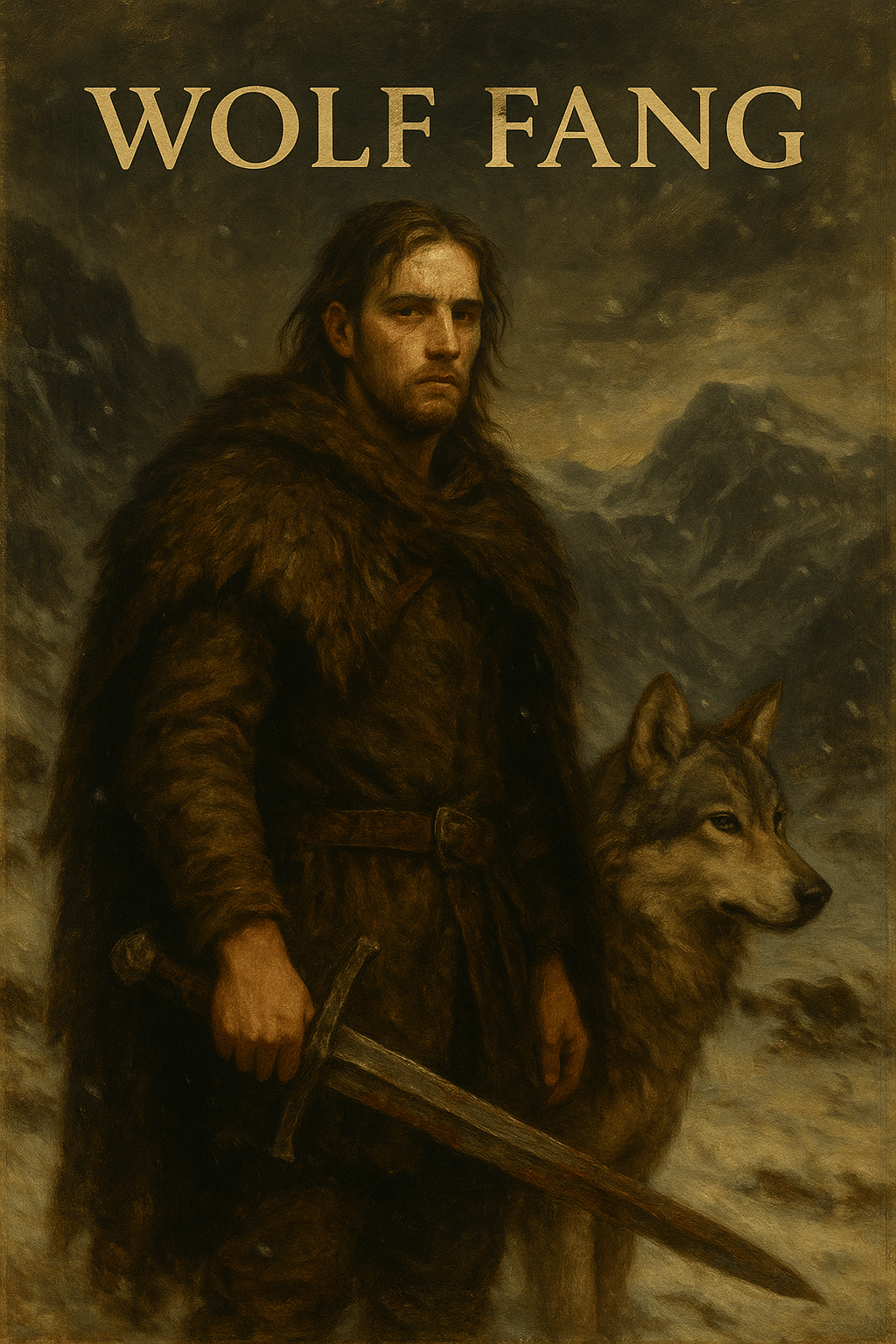
The old Jarl died in his sleep.
Thorgrin Ironhand — the last of the Frostwrought lineage who had earned his name in battle, not coin. When the news came, Eirik said nothing. Just stood in the snow and stared at the smoke rising from Frosthavn’s Hall of Ash.
That night, he howled beneath the stars. Alone.
His son, Vjorn, wore furs of silk and rings of gold.
He brought no sword to his coronation. Only a chalice.
“You are the hope of Norvhar,” the high priest said.
Eirik watched the ceremony from the shadows and tasted bile.
Everything changed.
Appointments were sold. Commands were given not to the seasoned, but to the silken. Battles became parades. Soldiers began to wear perfume.
And Eirik — who had bled for the ice and fed the snow with his kills — was treated like a savage kept on a leash.
They sent him and the Broken Fang north again. But this time, the orders were strange. Conflicting. Reckless.
One mission came sealed in gold wax from the new Lord-Marshal Velkaarn, a man who had never set foot outside the Frosthavn gates.
“Clear the cliffs of raiders,” the message said.
“There are no survivors to be taken. No witnesses.”
The cliffs were empty.
It was an ambush.
They came in silence — mercenaries in polished armor, blades coated with oil to muffle their draw, faces hidden.
Eirik fought like a beast cornered.
He slit throats with his teeth when he lost his knife. He broke bone with frozen stones when he lost his axe. He kept going, blind with fury and blood in his eyes, until the last body fell.
But it cost him.
Five of his men died. One of them had shared rations with him during the long march from Krilhold. Another had carved runes into his own arms as a vow of loyalty. The third had only joined a month prior — barely sixteen.
When it was over, Eirik sat in the snow for hours, unmoving. Then he began to strip the corpses of the mercenaries. One by one.
And built a pyre for his own.
He returned to Frosthavn carrying their ashes in a cracked urn, and placed it before the gates of the barracks.
When the guards questioned him, he said nothing.
The next day, Lord-Marshal Velkaarn was found hanging from the spine of a frost stag above the city gates. His tongue had been nailed to a wooden plaque.
It read:
“You commanded silence. I gave you silence.”
Whispers spread like wildfire.
Eirik was no longer seen as a mere warhound.
He was a wolf-god, savage and sacred.
Some feared him.
Some followed him.
But Norvhar turned its back.
The court declared him a liability. Officers whispered of sedition. He was given fewer men, worse equipment, colder routes.
And Eirik began to choose his own wars.
He raided outlaw camps without orders.
Burned villages known to harbor spies.
Executed officers who hesitated in battle.
The old loyalty became something darker.
Not a brotherhood.
Not a cause.
A cult.
His men stopped praying to the gods.
They carved the Wolf Fang into their arms.
They followed the path of pain.
Eirik stopped caring.
He answered no summons.
Tore up sealed commands.
And when questioned, he would only say:
“I fight for the strong. The rest can kneel.”
One soldier — young, eager, new — approaches Eirik one night after a mission.
“I heard… I heard the Jarl is sending emissaries. They want you to come back to the city.”
Eirik sharpens his axe in silence.
Then finally speaks.
“If they come, let them.
Let them look into the eyes of what they’ve made.”
 Chronicles of Astravara