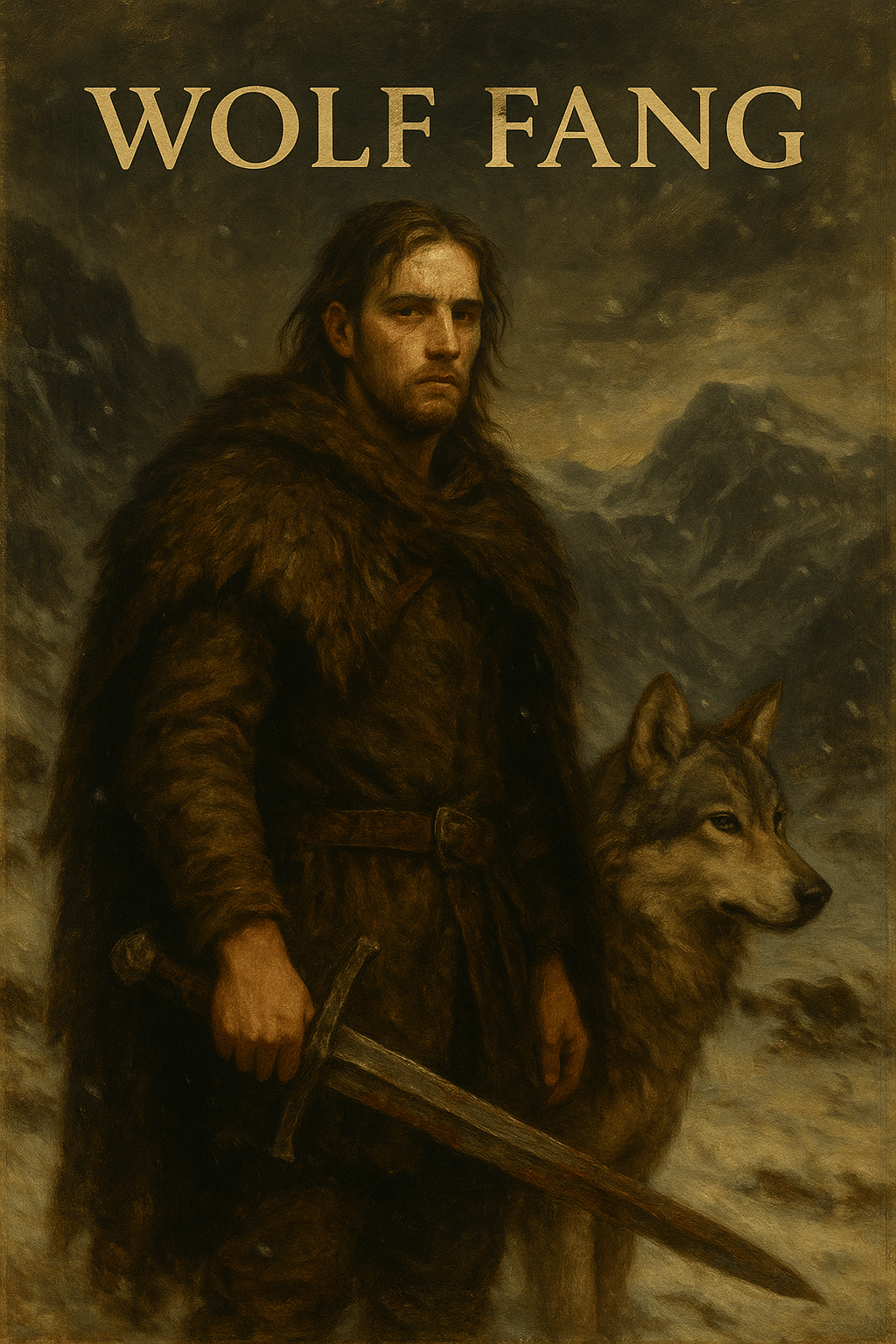
The snowstorm had passed, leaving behind a silence as heavy as guilt.
The order had come swift and clear: join forces with two other units and intercept a group of raiders who had attacked northern supply lines and fled west, toward an abandoned border-fort known as Varrgard’s Spine.
To most, it was a mission of routine.
To Eirik, it stank of politics.
He rode ahead of his men, eyes scanning the ice as if it might confess the truth. The tracks were recent, too clean — almost guided. The signs of battle staged. Burned carts, but untouched rations. Slaughtered guards, but untouched weapons.
When they found the raiders three days later, huddled in a frozen gulley… something was wrong.
They died too easily.
Not seasoned killers. Not even fighters. Just deserters. Poorly armed. Terrified.
Eirik found letters on one of them.
Sealed with Norvhar wax.
Inside, instructions: “Maintain the illusion. Return with bodies. Leave the rest.”
And beneath the signature — a familiar crest.
It was a commander Eirik had once reported to, years ago.
They arrived at the border-fort under a moonless sky.
No guards. No patrols. Just stone and shadow.
Inside, there was no sign of the ‘raiders’ they were told had taken refuge.
What they did find, chained in the lowest levels, shattered what little Eirik had left of belief in Norvhar’s crown.
Prisoners.
Mutilated.
Tortured for information they never had.
Many were former soldiers — men Eirik had trained with, fought beside in the Wolf Trials. Some were younger recruits, too green to be threats. Others were civilians — accused of speaking too much or being in the wrong place at the wrong time.
One of them, with both hands crushed and eyes torn out, whispered:
“They told us we were enemies of the kingdom… for knowing the wrong name.”
Among the loot stored in the fortress:
Imperial-grade weapons. Freshly minted blades. Sealed crates bearing the sigils of high command.
The fort wasn’t a haven for raiders.
It was a black site, used by corrupt officers to eliminate threats, fabricate enemies, and profit from fake wars.
Eirik said nothing.
He climbed the tower.
Raised the horn.
And the wolves howled.
The men who followed him did not question his rage. They had seen the corpses. Heard the sobs. Smelled the stench of rot and deception.
Eirik led them through the gates like death incarnate.
No quarter. No mercy. No hesitation.
Steel ripped through flesh. Doors splintered. Commanders begged for explanations they had long stopped deserving. Blood froze on the stone floors, smeared by boots and clawed by desperate hands.
When it ended, the fires of Varrgard’s Spine burned high into the sky, a pyre visible for miles.
The response from Frosthavn was immediate.
A decree. A proclamation.
“Commander Eirik Skallheim is hereby exiled from the armies of Norvhar, for the unlawful massacre of military personnel and destruction of crown property.”
No trial. No questions.
Only silence from the high halls, and coins handed to bounty hunters.
To them, he was a rogue officer. A killer. A traitor.
But to those who fought beside him, who saw what he saw—he was the only one left who still remembered what strength truly meant.
He left his command. Abandoned his quarters.
Took only the pelt of the first wolf he ever slew.
He said nothing to his men.
He simply walked north, toward the glacier plains. Alone.
A warrant was signed.
A bounty placed.
But not a single soldier was sent to claim it.
And within five days, they began to disappear.
One by one, two by two, entire squads vanished from the barracks.
Until one evening, by a bonfire deep in the wilds, they found him again.
Twenty-seven men and women.
Veterans. Scouts. Even civilians.
Those who had fought beside him.
Those who had been protected by him.
They knelt before him — not out of worship.
But of shared conviction.
“We follow the Fang,” said Varn, the scarred archer.
“No more kings. No more priests. Only the strong.”
Eirik said little.
But for the first time in his life, he spoke not to intimidate, but to lead.
“We are not an army,” he said, standing before them with a bloody crescent moon behind his back.
“We are not saviors.”
“We are what comes when the realm forgets its teeth.
We are what follows betrayal.”
“You will bleed.
You will suffer.
But if you endure — then nothing will break you again.”
The campfire crackled.
And in the morning, they burned the old banners and carved new ones: a wolf’s fang drawn with ash and blood.
The Fangs of the Wolf were born.
In the years that followed the fall of the Last Order, the name Wolf-Fang spread like wildfire across the frozen reaches of Norvhar and beyond.
Eirik and his growing warband — now calling themselves the Frostfangs — became synonymous with efficiency, brutality, and incorruptible purpose. They took contracts that others would refuse. Raiding undead strongholds, wiping out entire packs of snow-trolls, ambushing southern tax envoys crossing the mountains. But unlike most mercenaries, Eirik demanded no luxury. Payment came in steel, supplies, and silence.
Every campaign served a purpose: to sharpen the pack, to weed out weakness, and to remind the North that strength was still alive — even if it lived outside their corrupt keeps.
The Frostfangs quickly earned a reputation not just for their combat prowess, but for the strange discipline they followed. New recruits were never welcomed — they were watched. Mimicry was expected. Survival was the test. Those who lagged or questioned orders were ignored at best — or cut down at worst.
Eirik gave few speeches. When he did speak, his words were forged like blades: short, cold, and unquestionable.
“Strength needs no permission.”
“If you must ask what is allowed, you are not ready.”
“Your worth is proven by the blood that stays inside your body.”
Despite his cold nature, those who survived under his banner grew fiercely loyal — not out of affection, but from shared ordeal. They followed him not because he asked them to, but because his presence made the path forward undeniable.
Their campaigns were as varied as they were bloody.
- In the Driftlands, they were paid to crush a tribe of snow-marauders. Eirik turned the tables by infiltrating the tribe’s camp disguised in stolen armor and beheaded the chieftain before dawn. The rest scattered without a fight.
- In Grendel’s Vale, they purged a forgotten fortress overrun by plagueborn — half-mad, half-dead remnants of a cursed Norvhar battalion. Eirik torched the entire keep with oil and iron, locking the gates behind him until the screaming ceased.
- In the city of Kaerharth, they dismantled a corrupt militia that had been exploiting starving villagers. The Frostfangs left behind crates of stolen grain instead of demands for coin.
But with each mission, conflict with Norvhar’s military increased. Bounties were placed on Eirik’s head in hushed whispers. Some commanders feared his growing legend. Others hated him for exposing their failure by simply succeeding.
And Eirik began to notice the deeper rot.
Supply lines stretched thin not because of war, but because noble caravans rerouted them. Taxes were raised while villages froze. Conscripts were taken by force, then left to die on pointless patrols. Every time he passed through a ruined hamlet or heard of a child dying in the frost, he remembered his brothers — pale and breathless in the snow. His sister, sold for scraps. His parents, gone without farewell.
“This is the price of weakness,” he said one night, gazing into a campfire surrounded by silent warriors.
“They cry for kings, for gods, for mercy. But no one comes. Because mercy is for the dead.”
It was in the third winter after the Last Order that Eirik finally spoke what had been building in his soul.
They had just completed a contract — a brutal one. A Norvharian border town, choked by bandits and abandoned by its own garrison, had hired the Frostfangs in desperation. Eirik and his pack cleansed the streets with steel and fire. But the town was barely more than ash and children by the end.
He stood atop a broken well in the center square. Snow fell quietly as he looked over the silent crowd of survivors and warriors alike.
“Norvhar doesn’t deserve our blood,” he said. “Its lords will only feed on our strength until we are bones like the rest.”
He let his voice linger in the wind.
“The South waits. Gold, war, enemies worthy of death. If the North wants to rot — let it. We will not.”
No one cheered. There was only the sound of leather tightening and weapons being packed. For the Frostfangs, this wasn’t a choice. It was instinct.
They turned south the next morning, leaving behind the empire that had betrayed them.
The South was warmer, louder, and more alive than the frostbitten wilds of Norvhar — but to Eirik Skallheim, it reeked of softness.
Cities like Durathen, Kaelyr, and the outposts of Eldoria’s borderlands were bastions of gold, marble, and polished order. But beneath their luster, he saw the same patterns that had shattered Norvhar: fat nobles wrapped in silks, selling titles in back rooms; soldiers trained for parade but not for battle; mercenaries more concerned with coin than victory.
The Frostfangs cut through the southern chaos like a serrated blade.
Within two years, their name had eclipsed nearly every other warband in the Free Cities and frontier kingdoms. Word spread of their discipline, of how they moved and struck like a single creature. Lords began requesting them by name — not just to guard caravans or patrol borders, but for war.
They served in the Battle of Valemarch, where monstrosities summoned from forbidden rites tore through battalions. While other units broke rank and scattered, Eirik led his warriors in a coordinated counteroffensive that silenced the horrors in under an hour.
They fought in the Crimson Quarry, where a cult had unleashed chimeric beasts across the trade routes. The Frostfangs tracked, cornered, and eradicated them, dragging their mutant corpses through the gates as proof.
They were even paid by the Mage Circle of Aetherhymn to cull rogue orc tribes that had crossed the southern steppes — a campaign Eirik executed with brutal precision. No civilians were touched. No captives were taken. Only heads, left in rows along the cliffs.
And yet…
None of it brought peace.
Every battlefield felt the same.
Every warlord bled like the last.
Every victory tasted of ash.
“They are all soft,” Eirik muttered one night, sharpening his axe beneath a lone pine tree overlooking a battlefield smoldering with the corpses of beasts and men.
“North. South. Gold or snow — it makes no difference.”
He had once blamed Norvhar’s decay on its people. But now he saw that weakness was not a northern curse. It was a sickness in the soul of humankind.
He saw it in the eyes of noble commanders who flinched at the sight of blood. In generals who watched soldiers die while writing poetry in their tents. In mercenaries who laughed as they looted burned homes.
It exhausted him.
He no longer cared for riches or renown. He no longer savored the fear in his enemies’ eyes. What he sought now was challenge. He began to seek out missions others refused — not for coin, but for the chance to sharpen his warriors and silence his mind.
The more impossible the odds, the more eager he became.
Frostfangs began taking only contracts that others deemed suicidal: hunts for corrupted beasts in haunted woods, deep-raid exterminations in daemon-touched ruins, clandestine eliminations of traitorous captains too powerful to touch through diplomacy.
They did not always succeed easily. Sometimes they limped back with fewer men. But they always returned.
And those who did return followed Eirik with devotion. His silence spoke louder than any general’s orders. When he rose, they rose. When he marched, they marched. They knew he would never send them where he would not go first.
Still, the dreams returned.
He would wake in the dead of night — sweating, breathing heavy, hand on the hilt of his blade — haunted not by monsters or battlefields, but by Norvhar.
He saw it as it could have been.
Not the frostbitten ruins governed by cowards. But strong. Disciplined. Unyielding.
He pictured great halls filled not with gold and soft kings, but with warriors tempered by hardship. Villages defended by fighters trained from youth. No more crying children in the snow. No more hungry mothers bartering their bloodlines.
A real North.
“It could be remade,” he whispered once, when alone.
“Not cleansed — rebuilt. If I had the men… If I had the time…”
It was foolish. Dangerous. He knew this. Yet with every contract completed, with every soft lord exposed, the thought returned stronger.
He began to chart maps during his rare moments of rest. He marked the forgotten passes into Norvhar. He traced the old roads that had long since disappeared beneath ice.
He kept those maps hidden.
Not because he was ashamed.
But because some part of him was beginning to believe that it wasn’t a dream anymore.
Though they were known across the Free Cities as the most effective warband for hire, the Frostfangs were no polished legion. They were a storm of steel and fury — more akin to a pack of wolves than a regiment.
They fought bare-chested, painted in ash, their cloaks of snow-wolf hide stained with old blood. In battle, they shouted war chants in old Norvharan, clashed blades even amongst themselves in the heat of frenzy, and tore through enemies with a brutality that left entire towns whispering of monsters rather than men.
To their commander, this was not a weakness.
To Eirik Skallheim, this was the strength of his warband.
Let the southerners cringe and whisper of savagery. Let the noble generals frown at the lack of etiquette or military polish. When the walls broke and the tide of battle turned, it was not decorum that won wars — it was fury. And none knew it better than the men who followed Eirik.
Among the Frostfangs, a few began to stand apart — each leading their own cluster of wolves, each shaped by Eirik’s unspoken creed, but bending it to their own ways.
Varrek One-Ear, the berserker. A former pit fighter exiled from Norvhar, he was the loudest, wildest, and most feared among the Frostfangs. He wore the jawbone of a direwolf across his shoulder, and led the vanguard in nearly every charge. His followers respected no tactic but overwhelming aggression.
“Fear is a leash,” Varrek once said. “Break it, and bite.”
Kaela Ash-Mouth, the tactician. Once a scout of Eldoria, she had been left for dead after a failed expedition. Eirik had found her and offered her a blade. She rarely spoke, but her mind was a steel trap — quick, cold, and calculating. Her men followed formation and flanked with precision. She kept to herself, but some said she was the only one Eirik ever truly listened to.
Thorn Half-Blood, the bridge between madness and method. Born of a Norvharan woman and a southern mercenary, Thorn had grown up in both worlds and belonged to neither. His loyalty to Eirik was unshakable — almost religious — but his way of leading was erratic. He’d pray before battle, then slit throats like a demon in heat.
Their differences sometimes led to fights, but none ever dared challenge Eirik’s place.
“A wolf does not rule the pack with words,” Thorn once said, wiping blood from his blade.
“He rules it by surviving.”
Four years into their campaigns in the South, the Frostfangs had become more than just feared — they had become hated.
Among nobles, the name was spat with disdain. Among peasants, it was uttered with both reverence and terror. Their methods were efficient, but their rage was indiscriminate. The southern troops who fought beside them often found themselves unnerved by the bloodlust, by the guttural roars in battle, by the ritual fights held in camp.
Worse still, some Frostfangs began to take liberties. Brutality became ease. Executions replaced warnings. The line between soldier and raider blurred. To many, the southern cities were weak, and weakness deserved only contempt.
Xenophobia festered in their ranks — not by design, but by the weight of resentment and isolation.
“They’ve never starved through a Norvhar winter,” muttered Varrek.
“Let them cry about cruelty. They’ve never bled for fire.”
Eirik said nothing. But his silence was not approval — nor was it denial. He watched. He measured. And deep within, the old ache of Norvhar grew sharper.
It was late autumn when the messenger came.
He wore a cloak of velvet green, a brooch carved with the lion seal of Valthenor — richest of the merchant cities, its coffers deeper than the vaults of kings. His horse was finely bred, his voice refined. But there was a glimmer of fear in his eyes when he approached Eirik’s tent.
The tent was thick with the scent of leather, iron, and damp wolf pelts. Braziers hissed in the corners as fire met blood-crusted steel. Eirik sat in silence at the center of the war table, the pelt of the great snow-wolf draped across his back like a mantle. Around him stood his closest — the three Fangs of the pack.
Varrek One-Ear lounged on a crate, sharpening his axe with quick, harsh strokes. His eye never left the emissary.
Kaela Ash-Mouth stood like a ghost in the shadows, arms crossed, silent and unreadable as ever.
Thorn Half-Blood leaned against a pole, thumbing his prayer beads, lips moving in whispers.
The emissary of Valthenor shifted uncomfortably. His cloak was too fine for the bloodstained mud beneath his boots. His jeweled ring clinked nervously against the goblet he’d barely sipped.
“We’ve heard of your reputation,” he began, voice strained with the effort of keeping calm. “Efficiency unmatched. Victories… unorthodox, but absolute.”
No one replied.
He cleared his throat and pressed on.
“Valthenor faces a grave threat. The Imperial Legion of Caltheron moves to claim the free cities. We have gold — enough to fund a dozen campaigns. But more than that, we offer a cause.”
Eirik’s eyes rose slowly. Piercing. Cold.
“You think I care for causes?”
“You should,” Kaela said softly, breaking her silence. “We fought for gold before. It bought us blood, not peace.”
“Peace is for sheep,” growled Varrek. “But the Legion… now that is a hunt worth our blades.”
Thorn chuckled darkly.
“I’ve prayed for a worthy death. Perhaps the Empire will provide.”
The emissary seized the moment.
“The Legion is disciplined. Ruthless. They crush all opposition, bring law and order at the edge of a blade. If they take Valthenor, the other cities will follow.”
“And?” Eirik said, rising. The weight of his presence silenced even the wind against the tent.
“Let them. Why should we care who wears the crown while the people starve the same?”
“Because they will erase your kind,” the emissary said sharply. “Your way. They will not tolerate mercenary lords with northern savagery and unchecked power. They will hunt you to extinction.”
A long silence followed.
Then Eirik stepped forward.
“Good.”
His voice was calm. Measured.
“Let them come. Let them try. If we are to die, let it be as wolves, not chained dogs.”
“Then you accept?” the emissary asked, swallowing hard.
“I don’t fight for your city,” Eirik replied. “I fight to measure my steel against something that still has teeth.”
He turned to his warband.
“We march when ready. Valthenor will get its blades. And the Empire…”
He paused.
“Will learn the sound of howling in its bones.”
The emissary left pale, but satisfied.
Outside, the Frostfang camp stirred — men sharpening weapons, singing old Norvharan songs, spirits high with the promise of blood.
They were not soldiers. They were storm incarnate.
And they were moving south — not for gold, not for loyalty…
But for the thrill of the hunt.
That night, the Frostfangs began to march.
No horns. No banners. Just silence and snow underfoot.
Eirik led the column, his wolf-pelt cloak fluttering behind him, eyes fixed ahead. Not on the gold — not on the politics — but on the challenge.
A true battle. A chance to see if the legends of the Legion were true.
And maybe, just maybe, to see if the fire in his blood had not dulled after all.
“Let’s see what the South truly hides behind its walls of gold.”
 Chronicles of Astravara
Leave a comment