
Where gods whisper and empires rot.
Reading Time:
Krag’Dun, once known as the Worldforge, was a radiant jewel among the dwarven strongholds. Its blackstone walls shimmered with ancient runes, and its forges roared with the eternal flame of Vulkanar. The grand halls, carved deep into the mountain’s heart, echoed with songs of victory and the thunder of hammers shaping legends.
But now, those echoes had faded.
There was a time when Krag’Dun stood not only as a bastion of dwarven strength but as the very heart of their identity — a fortress where each clang of the hammer echoed pride, and every spark of the forge was a prayer to Vulkanar, god of fire and creation. Warriors and smiths alike carried runes not only etched on steel but in their souls, bound by purpose and a culture of resilience.
But those echoes had long since dimmed.
The grand forges still burned, but not with the brilliance of old. Flame turned to smoke, smoke turned to ash. The once sacred art of smithing had devolved into rote repetition — mass-producing trinkets and cheap blades for merchants more concerned with silver than sanctity. Innovation was discouraged, seen as wasteful risk. The elders no longer praised ingenuity or bold craftsmanship; they rewarded the predictable, the profitable, the polite.
Merchants ruled the undercurrent of Krag’Dun now — not through force or lineage, but by hoarding wealth and influence. Corruption, once a whisper in the tunnels, was now a booming voice in the Council of Stone. Deals were made behind closed doors, runes of approval bought with favors instead of honor. And the people… the people were beginning to break.
Ale flowed like a river through every corner of the city, not as celebration but as escape. Taverns were always full, not of song, but of slurred bitterness and vacant eyes. It was said that for every newborn beard, there were two drunk hands grasping at a forgotten glory. The young no longer sang the Songs of Fire — they mocked them. The old, once revered, were now reminders of failure, burdened with tales no one wished to hear.
In the lower districts, fights broke out not from hatred but from boredom, from helplessness, from the slow realization that Krag’Dun no longer built anything worthy of memory. The soldiers, proud warriors once forged in the crucible of the Deep Roads, were reduced to peacekeepers for petty disputes. They answered to scrolls, not instincts — bound by bureaucracy that turned even justice into paperwork. Many had lost the will to care, enforcing orders with empty eyes and heavy fists.
And the Deep Roads, once the sacred arteries that pulsed life and trade across the mountains, were now tombs. Goblins multiplied in the silence, feeding on what the dwarves had abandoned in fear. Corridor by corridor, outpost by outpost, Krag’Dun pulled back into itself, as if afraid of its own past.
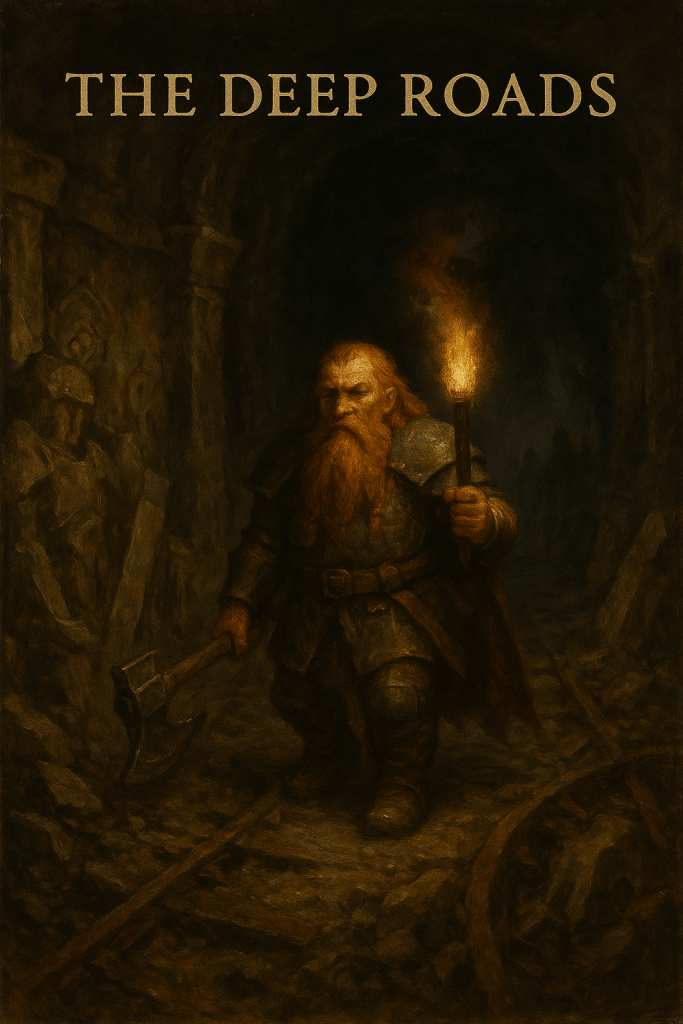
Tharik Ironstone was the embodiment of a people’s rage, trapped on the threshold of oblivion. Tall for a dwarf, with scarred arms and a nose forever crooked from old brawls, he was what remained of a warrior lineage.
At eighty-seven, he was no youth, but neither was he old. For a dwarf, he stood at the beginning of the middle — nearing two-sixths of a long lifespan. But his soul felt aged beyond counting. He had seen the spark leave the eyes of his kin one by one, seen honor traded for convenience, strength for comfort, bravery for excuses.
He walked the streets of Krag’Dun daily, not as a citizen but as a ghost among ruins still inhabited. He passed beggars that once bore the insignia of the Legion, blacksmiths who now mass-produced knives for caravan guards, children who no longer asked to be trained, but to be entertained.
And every night, he sat in the taverns, surrounded by the hollow laughter of those too tired to cry. The soldiers around him drank not to celebrate but to forget — forget the orders that made them complicit, the faces of citizens beaten because of protocol, the friends they watched become cold enforcers.
Tharik had once been a hammer in the hand of the mountain. Now he felt like rust, even Tharik, famed for his stubbornness, was sinking.
His days were spent patrolling empty corridors. His nights—drowned in bitter ale at the Smoldering Anvil Tavern, alongside other disillusioned soldiers. They mocked the elders’ squabbles, toasted to forgotten battles, and swore empty oaths of a final war that would never come.
“We’re already buried, my friends,” Tharik growled one drunken evening. “This mountain will be our tomb.”
The choice came to him not with ceremony, but in a whisper — a recruiter’s poster pinned on a cracked wall by the outer quarter. The Legion of Death was seeking volunteers. No medals, no songs. Just a promise: darkness, danger, and a chance to matter.
He stared at it for hours, the ink half-faded, the parchment curled with age.
It did not promise glory. But it promised a fight.
And to Tharik, that was enough.
In the deepest corners of dwarven memory, the Legion of Death once stood as a symbol of defiance. Forged in the era of the Daemon War, it was a shield against the corruption crawling through the Deep Roads, a bulwark manned by the desperate and the damned. They held the tunnels when kings faltered and nobles fled. Their creed was forged not in honor, but in necessity — to fight where no sane warrior would tread.
But time had not been kind to the Legion.
Now, it was little more than a name whispered in unease — a place where dwarves went to disappear. Veterans who refused to grow old quietly. Criminals offered one last chance in place of execution. Madmen obsessed with old songs of valor. And those like Tharik — broken, bitter, and without a place in the world.
Most in Krag’Dun viewed the Legion with a mix of dread and disdain. Parents threatened disobedient children with its name. “Careful, or you’ll be sent to the black armor.” Recruits who failed to pass muster in the regular army were sometimes dumped into the Legion as punishment — or to be forgotten. And many simply refused the call. Better to rot in a cell than face what lurked in the Deep.
Tharik did not refuse. He signed his name with fingers still sticky from spilled ale.
The march to the Black Gate — the hidden passage that led to the Legion’s stronghold — was long, cold, and silent. The dozen other recruits shuffled beside him, most in chains. A few, like Tharik, walked freely, but with the same blank resignation in their eyes. These were not soldiers. They were discards.
The entrance to the Legion’s training ground, Hall of Obsidian Silence, was a wound in the mountain. Beyond it, there was no sky. No song. Only shadow and stone.
There, Tharik learned quickly what made the Legion different.
Gone were the soft teachings of Krag’Dun’s peacekeeping militia, with their scrolls of bureaucratic protocol and ceremonial stances. The Legion trained for one purpose: survival. Every day began in darkness and ended in exhaustion. Recruits fought blind, bled together, and were punished together. Pain was the only lesson that mattered. Those who couldn’t keep up were left behind.
At first, Tharik resisted. He cut corners. He faked illness. He volunteered for latrine duty just to avoid drills. His laziness was not out of cowardice, but from that same heaviness he carried since childhood — the dull ache of a soul that no longer believed effort would change anything.
But the Legion did not allow such beliefs to fester.
On the fourth week, a recruit from the northern mines collapsed from heat stroke. No one helped him. They weren’t allowed. Tharik watched as the others finished the obstacle course and carried on, faces numb. That night, the recruit was gone — sent back? Executed? No one said. No one was allowed to ask.
The rules were simple:
“You are no longer a name, only a purpose.”
“Your past is ash.”
“Your brothers are your shield. Their blood is your price.”
And above all — “Speak of your crimes, and your tongue will be cut.”
Only those who had volunteered, and had no blood-stained hands, could keep their names.
Tharik kept his name. But every day, it felt heavier.
It was only when the days blended together — when his sweat mixed with that of those around him, when he carried another recruit half-conscious across a flooded shaft, when he buried one of his own beneath stone — that something began to shift in him. Not joy. Never joy. But… purpose. A quiet understanding that he was no longer standing still.
And always, watching them from the high ledge of the training hall, was Commander Hela Brokenrock.
She was legend and nightmare made flesh.
Once a warmaiden of the elite Hammerguard, she had walked into the Legion decades ago, already scarred by battle and disillusioned by politics. Her blonde-red hair was tied back in a braid like a length of rope, and her face was carved by the years of war — not old, but unyielding. A black eyepatch covered her left eye, taken by a troll’s hook in the tunnels of Dravengar. Her remaining eye burned with judgment.
She spoke rarely. But when she did, it was final.
“You are not here to be men,” she said on the first day. “You are here to be weapons. And I only keep the ones sharp enough to kill.”
No one dared test her. Not after the first recruit who tried to run was thrown from the training shaft by her own hand — a warning that still echoed in the rock.
Even before the Legion, Tharik Ironstone had already become a ghost in his own home.
Born into one of the old bloodlines of Krag’Dun, the Ironstone name once echoed in the council chambers and war halls, a lineage of proud warriors and shrewd politicians. But in the age of decline, it had grown soft — rich on mining contracts, tangled in merchant alliances and noble posturing.
Tharik never fit their mold.
Where his elder siblings schemed for political marriages or paraded in the Royal Guard with polished armor and dead eyes, Tharik wandered. He listened to old stories and slept through council hearings. He skipped combat drills to get drunk with tavern veterans, those who remembered what real war smelled like. He spent coin faster than he earned it, and rarely cared to explain why.
His family had long since run out of patience.
“You shame the Stonefury name,” his mother spat the last time he returned home after disappearing for weeks. “If you will not wear a uniform or hold a seat, then you are nothing.”
And so they cut him off.
At seventy, with no title, no income, and mounting debt, Tharik faced a grim reality. In dwarven caste law, a dishonored son without support who sank deep enough into debt could be legally claimed into indentured servitude — slavery in all but name. Already, the offers had begun to whisper through tavern halls. Mine lords who smelled blood. Bailiffs who watched with greedy eyes.
The only path left was the one he hated: enlistment.
But even then, Tharik chose the laziest route — the Peacekeeping Force. A hollow relic of a once-proud militia, now reduced to bureaucracy and ceremonial patrols. Their armor shined, but their blades were dull. Their duty was filing reports on drunken brawls and escorting merchants through safe zones.
Tharik fit right in.
He filed paperwork late, skipped mandatory lectures, and pocketed rations for beer. The job protected his name and kept him out of debtor’s prison — just enough stability to keep falling without crashing.
Until he saw what the Peacekeepers had become.
One evening, he watched a veteran sergeant order his men to ignore a goblin attack on a miner outpost, citing jurisdictional boundaries and “budget constraints.” The outpost was razed. No one was punished. The next day, a memorial plaque was commissioned. The sergeant was promoted.
Tharik filed his resignation.
He didn’t tell anyone where he was going when he signed up for the Legion of Death. He just walked into the recruiter’s tent, eyes bloodshot and heart empty, and handed over his name.
The Legion did not care who Tharik had been. They did not care about his family or his debts. Only that he could stand, fight, and carry others.
Excuses didn’t work here. Laziness earned punishment not just for him, but for the entire squad. And in the Legion, punishments were collective.
If Tharik missed a mark in weapons drill, everyone ran the tunnels. If he mouthed off to an officer, everyone scrubbed the latrines with bare hands. If he slacked in combat training, others bled because of it.
At first, they hated him for it. He became the weak link, the loudmouth, the drunken fool dragging them all down. He wore that hatred like a cloak, pretending it didn’t bother him. But in the dark, alone after drills, he heard them grumble, curse his name, swear they’d break his nose in his sleep.
One night, they nearly did.
He woke to fists. Three recruits — silent, grim — took turns striking him. They didn’t speak. They didn’t gloat. When it was done, they left. No one reported it. No one had to.
The next day, Tharik didn’t skip training.
Not because he wanted to improve. But because he realized, for the first time in years, his actions had consequences. Here, what he did mattered. It shaped how others suffered, how others endured.
It wasn’t morality. It wasn’t redemption. It was weight.
And over time, he started to carry it.
Not perfectly. He still cracked jokes at the wrong time. Still got the squad into group punishments more than once. Still questioned orders just to spite authority. But when something had to be done — when a tunnel collapse stranded two rookies, or a monster ambush caught them unprepared — it was Tharik who moved first.
It wasn’t leadership by rank. It was instinct. Raw, begrudging duty.
Even the others saw it.
A silent respect began to grow, unspoken but real. They didn’t like him, but they followed. And Commander Hela Brokenrock, ever watchful from her perch above the Obsidian Hall, made sure that any spark of disloyalty died fast.
One afternoon, she summoned them all after a particularly harsh trial in the lower shafts — three had nearly drowned in a collapsed aquifer, and Tharik had led the rescue.
She stood before them, red-blonde braid slick with sweat, eyepatch shadowed.
“You will not survive because of discipline,” she said. “You will survive because you carry each other. You fall alone, you rot alone. You carry your brother, and you live another day.”
Her gaze fell on Tharik.
“No more excuses. No more wasted breath.”
He didn’t nod. He didn’t speak. But for the first time, he looked her in the eye and didn’t turn away.
By the end of their second month, the recruits of the Legion felt invincible.
They had survived bone-breaking drills, tunnel collapse simulations, and weeks of poison resistance training that left their mouths dry and their skin blistered. The morale was high—too high for a group that had never seen true war. Many began to believe the worst was behind them. Even Tharik, though cautious, began to speak more freely, occasionally cracking grim jokes or sharing his rations. Hela allowed the momentary ease, but her silence grew heavier with each passing day.
Then, the bell sounded. A real call. Their first field mission.
They were to descend into Hollow Vein—an abandoned shaft that had gone dark three weeks earlier. Reports hinted at goblin activity: tunnels scoured, miners missing, a stench rising from the depths. No elder dared send regular troops. The Legion was called.
As they marched into the dark, the air turned cold and damp. The light from their lanterns grew distorted as if the shadows themselves pulsed and twitched. Even the bravest among them grew silent.
What waited was not battle. It was slaughter.
The goblins were not as they’d been described in the training scrolls. These were feral, bloated things with flesh in varying stages of rot. Their blood hissed when spilled, filling the air with a sickening vapor. Some wielded crude weapons. Others used teeth. They moved in waves, chittering and shrieking, eyes glowing like coals in the dark.
The formation broke almost immediately.
The first to fall was Brennar—cut down before he even swung his axe. Darrika lost her weapon trying to help him, then vanished into the dark with a scream. Korrin fought like a cornered beast, swinging madly, buying time.
And Tharik ran.
It wasn’t a conscious choice. The panic swallowed him like an avalanche. One moment he was standing shoulder to shoulder with the others, and the next his legs were carrying him through a side passage, lungs burning, heart hammering in his ears. He didn’t stop until the screams were gone.
When the survivors regrouped hours later, they had lost five. Among them were Brennar and Korrin—two of the few Tharik had trusted.
The silence in the camp was suffocating.
Hela said nothing when Tharik returned, his eyes hollow. She didn’t need to. The judgment was in every glance from the survivors. But Tharik didn’t run from it this time. When the commander ordered ten days of punishment detail—no rest, no food beyond hard rations, the worst tasks in the darkest parts of the fortress—he nodded and obeyed.
Not out of pride.
Out of guilt.
The ghosts of Brennar and Korrin followed Tharik into his dreams. Sometimes they screamed. Sometimes they stared, eyes rotted, mouths filled with blood. In those dreams, his legs would freeze. No matter how hard he fought, he couldn’t move.
He stopped drinking.
He stopped joking.
He trained harder than anyone. Not with pride, but obsession. He stayed in the poison resistance baths longer than ordered, gritting his teeth as the foul liquid burned his skin. He volunteered for extra tunnel sweeps. He took the night watch even when his limbs trembled from fatigue.
When others began to recover from the trauma, Tharik didn’t.
But he changed.
He became sharper. Colder. More aware.
Their next mission was a simple supply escort into a compromised storage shaft—but the team was ready this time. Even with goblins lurking, they kept formation. When an ambush came, they responded with steel and discipline. A few were wounded, but none died.
Tharik didn’t lead, but when a rookie froze, he was the first to shove him back into position.
The third mission was worse—recon into a partially collapsed cavern near the ancient breach from the Daemon War. The air was heavy with rot, and goblins attacked in silence, using tunnels above and below. One of the newer recruits, Velm, collapsed after killing a bloated goblin whose blood splashed across his face. He convulsed, foam at his lips.
Tharik didn’t hesitate.
He hoisted Velm over his shoulder and fought one-handed, dragging him back through the narrow paths, ignoring the blood searing into his own skin. He didn’t stop until they were clear.
Later, Hela simply looked at him and nodded.
The first decade passed not in glory, but in attrition.
Tharik Ironstone served without honors, without medals. The missions were not grand battles to be sung in halls, but reclamation patrols through forgotten veins of stone and abandoned fortresses, old tunnels half-swallowed by darkness and rot. They cleared the wreckage of ancient wars, recovered the bones of the lost, and lit pyres where no sun would reach.
His unit, under the direct command of Hela Brokenstone, operated with ruthless efficiency. The commander never offered praise easily, but more than once she allowed herself a grunt of reluctant approval after Tharik’s intuition saved a squad from ambush, or his axe silenced a goblin before its shriek could rally a pack.
“You’re not the same sluggard who stumbled into my camp a decade ago,” she once said, watching him tend to his gear in silence.
“But you’re still trouble. Just the kind we need.”
Tharik said nothing. He never did when praised.
He fought like a machine, deliberate and unrelenting. But never reckless. He knew how fast a tunnel could become a tomb. He had seen it.
He kept a tally—not in marks or notes, but in silence. For every dwarf he watched die, a little more of his warmth faded. He buried his friends without tears. He slept with his boots on. He dreamed only of screams.
Still, he endured.
And that, in the Legion, was a kind of sainthood.
In his eleventh year, Tharik was reassigned.
He was transferred from Hela’s line company to the Incursor Division, a grim fellowship within the Legion tasked with sabotage, deep recon, and extermination missions beyond mapped territory.
Few returned from those.
The training was harsher. There was no glory in these assignments. No formations, no banners, no songs. Only whispered objectives and silent paths into enemy tunnels. Every mission felt like walking into a crypt and carving your name on the walls before seeing what would try to kill you.
The blood of goblins no longer hissed in the air—it clung to the lungs, seeped into the beard, burned in the eyes.
Weeks would pass in the dark.
And the dreams came back.
After over a decade of sobriety, Tharik began to drink again.
Not to forget. Not to celebrate. But to flatten.
He drank just enough to hold back the edge. Just enough to blur the memories of Korrin’s scream. Of Brennar’s last breath. Of every comrade torn apart in those black corridors while he was too slow, too tired, too afraid.
He never drank to pass out. That would be weakness.
Only enough to function.
His squad didn’t ask questions. The Incursors all had their poisons—some chewed bitterroot to dull pain, others murmured prayers to gods no longer named. Tharik drank. He cleaned his blade with the same ritualistic care he once used to light the funeral pyres. He kept the flask tied beneath his armor, close to the heart.
Sometimes, after a long march, he’d sit alone and whisper to ghosts.
Sometimes they whispered back.
Hela visited him once, deep in the staging tunnels where the Incursors gathered.
She looked older. Harder. But still her voice carried steel.
“I hear you’re keeping the young ones alive. Just barely.”
She paused, eyeing the flask on his belt.
“I also hear you’re drinking again.”
Tharik shrugged, not meeting her gaze.
“I keep it measured,” he said simply.
“If that’s your concern.”
“It’s not,” she replied.
“I’ve lost better men sober. Whatever keeps your axe swinging.”
A beat passed between them. Then she added, quieter:
“Don’t forget who you are under all that ash, Tharik.”
He gave no answer. She left without another word.
 Chronicles of Astravara