
Reading Time:
The scent of spices was a constant reminder of the life Saharaa Vel’Rash once knew. Cinnamon, saffron, cardamom, and pepper danced in the air, carrying her back to the exotic trade routes she had only heard of in stories told by her father. Reylos Vel’Rash was a skilled merchant, known for his sharp tongue in negotiation and his courage in exploring treacherous routes.
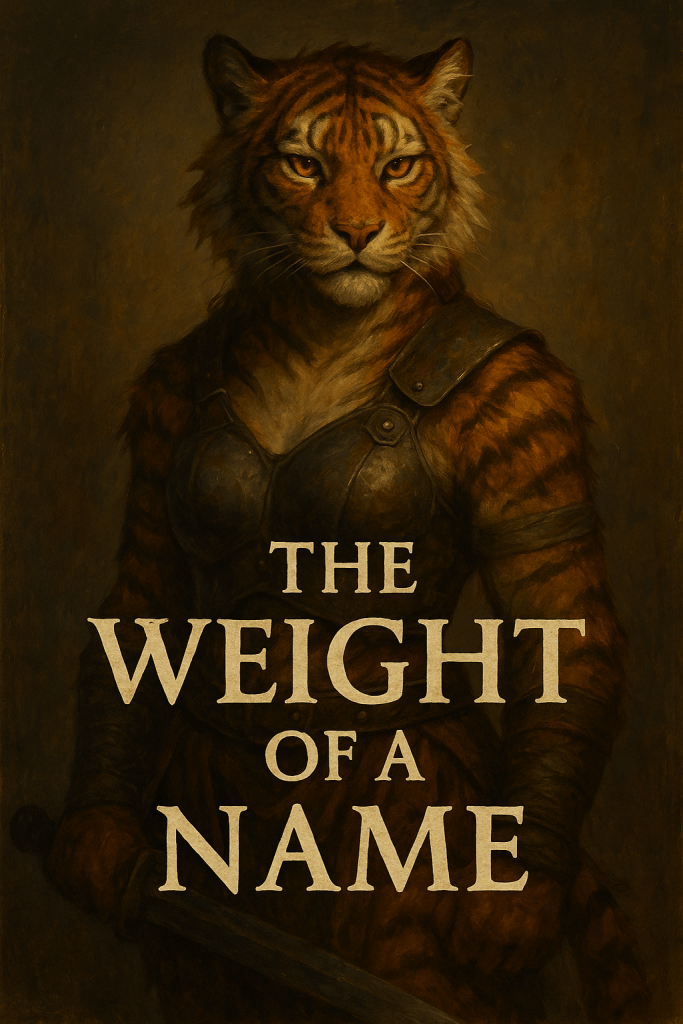
To Saharaa, life seemed like a vibrant tapestry, woven with threads of adventure and promise. She was a Ruh’rashi, belonging to the feline-blooded animalkin race. Her skin was a soft golden velvet, marked with dark stripes reminiscent of the tigers from distant jungles. Her amber eyes shimmered with unrelenting curiosity, and her tail moved subtly, betraying her emotions.
Since childhood, Saharaa dreamed of following in her father’s footsteps, of exploring the world beyond the bustling markets of Valthenor. She had always admired the way her father walked through a market—head held high, tail swaying with calm confidence, every word measured like the weight of gold. Reylos Vel’Rash was not merely a merchant. He was a Ruh’rashi of ancient blood, a man who bore the title with honor, whose stripes marked more than his skin—they were the memory of survival and a badge of silent strength.
He believed, above all else, in honor—in the sanctity of an agreement sealed by word and hand, and in the duty of a father to leave behind more than stories.
Their mornings together were filled with lessons in bargaining, in reading lies through twitching ears and shallow breaths, and in knowing the value of silence. Reylos taught her how to evaluate goods, how to twist an offer just enough to provoke greed, and how to walk away when pride became more valuable than coin.
“Gold comes and goes, little claw,” he used to say with a smirk, ruffling her ears. “But your name? That’s carved in blood and spoken in trade long after you’re gone.”
He was clever, no doubt—but his honor often made him too trusting. There were years when coin slipped through their fingers like sand, when bad deals nearly broke them. Yet somehow, Reylos always clawed his way back—through charm, wit, and an uncanny ability to make friends even among rivals. “They want to see me fall,” he laughed once. “But they enjoy the show too much to let me vanish.”
Despite the scars of trade, he pampered Saharaa like a treasure. He brought her rare fabrics to play with, spices to learn by scent, and maps to trace with her claws. As she grew, so did her pride. And yet, beneath his laughter, she began to see the signs of time catching up with him—the way he stared longer at the family ledger, the quiet sighs when he thought she wasn’t looking, the late-night conversations with himself.
“I’m not a young tiger anymore,” he muttered one dusk, sharing sweet wine with her under the stars. “One day I’ll be gone, and all this… all this must be yours. A proper fortune, a good name. Freedom, not just survival.”
He never forced her to follow his path. The Ruh’rashi valued freedom above all, after all. But he gave her the tools to make her own—sharpened not just by instinct, but by knowledge.
Their people were children of the sun and sand, of jungle and storm, a proud race born from both predator and poet. Ruh’rashi society revered strength and cunning, but did not measure it solely in muscle. A weak warrior was shamed. A foolish merchant—pitied. They cared little for the skin or race of outsiders; worth was proven, not assumed. Yet to them, those who could not rise—who lacked force or cleverness—were lesser.
Slavery, among them, was not viewed as cruelty, but as natural order. “The weak serve,” they said. “So the strong may build.” Entire clans thrived on the labor of captives and outcasts—those who had failed in war, in crime, or in debt. They were not tortured, but neither were they free.
Still, within their own, freedom was sacred. Every Ruh’rashi was born to hunt, to trade, to fight—to choose their path, and bear its weight. Saharaa had grown hearing tales of warrior-merchants who slew beasts in the day and sold their bones by night. Of queens who ruled markets sharper than any blade.
And Reylos wanted nothing more than for his daughter to outshine them all.
“I gave you claws,” he told her once. “Now I want to see if you’ll use them for gold or for glory.”
When Reylos finally invited Saharaa to join him on an important negotiation, it felt as though her dreams were about to take shape.
The meeting took place in a grand mansion on the outskirts of Nyrakali.
The mansion was too polished.
From the moment Saharaa and Reylos stepped through the gilded arch of its entrance, an unease settled over her like dust on silk. The floors were polished marble, etched with imperial patterns unfamiliar to Ruh’rashi hands. Tall mirrors reflected distorted versions of themselves—father and daughter draped in desert-born linen, striped skin, sun-kissed grace—trapped in a palace of glass and gold.
Their host arrived with a slow, deliberate gait.
“Dren Malak,” he introduced himself with a short bow. His voice was smooth, his smile carved with purpose. Human. Imperial. Dressed in layered silks of royal blue and crimson, rings gleaming like eyes on every finger, he gave the impression of a man who wanted to be seen, weighed, envied.
Reylos’ tail flicked once in irritation, but he offered his hand politely. “Reylos Vel’Rash. And this is my daughter, Saharaa.”
Dren’s cold gaze lingered a second too long on her.
“A pleasure,” he said, but it felt more like an evaluation.
They were ushered into a chamber where a feast had been prepared—too rich, too heavy. Exotic fruits, roasted meats, and wines imported from the Imperial core lined the table, untouched.
Saharaa remained silent, her ears alert to every detail. Her father’s teachings echoed in her mind: When a man offers too much before the bargain is made, he’s not a trader—he’s a spider.
Dren wasted no time with pleasantries. He unrolled a parchment map across the table, pressing it down with gilded knives.
“I propose a direct route,” he said, pointing to a path carved through cliffside territory. “This region is usually avoided by merchants, but the stories are just superstition. We’ll be protected—my men are seasoned.”
He spoke of spice contracts and private buyers in Raktharth, the Ruh’rashi trade capital in the Rakkesh desert. His proposal was vague in its core terms—no names of partners, no documents, only the promise of high returns. Too high.
Saharaa shifted beside her father, tail coiling around her ankle. She felt the lie before she heard it.
“Why us?” she asked finally, her voice measured. “You could afford any merchant guild in Nyrakali. Why choose an independent trader on the brink of debt?”
Dren smiled. “Because I value discretion, and I’ve heard of your father’s skill. Reputation travels faster than coin.”
But Saharaa’s eyes narrowed. That wasn’t an answer.
Reylos hesitated. His hands, usually steady, tapped once against the table. He smelled the trap too—but he also smelled salvation. After two brutal years of drought, failed shipments, and a near-collapse of his spice routes, Reylos was weeks away from formal bankruptcy. The friend who introduced him to Dren—a trusted contact from the House of Voresh—had sworn by the Imperial’s credibility.
And the deal… the deal could bring them back.
“I understand your concerns,” Dren continued. “That’s why I’m paying upfront. Fifty percent before departure. The rest upon arrival in Raktharth. No hidden clauses. No tricks.”
The clink of the heavy coin pouch he dropped on the table was louder than it should have been. The smell of polished metal filled the air—sharp, cold, final.
Saharaa looked to her father, searching his face for resolve. She saw it—and behind it, desperation. Pride made him hesitate. Love made him reach.
“I won’t do this,” she whispered to him in their tongue. “He’s hiding something. Can’t you feel it?”
Reylos lowered his gaze. “I know.”
“Then why—?”
“Because we’re out of time, little claw.”
He straightened, tail flicking once.
“We accept,” he said to Dren, voice calm.
Saharaa clenched her jaw, forcing her expression to remain neutral, just as she had been taught. But inside, her blood boiled.
They left the mansion with a date set, the contract agreed upon, and the journey booked for Raktharth—capital of desert spice and ancient trade. A ship would depart at dawn, carrying them from Nyrakali’s stinking docks to the mainland continent beyond.
Saharaa walked beside her father in silence, the city lights behind them, the scent of salt and smoke in the air.
“You don’t have to like it,” Reylos murmured. “Just trust that I’m doing what I must—for us.”
She didn’t answer.
She couldn’t.
Because trust was easy when the world made sense. But the world was beginning to taste of poison.
The heat hit her first. Dry, golden, and unrelenting.
Raktharth rose like a mirage made stone, towering above the scorched plains of the Rakkesh desert. Minarets carved from red sandstone reached toward the sun, their domes gilded and shimmering like coins in a dragon’s hoard. Banners fluttered from every arch and balcony—each one bearing the sigil of a merchant house, a tribe, or a foreign power trying to leave its mark upon the city of trade.
This was no outpost. Raktharth was an empire of commerce, a sultaned maze of secrets and gold.
Saharaa stood on the deck of the ship as they docked, tail swaying in silent awe. It was her first time on the continent, and the world before her was everything her father had ever promised—chaotic, rich, alive.
Streets burst with noise and color. Spice-sellers shouted from beneath silk canopies, their stalls brimming with saffron, cumin, and crushed ruby peppers. Snake charmers played eerie tunes in the shade of marble fountains. Slave caravans paraded past armored guards, chains clinking beneath veils and heat. Camels, warbeasts, and sand-runners clogged the roads, while glass-eyed nobles watched from shaded balconies behind embroidered drapes.
There were humans, elves, Ruh’rashi, dark elves in gilded turbans, and half-orcs bearing scrolls of sale. Even a white-skinned half-orc sat behind a stall of cursed jewelry, her black eyes glowing faintly beneath her hood. Trade here knew no bounds. Every coin was welcome, every secret had a price.
Saharaa inhaled deeply, the scent of dust and cinnamon filling her chest. So this is the world. For a moment, she forgot why they had come.
Their arrival caused no ripple. Dren Malak had arranged for discrete passage and a temporary merchant license—though he, as always, was absent. In his place came letters, sealed instructions, and a timeline.
“Two weeks of open trade in the Lower Bazaars,” Reylos read aloud. “Then, a delivery of private cargo. Sealed, no inspection. Buyer to be met at the northern cliffs, beyond the city walls.”
The tone was official, impersonal. But the terms were generous.
Too generous.
Still, Reylos, energized by the prospect of rebuilding his fortune, threw himself into the bazaar. Day after day, they unpacked wares: rare Ruh’rashi spices, silk blends, enchanted pottery, and smoked salts from the high dunes. Saharaa, trained from childhood in the art of the sale, held her own among the chaos—haggling, charming, counting.
They made good coin. Better than expected.
And no one interfered.
No mercenaries breathing down their necks. No strange glances. No signs of surveillance.
By the seventh day, Saharaa had begun to relax.
By the tenth, she laughed freely beneath the burning sky, haggling with a Dwarven gem-dealer over flawed rubies.
By the twelfth, she explored the city alone—visiting the Grand Temple of Malkirath, patron god of the Ruh’rashi, and walking the Hanging Gardens of Tal’Veem where assassins once bathed their blades in moonlight.
Reylos noticed the change. “You’ve taken to the sands quickly, little claw,” he said, offering her a cup of chilled date-wine under a striped canopy. “Told you the world was more than dusty docks and bitter debts.”
She smiled back. “It’s more than I imagined.”
But late at night, she still turned the sealed cargo in her hands.
It was heavy, locked, and lined with silvery runes she didn’t recognize. Dren’s instructions had been clear: do not open. Do not question. Deliver.
Reylos assured her it was only a rare artifact. A collector’s item. Legal in some places, frowned upon in others. “No daemon magic. No weapons. Just… valuable to the right buyer.”
But something in her gut twisted.
And she pushed it down.
We made it. Nothing’s happened. Father is rebuilding. I’m finally seeing the world.
What kind of daughter would she be if she kept casting shadows over his only chance?
So when the dawn of the fourteenth day arrived, and they loaded the cargo onto a modest caravan for the final leg of the journey, Saharaa said nothing.
The map directed them northward, along a narrow pass that cut through wind-carved cliffs. It was a route unused by caravans but quiet enough for private transactions. The kind of place a buyer who prized secrecy would favor.
The sun rose behind them as they left Raktharth’s walls, the city glowing like a flame in the distance.
Saharaa rode with her father at the front, the wind brushing over the scarf that covered her muzzle.
She allowed herself a moment of peace.
The cliffs rose like jagged teeth around them, casting long shadows in the desert light. Wind whispered through the narrow passage, stirring the dust into lazy spirals. The caravan moved in tense silence, hooves and wheels crunching over stone. Saharaa’s ears twitched at every echo.
They were alone.
Too alone.
Reylos rode ahead, his gaze fixed on the trail. The sealed cargo was secured in the rear cart, covered in black cloth. Two of Dren’s mercenaries rode with them—Varnik among them, his scarred face hidden beneath a veil.
“I don’t like this,” Saharaa murmured.
Reylos exhaled slowly. “We’re almost there. No more worries.”
But her instincts screamed.
The scent of the air shifted—burnt oil, sweat, and metal. Not desert. Not wind.
Death.
She turned sharply. “Stop the—”
Then came the whistling sound.
Arrows.
The first struck the driver of the rear cart in the throat. He toppled sideways without a sound. The second buried itself in the chest of one of the guards. Before he could even cry out, blades emerged from the rocks—figures in sand-colored cloaks, painted faces, and curved scimitars gleaming.
Ambush.
Chaos.
Saharaa’s world exploded into sand and screaming.
“Defend the cargo!” Varnik roared, drawing his blade—not at the ambushers, but at Reylos.
Saharaa froze, stunned.
Traitor.
The realization struck her harder than any blade. These weren’t mercenaries protecting them. They had been the wolves among the herd from the beginning.
Reylos turned, barely fast enough. He drew his curved dagger and intercepted Varnik’s first swing with a clang of steel. His old reflexes returned, but age slowed his movements. His blade deflected, then dropped from his fingers as Varnik kicked him backward.
Saharaa lunged, claws out, fangs bared—but a blade grazed her shoulder, tearing through cloth and skin. She staggered.
“Run!” Reylos shouted. “Saharaa, run!”
“I’m not leaving you!”
“Run—damn it, live!”
Another attacker charged. Reylos intercepted him with his bare hands, grabbing the man’s arm and stabbing upward with a hidden knife. The man screamed, collapsed. But more came. Too many.
Saharaa’s blood pounded in her ears. The world blurred. Her hands trembled.
Then she saw it.
Varnik driving his blade into Reylos’ side.
Her father gasped. Blood spilled from his lips. He reached for her—eyes wide, desperate—and held something in his hand.
The jade pendant.
His voice cracked. “Take it—live—”
A second blade sank into his back.
Time stopped.
Saharaa screamed, a guttural, feral cry.
She took the pendant but she couldn’t reach him.
The mercenaries, loyal to coin alone, formed a shield around her. “Go!” one barked, shoving her toward a narrow crack in the cliff wall.
“What are you—”
“Your father paid us for the journey. We honor that. GO!”
Saharaa stumbled backward, clutching the pendant, her eyes never leaving her father’s crumpling form.
She ran.
The cliffs blurred into dunes. Screams echoed behind her, followed by silence. No one chased her. No one needed to.
She was running into death itself.
 Chronicles of Astravara