Reading Time:
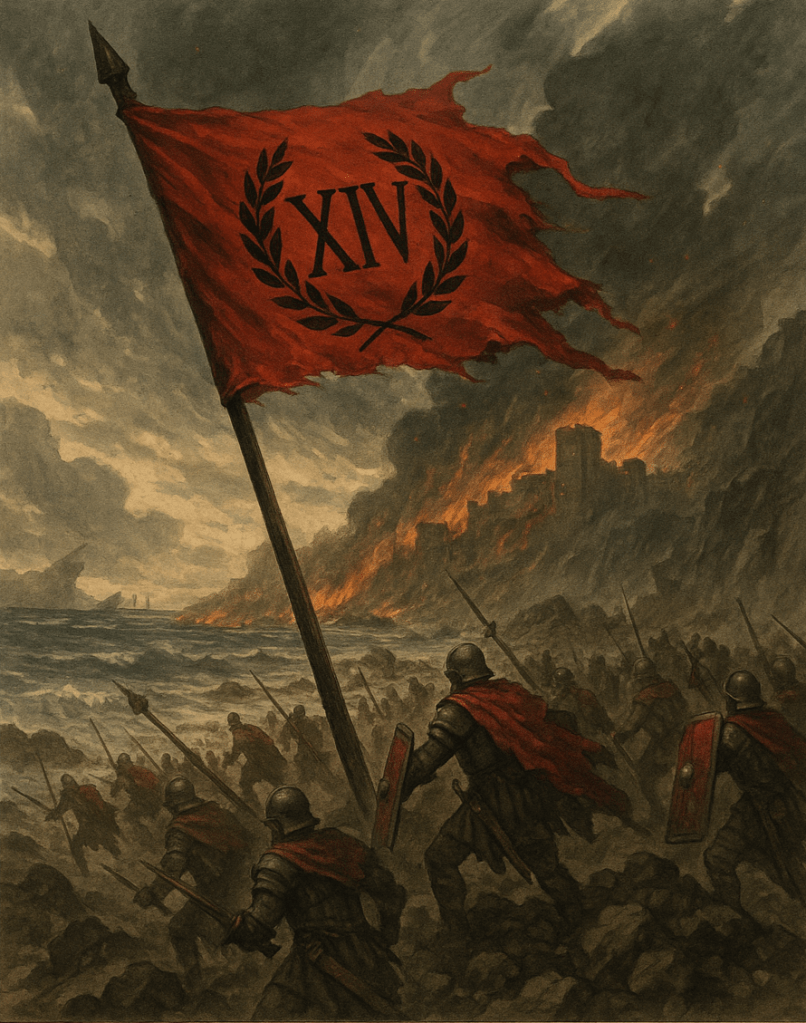
XIV LEGION — NORTHERN CAMPAIGN
The mist still clung to the ground when the first stakes of the imperial tents were driven in. Men clad in soot-darkened armor, thick woolen cloaks, and eyes hardened by campaign looked around. They had expected snow. Expected dead trees and cutting winds. Instead, they saw green fields waving in the morning breeze, crops blooming under the autumn sun, trails of dry mud connecting villages of stone and timber where naked children played, men plowed the earth, and women watched silently the arrival of the XIV Legion.
Kael dismounted his horse with a hint of discomfort. The sun wasn’t what he expected. The ground didn’t creak underfoot like ice. The air was heavy, yes — but with the scent of fertile earth, not of death. He tugged at his thick gloves, tearing one in the process, and tossed his fur cloak to the squire with a gesture of impatience. His eyes — taught to distrust even the light — wandered across the nearby hills.
“This is the North?” he murmured, more to himself than to anyone else. “Looks like a paradise looted.”
Tribune Galvor, one of the oldest officers of the XIV, answered with the neutral tone of a man who’d seen too much:
“That’s what the maps say, general.”
Kael didn’t respond. Instead, he walked among the soldiers, observing the faces of the locals. Hungry, gaunt, their skin sun-scorched, their hands like stone from toil. These weren’t barbarians. They were peasants. Survivors. And there was more than misery in their eyes — there was a passive coldness, a resignation that asked for nothing. None knelt. None saluted. They simply stared. One old man even spat on the ground, as if to mark his territory.
From that day forward, Kael studied more than roads and strategic positions. He listened to whispers. Some said the North had never truly belonged to the Empire. Others that taxes were extorted by local militias, that imperial coin was worth less than salt. And in more than one village, they heard tales of “imperial guards” — puppets with fake insignias, exploiting peasants with promises of protection.
“Lies,” grumbled the quartermaster, reviewing the supply reports. “Official documents claim this region is barren, barely sustaining its own fields.”
“Those reports were written by men who’ve never set foot here,” Kael replied, eyes fixed on a barley field stretching to the horizon. “Or by men who profited from the lie.”
In the following weeks, Kael and his retinue began mapping the true region — not the Senate’s parchment version, but one built of soil, of village pacts, of tributes paid in grain and blood. They found organized communities, self-governed, some with local councils, others ruled by ex-mercenaries calling themselves barons and charging “protection taxes.”
The new map, drawn by calloused hands and sleepless nights, bore more than roads. On one bend of a river, someone had etched a tree with broken roots — where a medic had lost her son. Near a mountain pass, a red ‘X’ marked a rebel ambush site that claimed half a company. And on the edge of a lake, a soldier had drawn a heart beside a tiny house — the only place that gave them shelter during a storm. It was not just a map of territory. It was a map of memory. Of pain. And of conviction.
The XIV Legion needed to advance, but the imperial routes were blocked by autonomous fiefs. Kael sent formal requests, as protocol dictated, asking for safe passage. Some were ignored. Others came laced with poisoned courtesy — invitations to banquets hiding blackmail, and exorbitant tolls for every barrel of supply.
It was in the fief of Val Adron that Kael reached his limit.
Lord Althis Marevar was a pig wrapped in gold. He received the delegation in a luxurious fortress while outside, peasants rotted in bread lines. Althis smiled with wine-blackened teeth and offered passage — in exchange for a vow of vassalage and 20% of the Legion’s tithes.
“Or,” he added, savoring his arrogance, “we can resolve this like civilized men. With diplomacy. With… mutual understanding.”
Kael said nothing. His fingers tapped once, then twice, against the hilt of his sword — not out of threat, but restraint. His jaw tensed. He could feel the weight of the Empire’s code, the chain of command, the thousand rules drilled into his spine. But deeper still, something heavier: the stifled fury of a soldier who sees the law serve only those who twist it.
He looked at Althis — a parody of nobility. And in that moment, Kael wrestled between duty and justice. The former demanded patience. The latter, action. If he walked away, he upheld protocol. If he acted… he might become what he hated.
Kael didn’t reply at first. He simply looked around — at the ornate banners, the musicians playing to no one, the well-fed guards, and the hoarded food in the stores. He knew what it was: decadence masquerading as power. And if the Empire tolerated it, then maybe the Empire was sicker than it dared admit.
That night, without warning, the XIV surrounded the castle.
The battle lasted less than an hour.
Althis tried to bargain until the end. Tried to bribe the officers. Tried to flee. He was dragged from the crypt where he hid, drenched in the blood of his own guards, and brought to Val Adron’s main square.
“By order of Commander Kael Valerius Drakar of the XIV Imperial Legion,” proclaimed the herald, “this man is declared a traitor to the people and the throne. Let him serve as a lesson to those who feed on the hunger of others.”
Kael was there. Silent. His eyes were dark, but his voice, when it came, cut the air like steel:
“The Empire is no longer built on titles. It is built on deeds. And where title serves hunger, it shall be burned.”
The lord was hanged in the same courtyard where he once hosted private hunts.
The hoarded grain was redistributed to the nearby villages.
In one of them, a woman who hadn’t spoken for weeks fell to her knees beside a sack of barley and wept — not for the food, but for the silence it ended. Her son, watching Kael from the edge of the crowd, whispered a word not heard in that village for years: “hope.”
The XIV Legion moved on. Behind them, they left the symbol of new command: a black banner with a red stripe stained in ash.
The march after Val Adron felt lighter, at least in the hearts of the men. The weight of the first conquered keep and the execution of a lord seemed to carve a new path not just through the roads, but through the spirits of the soldiers. It was as if they finally had a cause beyond orders. News of the redistributed grain spread like wildfire across the fields — and with it, the name of Kael Drakar began to be whispered not as a commander, but as an uncomfortable liberator.
But the echo of ashes does not remain silent for long.
At the war council assembled in the Sarven Hills camp, where the XIV paused to rest and regroup, the first tensions began to surface. The command tent simmered with unspoken friction, each voice carrying the weight of steel waiting to be forged — or broken.
“You broke the chain of command, general,” said Centurion Hadrien Voss, one of the oldest officers, his breastplate polished to perfection, voice soaked in institutional pride. “What we did in Val Adron might be morally defensible, but legally, it’s insubordination. And we are soldiers, not judges.”
Kael stood, arms crossed, eyes fixed on the map spread across the table before them. Not the Senate’s map — a new one, drawn by the calloused hands of legionaries, marked with real roads, living villages, and the places where children begged for bread with their eyes.
“We are not judges, Centurion,” he said firmly. “But we are armed men facing the silence of the Empire. And silence… is complicit.”
Galvor watched in silence, as always. His fingers tapped the leather of his scabbard. He already knew where this was heading.
Hadrien did not relent.
“And when the capital demands answers? When they accuse us of rebellion?”
“Let them come,” muttered Tribune Cassian Meros, young and restless, leaning on the tent pole. “I’d rather answer for saving a village than for ignoring its screams.”
Kael said nothing in that moment. But he remembered their names.
Hadrien — loyal to the structure. Incorruptible, but rigid.
Cassian — fervent. A possible incendiary. But not without reason. Years ago, he had watched his home village burn after an imperial delay — a delay he had argued against. His sister never made it out. Since then, the scream of a child had always been louder than the call of protocol.
Galvor — the observer. Never committing, always understanding the board.
The next morning, the crows brought word of a new threat.
In the following weeks, the XIV advanced steadily — not by decree, but by fire and resolve. But not all the North welcomed them. Some of the minor lords, seeing their power wane as Kael redistributed grain, punished extortion, and judged freely, began stirring unrest in the shadows.
In villages where the banners of the Empire had begun to reappear, old loyalties whispered poison. Arms and coin flowed from unseen hands. Mobs rose overnight — not of warriors, but of frightened peasants, manipulated by sermons of false freedom.
Kael crushed each rebellion without hesitation.
His orders were swift. Banners torn down. Arms seized. Leaders executed — whether paid rebels or manipulated fools. When ambushed, his retaliation was overwhelming. No negotiations. No compromises.
But when the dust settled, and the streets grew silent once more, Kael always returned to the survivors. Children were gathered. Grain from imperial stores shared. Burned roofs rebuilt by his own engineers.
“If we don’t sow roots,” he once told Galvor, “we only leave ashes.”
The men respected it. Some even admired it.
But not all.
Hadrien, watching another cartload of supplies being given to a village that had thrown spears at them days before, clenched his fists until the knuckles cracked.
“You call this justice?” he spat quietly to Galvor. “We bleed, we bury brothers — and then we feed the ones who would’ve slit our throats in their sleep.”
Galvor didn’t answer. He only looked at the children playing with the soldiers’ discarded helmets.
But Kael heard. And said nothing.
He knew Hadrien’s anger wasn’t born of cowardice — but of weariness. Of watching good men die to protect the same hands that sometimes threw stones.
And still… Kael would not stop.
The fire in the command tent burned low, casting long shadows across the map. Kael sat at the edge of the war table, still in half-armor, the leather straps unfastened, shoulders heavier than steel. Galvor stood nearby, sharpening a blade with slow, practiced motions. The silence between them was not awkward — it was earned. A silence only shared by men who have bled side by side.
Kael spoke first.
“I don’t know if I’m still building something… or just delaying the collapse.”
Galvor didn’t stop his motion.
“You’re doing what needs to be done.”
Kael looked down at his hands, the fingertips calloused, blood still in the creases from the last raid.
“They call me a liberator now. A reformer. But some nights… I wonder if all I’ve done is replace one chain by another. The Empire we fight for — it was supposed to be a beacon. Order. Justice. I was raised on the idea that the Senate was the spine of civilization. But what spine rots and expects to stand?”
Galvor finally sheathed the blade and looked at him.
“Maybe the dream was never real. Maybe the Senate was always a polished corpse. But the people still believe in the shape of that dream. They believe because you didn’t run. You marched into the filth and came back with fire.”
Kael scoffed, bitter.
“They follow me because I win.”
“No,” Galvor replied. “They follow you because you don’t look away. Not from the screams, not from the rot. Most leaders speak of duty. You bleed for it. That’s why we follow you through hell and high water. That’s why we still march.”
Kael fell silent. He looked at the map, now filled with ashes, blood marks, and paths redrawn by battle.
And in his eyes, for just a moment — doubt faded. Not because it disappeared, but because it was shared.
The following morning, the crows brought a different kind of message.
The reports were confused, but consistent. Villages burned under black banners. Women violated. Children taken. Survivors said it was the work of border rebels. But Kael knew better — there was too much method in the madness. Tactical chaos. Patterns only veterans noticed.
These were mercenaries.
And where there are mercenaries, there is gold.
The Four Merchant Cities — Valthenor, Arak, Quotros, and Barbarossa — had always resisted Imperial control. Masters of the straits. Masters of the ships. Masters of the trade. Their gold bought silence in the Senate — and death in the fields. And now… it bought fire.
Kael read the report on the village of Eldreth three times. Twenty dead. No Imperial garrison. Technically, it wasn’t within his jurisdiction.
But the refugees now stood at the gates of the camp.
And among them, a girl of seven — her eyes burned out with living fire.
“If we intervene, we break the treaties,” Hadrien said. “The city-states will respond with blood. And the Senate… will brand us deserters.”
“And if we don’t?” Kael muttered, watching the sunset. “Then we are complicit. Again.”
Silence.
“The XIV didn’t come North for honor. We came because no one else did. And if we let this village die… we leave our soul behind with it.”
He gave the order.
At dawn, XIV scouts crossed the valley. The mercenaries were still in Eldreth — drunk, looting what remained, torching what couldn’t be taken. They expected no resistance.
The assault was brutal. Precise. Merciless.
Kael led the vanguard. The first man he killed was a giant marked with the Black Rose — a symbol common to mercenaries from the Free Cities. The second he decapitated before the man could beg. The third, Kael let escape — deliberately.
He wanted the others to know.
When the blood settled, Eldreth still burned. But part of it lived. Enough to begin again.
Kael walked through the ruins, boots soaked in blood and ash. The eyeless girl recognized his voice and clung to his cloak. He had no words. He knelt. And remained there. Until nightfall.
The night after the mercenary slaughter carried a strange silence. From the outside, the XIV’s camp seemed ordinary — sentries at the gates, banners fluttering, the occasional clink of armor and shield. But within, cracks had begun to show. The older officers exchanged glances too short to be innocent, too long to be respectful. And in the center of it all, Hadrien Voss stood like a pillar under strain — too proud to bend, too rigid to weather what was coming.
Kael’s disobedience was no longer a murmur.
It was a decision.
And Hadrien, forged in the old doctrines, now saw that decision as not just dangerous — but corrosive.
A few hours later, a new message arrived from Caltheron — the capital.
“The XIV has exceeded its operational limits. Orders will be reviewed. Fall back. Await further direction.”
Kael read it in silence.
Then tore the letter to shreds.
“Let them come,” he said.
And for the first time in weeks — he smiled.
The torn letter became more than defiance. It became a signal.
Word spread.
The commander who had burned titles.
The general who hanged a lord.
The man who answered fire with fire — and still knelt for the broken.
And the people came.
From every village they crossed, from cities that had long abandoned imperial dreams, they came in twos and tens and dozens. Peasants. Freed servants. Former militiamen. Even deserters who sought a cause worth dying for. They came with sharpened hoes, rusted swords, and empty stomachs — but eyes that burned with purpose.
At first, Kael refused them.
“We’re not a crusade,” he told Galvor. “We’re a legion. We have discipline. Doctrine.”
Hadrien, ever strict, backed him.
“Protocol forbids civilians joining a campaign without Senate clearance. It’s chaos.”
But the people kept following. They marched behind the Legion, slept in ditches, brought water and supplies unasked. They guarded roads while the XIV moved ahead. And in one battle, when mercenaries struck a supply line, it was the civilians who fought them off with stones and sickles.
Kael saw it.
Saw the blood on their hands.
Saw how they stood over the dead with the same breathless focus of his best centurions.
And he made a choice.
He called them not recruits. Not conscripts.
But volunteers.
“No oath to the throne,” he told them. “Only to each other. And to the people.”
They received uniforms of patched leather and stolen mail. They trained under sergeants who once called them “vermin.” And they marched — ragged, determined, unbreakable — under a new banner. One forged in purpose, not permission.
The XIV was no longer just a legion. It was a movement.
And for Hadrien… that was when the fear truly began.
 Chronicles of Astravara