Reading Time:
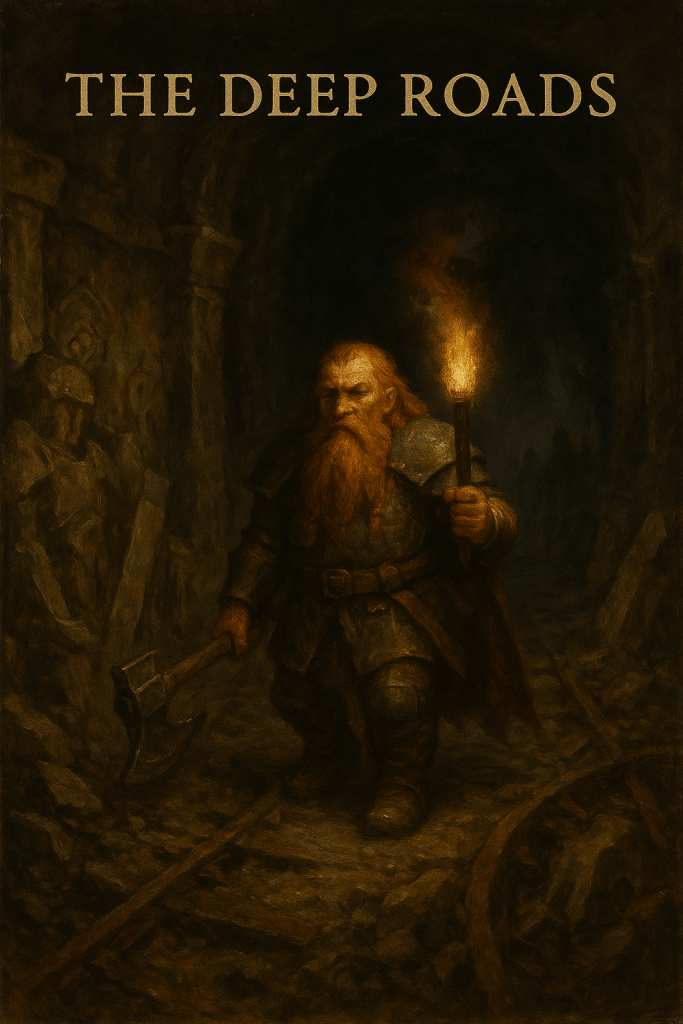
The echo of dwarven boots rang through the Deep Roads like the toll of a distant war drum — heavy, unrelenting, swallowed by the black. The sound rolled ahead of them into the dark and returned thinner, warped, as if the stone itself whispered back. The air here was old, weighted with the scent of wet stone, rusted metal, and something else… something stale, like breath left too long in a sealed crypt.
Tharik Ironstone marched at the front, the gleam of his eyes scanning every crease in the walls. He read the carved runes like a priest reads holy scripture, his fingers brushing over them without breaking stride. To most, these were just faded marks left by long-dead masons. To Tharik, they were the words of those who had walked here before — warnings, measurements, memories. They told him where the stone was safe to tread, where the air would grow thin, and where death had taken root.
Behind him, the rest of the company followed in loose formation. They were no recruits: every one of them had fought in the black beneath the mountains before.
- Garrim, broad-shouldered and quick to grin, kept up a running commentary about the forgework he’d left behind, promising to make a warhammer “so fine it’ll split a goblin skull with the sound of the strike.”
- Varnik, quiet and sharp-eyed, carried a crossbow strapped to his back and had the habit of counting steps under his breath.
- Dorrin, the youngest, barely past his first century, was still lean from youth and eager to prove himself.
- Brogni and Halmor, both veterans with graying beards, marched side by side, their conversation low and steady — the language of old warriors used to long walks and longer silences.
There were more — ten in all — each carrying steel and firelight into the dark. The air between them in those first hours was easy enough. Garrim’s jests drew the occasional chuckle. Varnik shared a pouch of dried apples. Even Tharik allowed himself the faintest smile when Dorrin, eyes wide, tried to read a wall rune and confused “safe path” with “watch for falling stone.”
The first clash came swift and sharp.
A band of goblins burst from a side tunnel, their wiry forms low to the ground, eyes catching the torchlight like coins in the dark. Tharik’s warning — “Front!” — was barely more than a growl before his axe was already in motion. The fight was short and brutal. Axes rose and fell, shields rang, and when it was over the floor was littered with the small, twisted bodies.
They moved on without slowing. In the Deep Roads, lingering over the dead was an indulgence that got you killed.
The second skirmish came hours later — an ambush from above, goblins dropping from a jagged ledge. One hit Halmor hard enough to stagger him; another clung to Garrim’s back until Tharik split it in two. That fight left one of their number bleeding out on the stone. They stripped his gear in silence and moved on, the mood tightened but not yet broken.
By the third day, the encounters blurred together: a sudden shriek, the rush of claws on stone, the hot spray of blood. The company learned to move like shadows themselves, slipping away from the larger swarms that prowled the dark. Tharik’s instincts — sharpened by years and by the strange gift goblin blood had left him — guided them around trouble more than once.
Still, the road took its toll. They lost another to a spear thrust through the gap in his armor. Dorrin, in one brutal fight, went down beneath a goblin’s corpse, its black blood spilling over his face and into his mouth as he gasped for air. They hauled him up, hacking the body away, but the taste and stench had already sunk deep. The others traded uneasy glances. Too much goblin blood was said to rot the mind over time.
When Tharik suggested sending him back, Dorrin’s jaw set like iron.
“If I turn back now, you’ll have one less axe in the fight,” he said. “I’m not leaving.”
The veterans respected that resolve, though Tharik saw the flicker in the youth’s eyes — the shadow that wasn’t entirely his own.
On the fourth night, they heard the swarm.
It began as a tremor underfoot, then a chittering roar that grew until it seemed to fill every passage. Tharik froze them with a fist raised high, then led them into a narrow side tunnel just before the horde poured past. The sound of thousands of claws on stone set their teeth on edge. Even Garrim had nothing to say after that.
It was after the swarm that things began to change.
First came the short tempers — a sharp word here, a muttered curse there. Then the dreams: great eyes in the dark, talons scraping just beyond the light, voices whispering in a tongue older than the mountains. The whispers followed into waking hours, curling just out of reach, vanishing when they stopped to listen. Shadows seemed to shift where no torchlight fell.
Tharik endured it, his will like a wall of stone. He had felt such things before and knew their work. But the others… the others began to crack. Dorrin gripped his axe even at rest, muttering under his breath when he thought no one was near. Varnik started glancing over his shoulder at every turn. Garrim stopped making jokes.
By the time they reached the edge of the place Tharik had once glimpsed the black dragon, they no longer marched as a company. They moved like survivors — heads down, steps heavy, voices gone.
And waiting ahead, in the black where Tharik had once glimpsed the dragon, was something else entirely.
They knew they were close before they saw it.
The tunnels widened, the air taking on a sharper, fouler taste, thick with the stink of unwashed bodies and rot. The whispers that had stalked them for days seemed to grow bolder here, sliding between the creak of armor and the thud of boots. Even Tharik, who had long since learned to set his mind like a stone wall against such things, felt them curling against the edges of his thoughts.
A broken arch marked the threshold. Beyond it lay the nest.
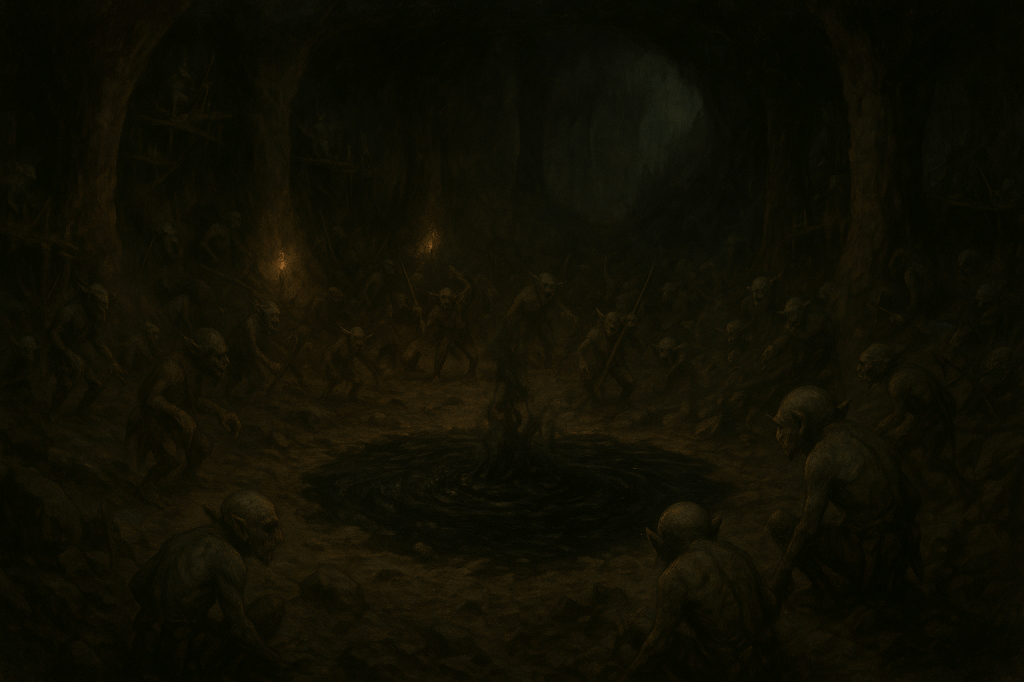
It wasn’t like any goblin warren Tharik had seen. The usual filth and chaos were here, but woven through it was a deeper madness. Goblins hunched in corners, mumbling to themselves. Others clawed at the walls until their nails split and bled, leaving streaks of dark red on pale stone. A group of orcs shambled through the chamber, not as guards or warriors but as if they had forgotten what either meant — their eyes glassy, their movements twitching and aimless.
“By the Forge…” one of the dwarves whispered, and even that was enough to make three goblins turn their heads, teeth bared in perfect, unnatural unison.
They moved like shadows, every step a risk. Twice they had to melt into the darkness of a side passage as skirmishes broke out between the creatures themselves, snarling and tearing at each other for no reason Tharik could guess. This was no army. This was something broken.
In the heart of it lay their target — the place to plant the charges. A cracked dais ringed with crude idols and scraps of bone. And in its center, the thing Tharik had hoped not to see.
A pool of black liquid, bubbling thickly in the still air. Its glow was faint, sickly, but it seemed to breathe with a rhythm all its own. Every instinct screamed to keep his distance, but something in it pulled at him all the same — the same pull he had felt in the dragon’s presence. His teeth clenched hard enough to ache.
He had prepared for this. A shallow cut across his palm, the sting of steel and the smell of his own blood — pain and grounding. The pull eased, but not enough to silence it.
The young dwarf froze, eyes locked on the pool. Tharik hissed his name, low but sharp. No response. The others turned, voices rising, hands gripping his arms, but his gaze didn’t break.
“Don’t look at it!” Tharik barked, but the words came too late.
With a guttural shout that didn’t sound like his own voice, the youth tore free and threw himself into the black. The liquid swallowed him whole, churning and hissing as if boiling around his body.
What came out of it was not a dwarf.
The black pool heaved like a living thing, each swell of its surface glistening with an oily sheen that caught the torchlight in sickly greens and purples. The young dwarf’s scream tore through the chamber, raw and primal, yet layered with something else — a deeper, alien tone that made the stone itself seem to vibrate.
The liquid clung to him as he thrashed, sinking into his skin rather than dripping away. His beard sloughed off in clumps, floating in the mire before vanishing beneath the surface. Patches of his flesh darkened, hardening into rough scales that shimmered like wet obsidian. His hands spasmed, fingers lengthening into black talons. Bones cracked and shifted under his skin, the sound sharp and wrong in the still air.
“Pull him out!” someone shouted, but no one moved. Every dwarf there knew — by instinct, by terror — that what had fallen into that pit was not coming back.
His eyes snapped open, the familiar brown gone, replaced by bottomless black orbs with no light in them, no reflection, no soul.
Then he moved.
The first dwarf he reached didn’t even raise his weapon in time. The creature’s claws tore through breastplate and ribs as if they were parchment, the body flung aside with a wet crash against the stones. Blood steamed where it splattered on the ground, the heat of the corruption eating into it like acid.
“Form on me!” Tharik roared, stepping forward, his axe already in motion. The blade met scaled flesh with a solid thud, sending the creature skidding back, but it did not fall. It snarled — a sound too deep for dwarven lungs — and came on again, faster this time.
The chamber erupted into chaos. Two dwarves broke formation to flank, only for the creature to whirl with unnatural speed, its talons catching one in the neck and dragging him down. The other swung low, burying his axe in its side, but the thing didn’t flinch; it simply seized him by the helmet and slammed him into the stone until the steel caved in.
Tharik’s voice cut through the din, barking orders, forcing the survivors into a rough circle. Shields locked. Axes ready. Every breath was ragged, every heartbeat loud in their ears.
It lunged again, meeting the shield wall with a force that staggered them all. The clang of steel on steel rang out, sparks flying where claws scraped against shields. Tharik stepped into the gap, his axe carving a deep line across its chest. This time it screamed — high, shrill, furious.
One of the dwarves in the rear shouted that the goblins were coming. The sound of their shrieks echoed faintly in the passages beyond, drawn by the fight.
“We hold!” Tharik barked, forcing the words through clenched teeth. “Finish it now!”
The creature struck low, knocking a dwarf off his feet and pouncing before anyone could react. Teeth sank into the man’s shoulder, crunching through armor and bone. Tharik didn’t think — he drove his axe down in a brutal arc, shearing the creature’s head halfway from its neck. It jerked, hissed, tried to rise again, but another blow from the opposite side finally sent it sprawling in a twitching heap.
No one cheered.
The goblin cries were louder now, the swarm close. The smell of them, thick and rancid, poured into the chamber with the draft of their approach.
“Light the charges!” Tharik snapped.
The detonator was in place, the wires set — but when they tried, nothing happened. A hiss of curses went up. Something in the blast mechanism had failed.
“I’ll do it,” one of the older dwarves said, already moving. His voice was calm, but his eyes told Tharik he knew what it meant.
“You’ve got ten breaths,” Tharik said, gripping his forearm in the old warrior’s clasp. No more words were exchanged.
The rest ran, boots hammering the stone. Behind them, the first goblin shrieks became a roar as the swarm poured into the chamber. Then came the flash — white light blooming for a fraction of a second, followed by a deep, rolling thunder that seemed to tear the air apart. The tunnel shook, dust and shards raining from the ceiling as the world behind them collapsed.
When the rumble faded, there was only silence.
The silence after the collapse was almost worse than the noise.
It pressed against their ears, thick and unnatural, as if the tunnels themselves had stopped breathing. Even the usual distant drip of water was gone.
They kept moving, the glow of their torches barely pushing back the dark. Every step felt too loud, their boots striking clean stone — too clean. The air here was different: dry, cool, and touched with a faint metallic tang.
“This isn’t goblin work,” one of the survivors muttered.
He was right. The walls were smooth, almost polished, with carved lines so faint they seemed to move at the edge of sight. The ground was free of debris, not a scrap of bone, not a smear of dirt. It was as though they had crossed into another place entirely, untouched by the filth and chaos they’d just fled.
Then they saw it.
At the far end of a short, arched passage, sitting atop a block of white-veined stone, was a sculpture the size of a dwarf’s head. Even in the dim torchlight, it gleamed as if newly carved. Its surface was a perfect blend of craftsmanship and artistry — every line of the beard, every fold in the hooded cloak it wore, shaped with precision only master smiths could achieve.
But something in it was wrong.
The proportions were almost imperceptibly off. The eyes seemed to follow without moving. The longer Tharik looked, the more he felt a tension in his chest, a subtle prickling at the back of his neck. His fingers twitched toward his weapon without thinking.
“Beautiful work…” one of the dwarves breathed, stepping closer.
Tharik caught his arm. “Don’t touch it yet.”
The dwarf glanced at him, and for the first time since the fight, there was something sharp in his gaze — not defiance, but a kind of hunger.
“We’re taking it to the council,” Tharik said, voice low but firm.
The others didn’t argue. The youngest survivor — barely older than the one they’d lost to the pit — volunteered to carry it. When he lifted it, his hands lingered on the cold stone a moment longer than necessary, his eyes never leaving the face of the idol.
They turned back the way they’d come, torches casting long shadows on the polished walls. The oppressive silence followed them, broken only by the faint scrape of boots.
It wasn’t until they re-entered the rougher, dirt-streaked tunnels that Tharik noticed something strange. The goblins were gone. No ambushes, no skittering claws in the dark, no guttural snarls from the shadows. The Deep Roads were still.
Too still.
From then on, whenever Tharik glanced at the dwarf carrying the idol, he saw the way his grip had tightened around it — the way he shifted it protectively if another drew too near, the way his eyes seemed just a little darker in the torchlight.
The whispers hadn’t returned. But Tharik couldn’t shake the feeling that whatever had silenced them was now walking beside him.
The road back was slower.
The Deep Roads had always felt vast to Tharik, but now the tunnels seemed longer, the turns sharper, as if the mountain had shifted in their absence. The survivors moved without the steady rhythm they’d had on the way in; their pace was uneven, sometimes quickening in silent bursts, sometimes slowing to a crawl for no reason anyone voiced.
No goblins followed them. No distant swarm-song rose from the shadows. Even the faint stink of their kind had thinned, replaced by the smell of old stone and stale air. In any other circumstance, such stillness would have been a blessing. Now, it felt like walking through a tomb before the dead had been buried.
The dwarf carrying the idol kept it wrapped in a piece of cloth torn from his cloak, but even covered, its shape was clear. He cradled it not at his side, but close to his chest, as if guarding a wounded comrade. At first, Tharik thought it was simply the instinct to protect a relic of their people — something valuable, perhaps even sacred. But the way the dwarf’s fingers stroked the carved surface when he thought no one was watching was… different.
Once, during a short halt to drink, Tharik caught a low murmur behind him. He turned to see the carrier hunched over the wrapped idol, lips moving. The words were too soft to hear, but the tone was unmistakable — not muttering to himself, but speaking to it. When he noticed Tharik’s gaze, the dwarf straightened and said nothing.
The others noticed, but no one mentioned it aloud. There was an unspoken agreement not to talk too much, not to break whatever fragile quiet hung over them. Conversation, when it came, was clipped and practical: directions, watch orders, the occasional warning about loose stone. The banter and crude jokes that had once filled the empty stretches of road were gone.
Sleep was fitful. They camped in defensible alcoves when exhaustion became too heavy, but even then, rest offered little peace. Tharik saw it in their faces each morning — pale skin, red-rimmed eyes, the twitch of a hand toward a weapon at the smallest sound. The idol never left the carrier’s side. He even kept it near while he slept, his arm draped over it protectively.
More than once, Tharik woke in the dim glow of the banked coals to find the dwarf sitting upright, the idol in his lap, his lips moving again. There was no expression on his face, no warmth in his eyes — just a fixed, intent focus. Once, Tharik thought he heard him laugh, a short, dry sound, before lying back down.
The silence of the tunnels pressed harder the further they went. Even Tharik’s instincts — that deep, prickling sense of danger — felt muted. It was as if the Deep Roads themselves were holding their breath, watching.
By the time the faint echo of the outer gates reached their ears, the company was little more than a collection of moving shadows. The return to Krag’Dun would bring them into light again, but Tharik knew that whatever had walked out of that chamber with them was not something the light could touch.


 Chronicles of Astravara
Leave a comment