Krag’Dun, once known as the Worldforge, was a radiant jewel among the dwarven strongholds. Its blackstone walls shimmered with ancient runes, and its forges roared with the eternal flame of Vulkanar. The grand halls, carved deep into the mountain’s heart, echoed with songs of victory and the thunder of hammers shaping legends.
But now, those echoes had faded.
There was a time when Krag’Dun stood not only as a bastion of dwarven strength but as the very heart of their identity — a fortress where each clang of the hammer echoed pride, and every spark of the forge was a prayer to Vulkanar, god of fire and creation. Warriors and smiths alike carried runes not only etched on steel but in their souls, bound by purpose and a culture of resilience.
But those echoes had long since dimmed.
The grand forges still burned, but not with the brilliance of old. Flame turned to smoke, smoke turned to ash. The once sacred art of smithing had devolved into rote repetition — mass-producing trinkets and cheap blades for merchants more concerned with silver than sanctity. Innovation was discouraged, seen as wasteful risk. The elders no longer praised ingenuity or bold craftsmanship; they rewarded the predictable, the profitable, the polite.
Merchants ruled the undercurrent of Krag’Dun now — not through force or lineage, but by hoarding wealth and influence. Corruption, once a whisper in the tunnels, was now a booming voice in the Council of Stone. Deals were made behind closed doors, runes of approval bought with favors instead of honor. And the people… the people were beginning to break.
Ale flowed like a river through every corner of the city, not as celebration but as escape. Taverns were always full, not of song, but of slurred bitterness and vacant eyes. It was said that for every newborn beard, there were two drunk hands grasping at a forgotten glory. The young no longer sang the Songs of Fire — they mocked them. The old, once revered, were now reminders of failure, burdened with tales no one wished to hear.
In the lower districts, fights broke out not from hatred but from boredom, from helplessness, from the slow realization that Krag’Dun no longer built anything worthy of memory. The soldiers, proud warriors once forged in the crucible of the Deep Roads, were reduced to peacekeepers for petty disputes. They answered to scrolls, not instincts — bound by bureaucracy that turned even justice into paperwork. Many had lost the will to care, enforcing orders with empty eyes and heavy fists.
And the Deep Roads, once the sacred arteries that pulsed life and trade across the mountains, were now tombs. Goblins multiplied in the silence, feeding on what the dwarves had abandoned in fear. Corridor by corridor, outpost by outpost, Krag’Dun pulled back into itself, as if afraid of its own past.
Tharik Ironstone was the embodiment of a people’s rage, trapped on the threshold of oblivion. Tall for a dwarf, with scarred arms and a nose forever crooked from old brawls, he was what remained of a warrior lineage.
At eighty-seven, he was no youth, but neither was he old. For a dwarf, he stood at the beginning of the middle — nearing two-sixths of a long lifespan. But his soul felt aged beyond counting. He had seen the spark leave the eyes of his kin one by one, seen honor traded for convenience, strength for comfort, bravery for excuses.
He walked the streets of Krag’Dun daily, not as a citizen but as a ghost among ruins still inhabited. He passed beggars that once bore the insignia of the Legion, blacksmiths who now mass-produced knives for caravan guards, children who no longer asked to be trained, but to be entertained.
And every night, he sat in the taverns, surrounded by the hollow laughter of those too tired to cry. The soldiers around him drank not to celebrate but to forget — forget the orders that made them complicit, the faces of citizens beaten because of protocol, the friends they watched become cold enforcers.
Tharik had once been a hammer in the hand of the mountain. Now he felt like rust, even Tharik, famed for his stubbornness, was sinking.
His days were spent patrolling empty corridors. His nights—drowned in bitter ale at the Smoldering Anvil Tavern, alongside other disillusioned soldiers. They mocked the elders’ squabbles, toasted to forgotten battles, and swore empty oaths of a final war that would never come.
“We’re already buried, my friends,” Tharik growled one drunken evening. “This mountain will be our tomb.”
The choice came to him not with ceremony, but in a whisper — a recruiter’s poster pinned on a cracked wall by the outer quarter. The Legion of Death was seeking volunteers. No medals, no songs. Just a promise: darkness, danger, and a chance to matter.
He stared at it for hours, the ink half-faded, the parchment curled with age.
It did not promise glory. But it promised a fight.
And to Tharik, that was enough.
In the deepest corners of dwarven memory, the Legion of Death once stood as a symbol of defiance. Forged in the era of the Daemon War, it was a shield against the corruption crawling through the Deep Roads, a bulwark manned by the desperate and the damned. They held the tunnels when kings faltered and nobles fled. Their creed was forged not in honor, but in necessity — to fight where no sane warrior would tread.
But time had not been kind to the Legion.
Now, it was little more than a name whispered in unease — a place where dwarves went to disappear. Veterans who refused to grow old quietly. Criminals offered one last chance in place of execution. Madmen obsessed with old songs of valor. And those like Tharik — broken, bitter, and without a place in the world.
Most in Krag’Dun viewed the Legion with a mix of dread and disdain. Parents threatened disobedient children with its name. “Careful, or you’ll be sent to the black armor.” Recruits who failed to pass muster in the regular army were sometimes dumped into the Legion as punishment — or to be forgotten. And many simply refused the call. Better to rot in a cell than face what lurked in the Deep.
Tharik did not refuse. He signed his name with fingers still sticky from spilled ale.
The march to the Black Gate — the hidden passage that led to the Legion’s stronghold — was long, cold, and silent. The dozen other recruits shuffled beside him, most in chains. A few, like Tharik, walked freely, but with the same blank resignation in their eyes. These were not soldiers. They were discards.
The entrance to the Legion’s training ground, Hall of Obsidian Silence, was a wound in the mountain. Beyond it, there was no sky. No song. Only shadow and stone.
There, Tharik learned quickly what made the Legion different.
Gone were the soft teachings of Krag’Dun’s peacekeeping militia, with their scrolls of bureaucratic protocol and ceremonial stances. The Legion trained for one purpose: survival. Every day began in darkness and ended in exhaustion. Recruits fought blind, bled together, and were punished together. Pain was the only lesson that mattered. Those who couldn’t keep up were left behind.
At first, Tharik resisted. He cut corners. He faked illness. He volunteered for latrine duty just to avoid drills. His laziness was not out of cowardice, but from that same heaviness he carried since childhood — the dull ache of a soul that no longer believed effort would change anything.
But the Legion did not allow such beliefs to fester.
On the fourth week, a recruit from the northern mines collapsed from heat stroke. No one helped him. They weren’t allowed. Tharik watched as the others finished the obstacle course and carried on, faces numb. That night, the recruit was gone — sent back? Executed? No one said. No one was allowed to ask.
The rules were simple: “You are no longer a name, only a purpose.” “Your past is ash.” “Your brothers are your shield. Their blood is your price.”
And above all — “Speak of your crimes, and your tongue will be cut.”
Only those who had volunteered, and had no blood-stained hands, could keep their names.
Tharik kept his name. But every day, it felt heavier.
It was only when the days blended together — when his sweat mixed with that of those around him, when he carried another recruit half-conscious across a flooded shaft, when he buried one of his own beneath stone — that something began to shift in him. Not joy. Never joy. But… purpose. A quiet understanding that he was no longer standing still.
And always, watching them from the high ledge of the training hall, was Commander Hela Brokenrock.
She was legend and nightmare made flesh.
Once a warmaiden of the elite Hammerguard, she had walked into the Legion decades ago, already scarred by battle and disillusioned by politics. Her blonde-red hair was tied back in a braid like a length of rope, and her face was carved by the years of war — not old, but unyielding. A black eyepatch covered her left eye, taken by a troll’s hook in the tunnels of Dravengar. Her remaining eye burned with judgment.
She spoke rarely. But when she did, it was final.
“You are not here to be men,” she said on the first day. “You are here to be weapons. And I only keep the ones sharp enough to kill.”
No one dared test her. Not after the first recruit who tried to run was thrown from the training shaft by her own hand — a warning that still echoed in the rock.
Even before the Legion, Tharik Ironstone had already become a ghost in his own home.
Born into one of the old bloodlines of Krag’Dun, the Ironstone name once echoed in the council chambers and war halls, a lineage of proud warriors and shrewd politicians. But in the age of decline, it had grown soft — rich on mining contracts, tangled in merchant alliances and noble posturing.
Tharik never fit their mold.
Where his elder siblings schemed for political marriages or paraded in the Royal Guard with polished armor and dead eyes, Tharik wandered. He listened to old stories and slept through council hearings. He skipped combat drills to get drunk with tavern veterans, those who remembered what real war smelled like. He spent coin faster than he earned it, and rarely cared to explain why.
His family had long since run out of patience.
“You shame the Stonefury name,” his mother spat the last time he returned home after disappearing for weeks. “If you will not wear a uniform or hold a seat, then you are nothing.”
And so they cut him off.
At seventy, with no title, no income, and mounting debt, Tharik faced a grim reality. In dwarven caste law, a dishonored son without support who sank deep enough into debt could be legally claimed into indentured servitude — slavery in all but name. Already, the offers had begun to whisper through tavern halls. Mine lords who smelled blood. Bailiffs who watched with greedy eyes.
The only path left was the one he hated: enlistment.
But even then, Tharik chose the laziest route — the Peacekeeping Force. A hollow relic of a once-proud militia, now reduced to bureaucracy and ceremonial patrols. Their armor shined, but their blades were dull. Their duty was filing reports on drunken brawls and escorting merchants through safe zones.
Tharik fit right in.
He filed paperwork late, skipped mandatory lectures, and pocketed rations for beer. The job protected his name and kept him out of debtor’s prison — just enough stability to keep falling without crashing.
Until he saw what the Peacekeepers had become.
One evening, he watched a veteran sergeant order his men to ignore a goblin attack on a miner outpost, citing jurisdictional boundaries and “budget constraints.” The outpost was razed. No one was punished. The next day, a memorial plaque was commissioned. The sergeant was promoted.
Tharik filed his resignation.
He didn’t tell anyone where he was going when he signed up for the Legion of Death. He just walked into the recruiter’s tent, eyes bloodshot and heart empty, and handed over his name.
The Legion did not care who Tharik had been. They did not care about his family or his debts. Only that he could stand, fight, and carry others.
Excuses didn’t work here. Laziness earned punishment not just for him, but for the entire squad. And in the Legion, punishments were collective.
If Tharik missed a mark in weapons drill, everyone ran the tunnels. If he mouthed off to an officer, everyone scrubbed the latrines with bare hands. If he slacked in combat training, others bled because of it.
At first, they hated him for it. He became the weak link, the loudmouth, the drunken fool dragging them all down. He wore that hatred like a cloak, pretending it didn’t bother him. But in the dark, alone after drills, he heard them grumble, curse his name, swear they’d break his nose in his sleep.
One night, they nearly did.
He woke to fists. Three recruits — silent, grim — took turns striking him. They didn’t speak. They didn’t gloat. When it was done, they left. No one reported it. No one had to.
The next day, Tharik didn’t skip training.
Not because he wanted to improve. But because he realized, for the first time in years, his actions had consequences. Here, what he did mattered. It shaped how others suffered, how others endured.
It wasn’t morality. It wasn’t redemption. It was weight.
And over time, he started to carry it.
Not perfectly. He still cracked jokes at the wrong time. Still got the squad into group punishments more than once. Still questioned orders just to spite authority. But when something had to be done — when a tunnel collapse stranded two rookies, or a monster ambush caught them unprepared — it was Tharik who moved first.
It wasn’t leadership by rank. It was instinct. Raw, begrudging duty.
Even the others saw it.
A silent respect began to grow, unspoken but real. They didn’t like him, but they followed. And Commander Hela Brokenrock, ever watchful from her perch above the Obsidian Hall, made sure that any spark of disloyalty died fast.
One afternoon, she summoned them all after a particularly harsh trial in the lower shafts — three had nearly drowned in a collapsed aquifer, and Tharik had led the rescue.
She stood before them, red-blonde braid slick with sweat, eyepatch shadowed.
“You will not survive because of discipline,” she said. “You will survive because you carry each other. You fall alone, you rot alone. You carry your brother, and you live another day.”
Her gaze fell on Tharik.
“No more excuses. No more wasted breath.”
He didn’t nod. He didn’t speak. But for the first time, he looked her in the eye and didn’t turn away.
By the end of their second month, the recruits of the Legion felt invincible.
They had survived bone-breaking drills, tunnel collapse simulations, and weeks of poison resistance training that left their mouths dry and their skin blistered. The morale was high—too high for a group that had never seen true war. Many began to believe the worst was behind them. Even Tharik, though cautious, began to speak more freely, occasionally cracking grim jokes or sharing his rations. Hela allowed the momentary ease, but her silence grew heavier with each passing day.
Then, the bell sounded. A real call. Their first field mission.
They were to descend into Hollow Vein—an abandoned shaft that had gone dark three weeks earlier. Reports hinted at goblin activity: tunnels scoured, miners missing, a stench rising from the depths. No elder dared send regular troops. The Legion was called.
As they marched into the dark, the air turned cold and damp. The light from their lanterns grew distorted as if the shadows themselves pulsed and twitched. Even the bravest among them grew silent.
What waited was not battle. It was slaughter.
The goblins were not as they’d been described in the training scrolls. These were feral, bloated things with flesh in varying stages of rot. Their blood hissed when spilled, filling the air with a sickening vapor. Some wielded crude weapons. Others used teeth. They moved in waves, chittering and shrieking, eyes glowing like coals in the dark.
The formation broke almost immediately.
The first to fall was Brennar—cut down before he even swung his axe. Darrika lost her weapon trying to help him, then vanished into the dark with a scream. Korrin fought like a cornered beast, swinging madly, buying time.
And Tharik ran.
It wasn’t a conscious choice. The panic swallowed him like an avalanche. One moment he was standing shoulder to shoulder with the others, and the next his legs were carrying him through a side passage, lungs burning, heart hammering in his ears. He didn’t stop until the screams were gone.
When the survivors regrouped hours later, they had lost five. Among them were Brennar and Korrin—two of the few Tharik had trusted.
The silence in the camp was suffocating.
Hela said nothing when Tharik returned, his eyes hollow. She didn’t need to. The judgment was in every glance from the survivors. But Tharik didn’t run from it this time. When the commander ordered ten days of punishment detail—no rest, no food beyond hard rations, the worst tasks in the darkest parts of the fortress—he nodded and obeyed.
Not out of pride.
Out of guilt.
The ghosts of Brennar and Korrin followed Tharik into his dreams. Sometimes they screamed. Sometimes they stared, eyes rotted, mouths filled with blood. In those dreams, his legs would freeze. No matter how hard he fought, he couldn’t move.
He stopped drinking.
He stopped joking.
He trained harder than anyone. Not with pride, but obsession. He stayed in the poison resistance baths longer than ordered, gritting his teeth as the foul liquid burned his skin. He volunteered for extra tunnel sweeps. He took the night watch even when his limbs trembled from fatigue.
When others began to recover from the trauma, Tharik didn’t.
But he changed.
He became sharper. Colder. More aware.
Their next mission was a simple supply escort into a compromised storage shaft—but the team was ready this time. Even with goblins lurking, they kept formation. When an ambush came, they responded with steel and discipline. A few were wounded, but none died.
Tharik didn’t lead, but when a rookie froze, he was the first to shove him back into position.
The third mission was worse—recon into a partially collapsed cavern near the ancient breach from the Daemon War. The air was heavy with rot, and goblins attacked in silence, using tunnels above and below. One of the newer recruits, Velm, collapsed after killing a bloated goblin whose blood splashed across his face. He convulsed, foam at his lips.
Tharik didn’t hesitate.
He hoisted Velm over his shoulder and fought one-handed, dragging him back through the narrow paths, ignoring the blood searing into his own skin. He didn’t stop until they were clear.
Later, Hela simply looked at him and nodded.
The first decade passed not in glory, but in attrition.
Tharik Ironstone served without honors, without medals. The missions were not grand battles to be sung in halls, but reclamation patrols through forgotten veins of stone and abandoned fortresses, old tunnels half-swallowed by darkness and rot. They cleared the wreckage of ancient wars, recovered the bones of the lost, and lit pyres where no sun would reach.
His unit, under the direct command of Hela Brokenstone, operated with ruthless efficiency. The commander never offered praise easily, but more than once she allowed herself a grunt of reluctant approval after Tharik’s intuition saved a squad from ambush, or his axe silenced a goblin before its shriek could rally a pack.
“You’re not the same sluggard who stumbled into my camp a decade ago,” she once said, watching him tend to his gear in silence. “But you’re still trouble. Just the kind we need.”
Tharik said nothing. He never did when praised.
He fought like a machine, deliberate and unrelenting. But never reckless. He knew how fast a tunnel could become a tomb. He had seen it.
He kept a tally—not in marks or notes, but in silence. For every dwarf he watched die, a little more of his warmth faded. He buried his friends without tears. He slept with his boots on. He dreamed only of screams.
Still, he endured.
And that, in the Legion, was a kind of sainthood.
In his eleventh year, Tharik was reassigned.
He was transferred from Hela’s line company to the Incursor Division, a grim fellowship within the Legion tasked with sabotage, deep recon, and extermination missions beyond mapped territory.
Few returned from those.
The training was harsher. There was no glory in these assignments. No formations, no banners, no songs. Only whispered objectives and silent paths into enemy tunnels. Every mission felt like walking into a crypt and carving your name on the walls before seeing what would try to kill you.
The blood of goblins no longer hissed in the air—it clung to the lungs, seeped into the beard, burned in the eyes.
Weeks would pass in the dark.
And the dreams came back.
After over a decade of sobriety, Tharik began to drink again.
Not to forget. Not to celebrate. But to flatten.
He drank just enough to hold back the edge. Just enough to blur the memories of Korrin’s scream. Of Brennar’s last breath. Of every comrade torn apart in those black corridors while he was too slow, too tired, too afraid.
He never drank to pass out. That would be weakness.
Only enough to function.
His squad didn’t ask questions. The Incursors all had their poisons—some chewed bitterroot to dull pain, others murmured prayers to gods no longer named. Tharik drank. He cleaned his blade with the same ritualistic care he once used to light the funeral pyres. He kept the flask tied beneath his armor, close to the heart.
Sometimes, after a long march, he’d sit alone and whisper to ghosts.
Sometimes they whispered back.
Hela visited him once, deep in the staging tunnels where the Incursors gathered.
She looked older. Harder. But still her voice carried steel.
“I hear you’re keeping the young ones alive. Just barely.” She paused, eyeing the flask on his belt.
“I also hear you’re drinking again.”
Tharik shrugged, not meeting her gaze.
“I keep it measured,” he said simply. “If that’s your concern.”
“It’s not,” she replied. “I’ve lost better men sober. Whatever keeps your axe swinging.”
A beat passed between them. Then she added, quieter:
“Don’t forget who you are under all that ash, Tharik.”
The winds of Norvhar cut like invisible daggers through skin and bone.
To Eirik Skallheim, the cold was not merely a sensation — it was an enemy, a constant, suffocating force that clung to his breath and burrowed into his bones. At sixteen, he was one among countless orphans left behind by families too poor to feed another mouth.
The village where he grew up was little more than a scatter of soot-darkened huts huddled along a frozen bay where the ice never melted. His parents, hardened fishermen, had vanished during a sea storm when he was just twelve. Since then, Eirik survived as he could — hunting small game, stealing fish from neighbors’ hooks, and sleeping in a shelter he built from driftwood and stolen cloth.
“The cold isn’t your enemy, boy,” an old man from the village had once told him. “It’s what keeps us alive. Respect it, or it’ll bury you.”
But Eirik had never seen the cold as a friend. To him, it was a prison — a wall that kept Norvhar isolated from the world, dooming its people to rot in silence.
The winds of Norvhar whispered like old spirits, slipping through the cracked bones of the land. Each step was a conversation with the cold — and the cold spoke of death.
At sixteen, Eirik Skallheim was no longer a child, but not yet a man. His frame was lean from hunger, his spirit shaped by grief. He had grown up counting losses like others counted winters. When he was ten, his elder brother succumbed to fever in a storm-wracked hut, his body buried under stone and silence. Two years later, their parents vanished into the sea during a violent squall — swallowed by waves while fishing beyond the cliffs. He never saw their bodies. Just the empty boat, carried back by the tide.
But it was at fourteen that the last ember of his childhood was extinguished. His younger brother died during a frostbite outbreak that swept through the village. The healers said it was quick. Eirik knew better. The boy had cried for hours before sleep took him.
And then there was his sister.
She had been the only one who still laughed. A gentle soul in a place where softness froze. Two winters before the sea took their parents, she was sold to a distant trader family — a deal struck quietly in the night for dried cod, grain, and a promise that was never kept. His mother didn’t cry. His father simply stared at the fire.
That night, Eirik punched the wall until his knuckles split. After that, he stopped speaking unless necessary.
The village of his birth was no cradle of kinship. It was survival carved into black wood and colder stone — a clutch of wind-battered huts trapped between glacier and sea. The elders left offerings to the storm gods and whispered that Norvhar made strong men. But Eirik had seen it made only graves.
No one stopped him when he left. Not even the elders. Not even the drunk old fisherman who once taught him to gut a seal. Eirik took only what he could carry: a stitched sack of pelts, a hunting knife, and a shortbow bought with stolen coins.
He didn’t say goodbye.
The journey south was a passage through desolation. Tundra stretched endlessly, broken only by the skeletons of trees and frozen rivers that glistened like glass veins. At night, he dreamed of wolves gnawing at his bones. During the day, he saw nothing but white and shadow. Loneliness pressed on him like a second skin.
On the fourth night, a sudden blizzard descended — a white wall of shrieking wind and ice. He took shelter beneath a jagged outcrop, limbs curling into himself as the snow swallowed the world. His teeth chattered, his breath shallow and sharp.
“Is this what’s left of me?” he thought. “A whisper in the snow? Like them?”
He remembered the shape of the boat drifting back without his parents. The silence after his brother’s last breath. The sound of the door closing when his sister was led away.
But he did not die.
At dawn, he crawled from the stone’s embrace, crusted with frost but breathing. He walked without thought, fueled by instinct and spite. The village elder’s words echoed faintly: “The cold keeps us alive, boy. Or it buries us.”
He wasn’t sure anymore which one he deserved.
When the walls of Frosthavn appeared days later, they shimmered through the haze like a mirage — towers of black stone wrapped in steel and smoke. Eirik stumbled through the gates like a half-dead fox. No one looked at him. No one cared.
The city smelled of fish oil, soot, and salt. The alleys hissed with secrets. The poor slept in barrels, their breath clouding the night air. Above them, noble estates glowed with firelight and excess.
But for a boy with frost in his lungs and a scream sealed in his chest, it was still a beginning.
Arriving at Frosthavn was a harsh awakening. He had expected a place of promise. Instead, he found a brutal city, where the wealth of nobles towered above the misery of the ice-crusted slums. The markets reeked of rot and fish oil, and every alley held the stench of desperation.
The city was a jagged mouth — stone teeth, smoke-veined breath, and alleys that bit with frost. No one asked his name. No one offered a hand. In the slums of the outer ring, children died of cold with snow still dusting their eyelashes.
Eirik watched. And learned.
He slept in the cracks between buildings, under carts, and once inside a butcher’s refuse barrel. He stole bread and dried roots, chewed leather and scavenged meat left for dogs. His hands grew calloused. His stomach forgot what warmth felt like. But he did not beg. He never would.
Each time he passed a shivering beggar, whispering for coin beneath a frozen shrine, his lips twisted into quiet contempt.
“Weakness is a choice,” he told himself. “And choice is survival.”
In the temple squares, he saw people crying before statues — desperate sobs echoing off the stone faces of forgotten gods. He felt nothing for them. They prayed, and still starved. They wept, and still froze. The gods were as useless as the elders of his village.
He remembered his sister’s pleading eyes the night she was sold. His father’s silence. His mother’s numb acceptance. They gave up, he realized. They let life take them.
And so, a thought took root — one that never left:
“The weak die. The strong endure. The rest is just noise.”
As weeks passed, he began to see people differently — not as people, but as measures of strength. The drunkards sprawled in gutters. The orphans too soft to steal. The women wailing outside brothels. The priests with soft hands and softer spines.
All of them were fading things, waiting to vanish.
Eirik hardened.
He trained his body in secret — climbing rooftops at night, leaping over gutters, scaling the cold iron ribs of the city’s abandoned bell towers. He hunted rats with bare hands in the market refusing to sell their pelts. He carried stones up frost-bitten stairways just to feel pain in his arms. Not for pride. For proof.
Proof that he was still becoming. That he hadn’t decayed like them.
He stopped speaking unless necessary. His eyes, already grey, took on the sheen of steel left too long in snow.
One night, while raiding a storage shed behind a tannery, he caught sight of his reflection in a sheet of frozen glass. He stared.
Not at a boy.
At something colder.
A shadow with hunger in its eyes.
The streets began to whisper about a feral youth with a wolf’s gaze and a hunter’s silence. Shopkeepers watched their stalls when he passed. The city guards began to take note.
But it was not fear he desired — not yet. It was distance.
A wall between himself and everything that reeked of pity.
Sometimes, he’d see a child crying in the snow and feel a flicker of something — a memory, maybe. But he’d crush it quickly. If they’re too weak to fight, let the frost take them, he’d think. The snow is honest.
One winter morning, as he passed through a narrow alley, he saw a man collapse, coughing blood onto the stone. People stepped around him. One woman crossed herself. Eirik paused, watched.
Then walked away.
“Mercy makes corpses.”
That was the day he stopped flinching at suffering.
That was the day the cold inside him stopped being a shield — and became a weapon.
One gray morning, Eirik tried to snatch a merchant’s coin pouch and was caught. The guard who seized him was massive, with a beard like a tangled flame.
“You think you can steal from us, vermin?” the man growled, slamming Eirik against a wall.
The blow knocked the air from his lungs, but Eirik didn’t cry out. When the guard lifted him by the collar and punched him hard in the face, he spat blood on the snow and met the man’s eyes, blazing with silent defiance.
“Hit me all you like,” he hissed, teeth red with blood. “I won’t kneel.”
His defiance only fueled the guard’s fury. He threw Eirik to the ground and began to kick him, each strike a wave of agony. Still, Eirik never screamed. With every blow, something hardened in him — a will he didn’t know he had.
Then a voice cut through the chaos, firm and cold as the air.
“That’s enough.”
The guard froze. The speaker was a man of presence — a weathered veteran in a dark fur cloak. It was Commander Rorik Thaldran, a legend among Norvhar’s legions.
He looked down at Eirik, bleeding in the snow, with quiet interest.
“Get up,” he said.
Eirik obeyed, barely standing.
“You have fire in your eyes,” Rorik said. “That’s rare around here. Maybe you’re more than just a street rat. Tell me, boy — ever thought about serving the kingdom?”
Eirik hesitated, his lip split and still bleeding, one eye swelling shut. The snow beneath him was stained red, and yet… he stood.
The word “kingdom” tasted foreign in his mouth. A concept wrapped in banners and thrones — things that had never fed him, clothed him, or saved his family. But the weight in Rorik’s voice was different. It wasn’t a sermon. It was a challenge.
“I’ve thought about surviving,” Eirik muttered, teeth gritted. “If that’s what serving means… then maybe.”
Rorik’s smile didn’t reach his eyes. “It’s a start.”
He was taken not to a barracks, but to a stone courtyard behind the local garrison — little more than a patch of ice and gravel surrounded by weather-worn training dummies and racks of splintered weapons. There were no welcoming speeches. No congratulations. Just a command:
“Train until your body remembers what your mind refuses to learn.”
Rorik oversaw everything.
Mornings began before dawn, with Eirik forced to plunge into a half-frozen trough and scrub himself raw. Then came sprints through thigh-deep snow. Lifting stones heavier than his own body. Swinging a wooden blade until his palms split and bled. Again. And again. And again.
“Discipline is colder than Norvhar,” Rorik said one morning. “But it cuts deeper when you lack it.”
Eirik never complained. He’d already mastered pain. What tested him was structure — the repetition, the rules, the brutal honesty of the drills. Here, he couldn’t lie. Not to others, not to himself.
But what began as contempt shifted into obsession. With each passing day, his strikes grew sharper. His breathing steadier. His wounds slower to appear — and faster to heal.
Rorik watched.
“You’re learning,” he said once. “But strength without purpose rots into cruelty.”
Eirik didn’t answer. Deep down, he still believed most people weren’t worth saving.
He trained with other recruits only when forced to. Most avoided him, wary of the boy with the scarred face and silent stare. A few tried to provoke him — all of them regretted it. Eirik fought like a starving wolf, not for victory, but domination.
In private, he still repeated the mantra he’d forged alone in Frosthavn’s streets:
“Weakness is a disease. I won’t catch it.”
Yet Rorik saw the cracks.
One evening, after a day of blade drills, the commander handed him a dull dagger and gestured to a frozen stump nearby. “Cut that knot.”
Eirik struck it — once, twice, a dozen times — until the wood split.
“Now tell me what you saw.”
“A flaw,” Eirik answered. “The crack beneath the surface.”
“And what would’ve happened if you struck blindly?”
“The dagger would break.”
Rorik nodded. “That’s strength, boy. Knowing where to strike. When to hold. What not to destroy.”
That night, Eirik sat alone in the snow, eyes closed, the dagger still in his lap. The cold didn’t bother him anymore. What bothered him… was that he hadn’t thought of that on his own.
They began watching him in silence.
At first, the other recruits mocked him — the pale-eyed boy who never spoke unless necessary, who trained alone long after the drills had ended. But soon, curiosity replaced mockery. Then wariness. Then something closer to awe.
Eirik didn’t try to lead. He didn’t speak to them. Didn’t offer advice. He ran alone. Ate alone. Fought alone. And yet… every morning, when he rose before the sun, they began rising too. When he filled buckets with ice to soak his bruises, they did the same. When he spent hours striking the training post until the wood split or his hands bled — they followed, copying his rhythm from a distance.
They called him Skallheim the Silent. The Wolf Pup. Never to his face.
One recruit, a broad-shouldered boy named Vorn, once approached during sparring drills. “Teach me that last feint,” he muttered, hopeful.
Eirik didn’t answer. He turned, struck Vorn in the ribs hard enough to drop him, then waited as the boy staggered up — only to knock him down again. And again.
There were days when the snow blurred his vision and his fingers trembled too violently to hold a blade. Days when his body collapsed during drills, convulsing in the cold, and he’d vomit from sheer exhaustion. One night, his legs gave out mid-sprint, and he struck his head on the stone barracks wall — blood froze instantly on his temple.
Rorik found him hours later, unconscious in the snow.
The commander didn’t scold him. Only ordered the healers to tend to the worst wounds.
When Eirik woke, he asked only one thing:
“Did I finish the run?”
Rorik didn’t answer.
By the next dusk, Eirik was back on his feet — limping, coughing, but moving.
And the recruits… they watched that too.
They began following him from a distance on the running tracks. Matching his weight drills. Even mimicking the rhythm of his breathing exercises — sharp inhale, longer exhale, just as Rorik had taught.
But when one of them tried to run beside him, Eirik elbowed him off the path. Another tried to spar; Eirik broke the boy’s stance with a vicious sweep and left him gasping in the mud.
It wasn’t cruelty. Eirik didn’t sneer, didn’t boast, didn’t taunt. He simply didn’t tolerate weakness in his space — not even shadows of it.
That was what made him dangerous.
And Rorik observed all of it.
From the ramparts. From the mess hall. From the frost-covered benches near the training yard.
He watched the bruises that never healed. The nights Eirik didn’t sleep, pacing alone. The eyes that never softened — even when the boy’s body was breaking.
“You’re not forging him,” the healer whispered once. “You’re letting the ice shape him.”
Rorik said nothing.
But at night, when the wind howled across the compound like a mourning wolf, he sometimes lingered outside Eirik’s quarters — just to be sure the boy still breathed.
The port city of Caltheron was a tapestry of contradictions—luxuries draped in velvet and horrors clothed in silence. Towering marble facades cast long shadows over alleys soaked in spilled wine and forgotten blood. Spices from distant lands perfumed the air even as rats scurried beneath the carriages of gold-gilded nobles. Beneath the banners of commerce and conquest, the city pulsed with ambition, hunger, and whispered prayers to nameless powers.
For Selena, a young courtesan raised in the gutters of the Lower Quarters, Caltheron was both a glittering dream and a golden cage. Her life was a cycle of rehearsed laughter, measured glances, and silken steps across ballrooms where power masqueraded as romance. Each day she wore a different mask, each night she offered a different version of herself—always in search of a patron who might lift her from the mire of poverty.
But the attentions she earned, however sweet, faded like perfume at dawn. She was desired, but never remembered. She was envied, but never loved.
One evening, after a particularly bitter celebration where she had been paraded like a jewel and discarded like an empty goblet, Selena wandered alone through the opulent Golden District. Her dress, once white and perfumed, was torn and stained; her sandals were dust-covered relics of the night. Tears traced silent paths down her cheeks, their salt burning in the summer wind.
She passed under balconies of gold filigree and through archways carved with ancient hymns to prosperity. The laughter of nobles echoed above, indifferent to the girl unraveling below.
It was in this liminal hour—neither night nor dawn—that she saw the figure that would change everything.
Beneath the shadow of an arched bridge carved with scenes of mythical triumphs, a woman stood. Her beauty was otherworldly, untouched by the grime of the city. Her eyes shimmered with a vibrant green, like emeralds aflame. Raven-black hair flowed as if stirred by invisible currents, and her translucent gown danced around her form like mist given shape.
“Are you lost, my sweet child?” the woman asked, her voice no louder than the hush of wind across silk.
Selena halted. The woman’s presence was disarming—not frightening, but eerily familiar, like a lullaby once sung in a forgotten cradle.
“I… I am lost,” Selena whispered, her voice hoarse with exhaustion. “Lost in everything. In this life… always chasing something I can never seem to reach.”
The woman smiled, and that smile was a secret. A secret older than Caltheron’s stones.
“Perhaps you’ve been searching in the wrong places,” she said gently, extending a graceful hand. “Come. I know a sanctuary where you may see yourself clearly.”
Selena hesitated—but only for a heartbeat. Something in her bones knew this path could not be turned from. Moved by desperation and drawn by something deeper, she followed the stranger into the narrow veins of the city.
They walked in silence through a maze of alleys that seemed to fold around them, until they arrived at a hidden courtyard bathed in moonlight. There, nestled between ancient olive trees and a fountain of silver lions, stood a small marble temple. Its walls were lined with mirrors, each reflecting the flickering torchlight into endless, dancing echoes.
“This,” the woman said, her voice hushed with reverence, “is the Temple of Larythis—Lady of Emotion, Weaver of Desire. And I am her servant.”
The temple’s air was thick with incense—sweet and bitter, a scent that clung to memory like perfume on skin. The walls, veined with silver and pearl, bore strange carvings in a flowing script that seemed to shimmer when looked at too long. Mirrors adorned every surface—arched, cracked, twisted. Some showed reflections that lingered even after the observer stepped away. Others whispered, barely audible, the echoes of emotions long departed.
Soft music, wordless and dreamlike, drifted through the chamber as if played by unseen hands. The floor was warm to the touch, a polished stone etched with spirals that pulsed faintly underfoot.
Selena felt as if she had stepped outside of time.
“In this place,” the priestess continued, “your true beauty may be revealed. Not as the world sees you, but as you might become.”
At the heart of the temple stood a grand mirror, taller than any man, its frame carved from obsidian and gilded with veins of gold and violet stones. Selena stepped toward it, drawn as if by gravity.
“Look, Selena,” said the priestess, her voice a silk whisper. “See not what is… but what could be.”
Selena stared into the mirror. At first, she saw only herself as she was—tired, worn, ordinary. But then the reflection shifted. Her skin smoothed. Her eyes became twin sapphires, clear and bright. Her hair curled into cascading waves of midnight. What looked back at her now was no longer a girl, but a goddess.
“Is this what you desire?” asked the priestess.
“Yes,” Selena breathed. “More than anything.”
The priestess turned toward her, her face aglow with torchlight. “My name,” she said, “is Elyra. I was once as you are—hungry for more, aching from never being enough.”
Selena swallowed hard, her voice uncertain. “What… happens if I accept this gift?”
Elyra tilted her head, smile never faltering. “Then Larythis will see you. Truly. She will shape what is already within you. She does not give power—she reveals it.”
Selena’s eyes drifted back to the mirror. That radiant, perfect version of herself stared back with confidence she had never felt but always yearned for.
She thought of her life—the life before tonight.
Noblemen’s laughter echoing in her ears as they passed her on to each other like a shared jewel. The taste of wine gone sour on her lips. The whispered promises of affection that vanished with the morning. The rooms scented with sweat and spice, the masks she wore with each new client—wild, tender, cruel—whatever they wanted.
Her body had been currency. Her charm, a weapon. Yet despite her skill in pleasure, despite her beauty and wit, she was never the one chosen. Never the one kept. Always the illusion, never the dream.
She’d watched other courtesans—less talented, less devoted—rise above her. Watched them draped in silk, escorted in carriages, given rings and deeds and names. She saw their jewels and their gardens and their freedom. And in the solitude of her rented room, between silk sheets bought on borrowed coin, she would weep in silence, wondering why not me?
“I gave everything,” she whispered aloud now, her voice raw. “And still, it was never enough.”
Elyra stepped behind her, placing cool hands on her shoulders. “Then give it to her. Give it to Larythis.”
From the folds of her gown, the priestess produced a silver dagger. Its blade shimmered unnaturally, like light dancing on water.
Selena hesitated.
“I’m not… I don’t worship demons,” she said, though the words rang hollow.
Elyra chuckled softly. “Who said anything about demons? Larythis is no monster. She is truth. The truth of what lies beneath your skin, behind your eyes, beneath every sigh and scream. She is hunger made divine.”
Selena took the dagger. Its hilt molded to her palm like it had been waiting for her.
“Offer your desire,” said Elyra. “Let it be known. Let it shape you.”
With trembling fingers, Selena cut a shallow line across her palm. The pain was sharp but fleeting—almost pleasing. As the blood touched the mirror’s surface, the golden frame pulsed with light, and a wave of warmth rushed through her body.
The world blurred. The mirror shimmered like liquid gold. Her knees gave way, and the chamber spun.
Selena collapsed into Elyra’s arms, gasping. She felt her skin tighten, then soften. Her breath deepened. Her spine arched with unfamiliar grace. It was as if she were being remade from within.
She saw herself reflected, not in one mirror, but in a thousand—each one showing a different version of her: the child scraping coins in the market, the girl weeping in moonlight, the courtesan biting back shame, the goddess rising in ecstasy.
And behind all of them… eyes. Emerald eyes watching. Loving. Claiming.
In a flash of violet flame, Selena saw her. The Lady.
Larythis.
She stood behind the mirrors, beyond the veils of the world, bathed in starlight and shadows. Her skin shimmered violet and opal. Her lips curved in divine amusement. She said nothing, but Selena heard her voice in every corner of her mind.
“You are mine.”
Caltheron did not change overnight.
But it felt as if it had.
Wherever Selena went, silence followed—then whispers, then gasps. She no longer had to fight for attention; it flooded her like sunlight through a shattered windowpane. Nobles paused their conversations to look her way. Servants froze mid-step. The laughter of the city stilled as she passed, like an invisible tide that bent the world around her.
In the first week, she was invited to a dozen salons. In the second, she received gifts from five different merchant princes—perfumes brewed in Altharion, silk imported from the floating markets of Zehrat, and even a necklace said to have belonged to a queen of the Southlands.
They all came with the same note, written in different hands:
“For the jewel that outshines them all.”
Selena wore them briefly, then cast them aside.
She began to glide through the world like a dream in motion. Her skin seemed to catch fire beneath candlelight. Her voice could make a grown man weep or a room fall into silence. Her touch sparked longing, and her absence birthed despair.
But none of it was enough.
Wine, once her escape, now tasted like spoiled fruit. The laughter of guests felt forced. The hands on her skin—greedy, trembling, worshipful—meant nothing.
She drank more. Stronger. Imported spirits said to be laced with rare herbs from beyond the eastern border. She inhaled powders crushed from crimson lotus petals that burned her throat and turned her dreams into screaming stars. She lay with those who ruled fleets and ruined families, just to feel the hunger in their eyes.
And still, it was never enough.
“I need more,” she whispered one night, curled in silk sheets soaked with sweat and perfume. “I was promised more.”
She began to frequent darker places—underground taverns where masked nobles sought secret pleasures, houses with no names and no rules. Her reputation only grew. They said she was the muse of Caltheron’s madness, the spark behind a dozen duels, the reason a governor abandoned his post.
Selena knew what they said. And part of her adored it.
“Let them worship,” she told herself, reclining in a bath filled with crushed violets and heated milk. “Let them burn.”
But a shadow had begun to form. She noticed it in the eyes of her admirers—how their joy turned to need, and their need to desperation. One strangled his wife after glimpsing Selena kiss another man. Another carved her name into his skin with broken glass.
Her presence stirred not only love and lust, but obsession. Violence. Madness.
She felt it growing inside her too.
“Why do I still feel hollow?” she asked Elyra during one of her rare visits to the temple. “I have everything now.”
Elyra only smiled.
“You were not made to be filled,” the priestess said, running a finger across the mirror’s surface. “You were made to reflect. The more they give you, the more they need. And the more you reflect, the more she sees.”
Selena stared at her reflection. It was stunning. But behind the beauty, she began to notice something else—a tremor in the hand, a flicker of something hungry in the eyes. A faint distortion.
The mirror never lied.
The golden glow that had once followed her now cast long, devouring shadows.
There was no corner of Caltheron where Selena’s name had not been whispered. Poets sang her praises, masked nobles begged for her gaze, and commoners wept at the chance of catching her scent in the air.
But her allure had become… unpredictable.
A single glance could now stir uncontrollable longing. Touches left burn marks—metaphoric or real, none could say. Some collapsed into convulsions after nights with her. Others, unable to cope with the hunger she awakened, took their own lives in silence.
And Selena felt it—the hunger inside her growing too.
At first, she blamed the wine. Then the opium. Then the priests of Ralthor who spoke of curses woven through pleasure. But none could offer relief. Each time she indulged, the craving only grew stronger, darker, emptier.
“I should stop,” she murmured to herself one morning, her fingers trembling as she reached for a silver vial of dream-smoke.
“I can’t,” she added, almost laughing—a desperate sound.
Her skin pulsed with heat when others looked at her. Her breath quickened when desire surrounded her in the rooms of velvet and incense. Yet with every peak of pleasure came a hollowing ache, as though something inside her was being carved away—scooped out, replaced by fire.
She began to dread sleep.
Each night, her dreams were mirrors—endless, shifting. Reflections that stared back with too many eyes. Sometimes she saw herself walking through a hall of lovers who fell dead at her feet, their mouths open in silent ecstasy. Other times, she dreamt of Elyra watching from the corner, smiling as Selena writhed in a bed of roses that turned to glass.
And always, from behind the mirror, a voice:
“More…”
Selena stopped attending the grand feasts. Her skin burned in sunlight. Her reflection flickered. At times, it no longer mimicked her movements. Once, she saw her mirror-self blink long after she had.
In one of the noble villas, a young woman fell in love with her. Purely. Selflessly. She brought her flowers, played the harp by moonlight, and whispered stories by candlelight.
Selena tried to love her back.
But one night, overwhelmed by a surge of desire not her own, Selena kissed her—and the girl collapsed, body shaking with fever. She never recovered.
That night, Selena screamed into her pillow until her throat bled.
“Please… someone help me,” she gasped into the silence. “I can’t stop…”
She returned to the temple—but Elyra was gone. Only the great mirror remained, cold and waiting.
“Take it back,” she begged. “Take it all back. I don’t want this anymore.”
There was no answer. Only her reflection, smiling faintly. And behind her own image… Larythis, watching through emerald eyes.
Selena awoke in darkness.
Not the darkness of night—but the kind that lives beneath the skin, behind the eyes. A place where light had no name.
Her breath was shallow, her heart pounding. She hadn’t eaten in days, nor drunk. The wine made her sick. The perfumes stung her nostrils. The touch of others, once her only comfort, now felt like glass beneath her skin.
She stared at her reflection in the silver washbasin. Her eyes were too bright, gleaming like emeralds licked by fire. Her lips too red, as if always freshly kissed—or freshly fed.
“Why am I still empty?” she whispered. “Why am I still… starving?”
The answer came not as a voice, but a sensation.
She was alone in her chamber when it struck. A servant boy brought her letters—gifts from distant nobles begging for her favor. He bowed and turned to leave, but she stopped him. Her hand touched his wrist—barely.
And something shifted.
He gasped. His body trembled. His eyes rolled back, and a shiver coursed through him like cold lightning.
Selena recoiled.
“What… was that?”
The boy collapsed, breathing shallow, eyes wide in rapture.
“I felt… everything,” he whispered.
Selena fled the room, but the tremor followed. Her skin tingled. Her heart raced. Her hunger sharpened. It wasn’t for food. Nor drink. Nor lust.
It was for them. For their heat, their emotions, their life.
And when she fed—even if just a little—she felt whole.
For a moment.
The days blurred.
Selena stopped attending events. People came to her now—drawn like moths to her flame. And she let them. Their desire filled her veins like wine. But it never lasted. She needed more.
She began to take from them slowly: a whisper, a kiss, a touch. Then—more. A hand resting too long on a chest. A breath shared too closely. And when they collapsed, shaking and smiling and ruined, she watched with wide eyes.
“I didn’t mean to,” she told herself.
But she always came back.
She stopped sleeping. Her body began to change—first imperceptibly. Her skin lost its warmth, glowing faintly in candlelight. Her nails sharpened. Her voice could coax even the most stoic men to tears.
One night, a noble came to her chamber bearing a rose forged from rubies. He knelt, shaking with adoration.
“Take my name,” he begged. “Take my lands. My soul, if you wish.”
She smiled. And kissed him.
When the sun rose, only ash remained.
Selena stared at her hands. They pulsed with violet light. Her fingers shook—not from fear, but from hunger.
“I need more.”
She ran.
Back to the temple. Back to the mirror.
It no longer showed her face.
Instead, it revealed a creature of terrible beauty. Eyes of emerald flame. Lips curved in endless hunger. Hair of shadow. Skin like liquid moonlight. Wings, at times. Claws, sometimes. A shape that changed with the desires of those who looked.
Selena fell to her knees.
“Please,” she sobbed. “Let me die. Let me end.”
But the mirror did not grant mercy. It only shimmered with her reflection—now shifting endlessly. Woman. Flame. Smoke. Beast. Desire incarnate.
And behind it, as always… Larythis.
Watching. Smiling.
“You wished to feel alive,” the goddess whispered. “Now you feed to remember what life once felt like.”
“You are no longer mine. You are your own hunger.”
That night, Selena’s body cracked.
Her skin peeled like silk. Her eyes burned. Her mouth opened and did not close for hours—as if screaming without sound. Her form dissolved, piece by piece, into mirrors and shadow.
When the dawn came, there was no trace of her in the temple.
Only a scent of rosewater and ash.
The Legend Remains
Selena vanished, as so many do, consumed by the very hunger they once believed would set them free.
Her name faded from ledgers and letters, but not from memory. In the whispering alleys of Caltheron, they still speak of her. Of eyes that shimmered like emerald fire. Of a touch that blessed—and ruined. Of a beauty too sharp to be mortal.
Some say she still lingers in mirrors, watching through the reflections of those who crave too much. Others claim she visits dreams, veiled in silk and shadow, offering pleasure so deep it leaves only emptiness behind.
But it is not in temples or courts that her legacy truly lives.
It lives in song.
At twilight, in the smoky corners of taverns where hearts run hot and tongues run loose, her story is sung. Bards pass it from mouth to mouth, turning her tragedy into melody. Sometimes as a warning. Sometimes as a seduction. Always as a mirror.
A mirror of desire. Of loss. Of longing too deep to escape.
And when the fire is low and the crowd is drunk on laughter or tears, the bard leans close to the strings and begins:
Ballad of the Mirror Rose
(as sung in the taverns of Caltheron and beyond)
In Caltheron’s golden-blooded halls, Where laughter weeps and pleasure calls, A girl with tears behind her eyes Danced beneath a painted sky.
She wore desire like perfume sweet, And kissed the wine from nobles’ feet. Yet no man stayed, no love would bloom— Her heart a cage, her soul a room.
O mirror rose, O mirror flame, They gave her gold, but not a name. She asked for love, they gave her lust— And turned her joy to bitter dust.
One night a lady dressed in mist Spoke words like silk, with eyes that hissed: “Come find the face behind your veil, And drink from fire what love won’t tell.”
They walked through glass and temple gate, Where shadows bloom and mirrors wait. She bled a drop upon the frame— And rose anew, no more the same.
O mirror rose, O mirror fire, She fed on touch, on need, desire. But every kiss, and every moan— Carved deeper hunger in her bone.
Her name was sung, her skin adored, But hearts around her split and tore. She tasted men like vintage wine, Then left them pale by morning’s shine.
She begged the gods to lift the flame— But found her shape no more the same. Her voice turned sweet, her soul turned black, There was no road that led her back.
O mirror rose, O mirror shade, She lost herself the night she prayed. Now those who seek her feel the sting— Of longing born from shadowed wings.
So heed this song, ye hearts that burn, For love that never will return. Beware the kiss too deep, too warm— It may not come in human form.
Some pleasures bloom and some destroy— Some lovers dance, and some are toys. The mirror waits with rose and flame… But never shows you quite the same.
O mirror rose, beware the fire… She lives within your own desire.
The mountains and valleys of Astravara still burned under the growing threat of the Daemon horde. The smoke of Ghor’Nazruk still clung to the wind when the messengers departed from Durath’Khar. They rode through mountain passes and river valleys, across forests scorched by war and through skies darkened by storm, bearing a single truth:
The daemons had come. And they would not stop at stone.
Wound-Eye—once Thargrim, now broken, now bound by oath alone—had placed the Hammer of Vulkanar at the heart of the Council of Kings, alongside Reikal’s final letter. His voice, hoarse with grief, had cut through tradition like an axe through rot.
“They took our sons,” he had said. “And they turned them into weapons.”
“We stood proud. Alone. And the mountain fell.”
Now, from the throne-halls of Durath’Khar, a call was sent to every free people of Astravara—not for allegiance to the dwarves, but for war against the darkness.
The response was not swift. Nor united.
The humans of Eldoria, ever pragmatic and newly shaken by tales of undead rising in northern provinces, were the first to answer. King Caelric II dispatched legions and supplies within days, naming the cause a divine war in service of Elyonel. But beneath their generosity lingered ambition, and mistrust between dwarves and men—never forgotten since the Black Treaty—resurfaced like rusted chains.
From the green vastness of Viridiana came only silence at first. When emissaries finally arrived, they spoke for the forest elves with voices calm and eyes cold. Their leader, Lytheris Alavien, archer-mage and ward of the Emerald Court, bore a single demand:
“The roots of our groves are older than your cities. If your war scorches them, we will fight you before we fight the Daemons.”
The gnomes of Ravelspire responded with tempered urgency. Ardo Vixwin, High Executor of Arcane Logistics, sent clockwork couriers and arcane supplies, offering strategy, devices, and magical transport networks. But no gnomish battalions marched. “Precision is our weapon,” he wrote, “not blood.”
Halfling representatives from the Westfold—led by Eldora Swiftstep, a healer whose hands had saved hundreds during the refugee waves—offered scouts, medics, and supply caravans. They spoke little in council, but where others brought banners, the halflings brought bread. And bandages. And quiet resolve.
But it was the Ruh’Rashi who posed the greatest challenge.
Beast-blooded and fiercely territorial, the southern clans were fractured even among themselves. Some tribes—lion-born, hyena-born, jackal-born—rejected the summons entirely, guarding their lands with suspicion sharpened by centuries of disdain from the other races. Others, led by Karnak the Loyal, tiger-born champion of the eastern plains, answered the call in small bands—silent, lethal, unyielding—but refused to serve under a united command.
“We do not bow to councils of stone and law,” Karnak growled before the High Table. “But we have seen the sky blacken. And when the storm comes, even the wild must bare its fangs.”
The council chamber of Durath’Khar became a crucible of tempers and grief. There, beneath the golden firelight of Vulkanar’s Flame, the leaders of the free races gathered not in friendship, but in fear.
Old wounds bled anew.
The elves recalled betrayals at the Siege of Myrrhfen. The dwarves spoke bitterly of human merchants who broke mountain trade accords. The Ruh’Rashi named the centuries of enslavement under northern kings. Even the halflings, peaceful by nature, whispered of burned villages left to die when the last war turned south.
Only Wound-Eye stood without nation, without title. He wore no crest. No colors. Just blackened mail and the weight of a kingdom buried.
“Unity is not a gift,” he told them. “It is a grave you climb from together, or not at all.”
“The Daemons do not care whose forest grows tallest. They will burn it.”
“They do not care what crest you wear. They will twist it.”
“They have already taken a fifth of the continent. How many sons must scream before you answer?”
Some were moved. Others not. But war had already arrived.
From the east came reports of entire villages drowned in black swamp. From the north, towns where the dead walked beside the living. Orcish warbands surged across the central steppe, guided by unholy brands and voices in the blood-mist. Thanarok’s corruption spread like a plague of the soil. Nothing grew where it touched.
And so, after endless debate and bitter silence, the Sacrosanct Inquisition of Divine Flame was born.
Its name was spoken first not by kings, but by a boy-priest who had seen his temple turned to ash and his brothers raised in chains. “We need a fire that does not fade,” he said. “One not tied to nation, but to survival.”
The Hammer of Vulkanar became the symbol of the order. Its flame, the banner. Its mission: to lead the war against the Daemons and purge the corruption that crept through the veins of the world.
Deep within the mountains of eastern Astravara, where the veins of the world pulsed with magma and stone, lay the eternal halls of Ghor’Nazruk—a subterranean city of dwarven splendor. Its forges burned without pause, echoing day and night with the ringing of hammers against steel. Sparks danced through vaulted corridors, lighting the paths of smiths who shaped not only weapons, but legacy.
The walls of Ghor’Nazruk gleamed with sacred runes, glowing softly with celestial energy—tributes to Tianara, goddess of harmony, and Vulkanar, the god of flame and creation. These divine symbols were more than decorations; they were living vows, etched into the stone to remind every dwarf of their sacred duty to build, to endure, to create.
In every corner of the city, pride thrived—not arrogance, but the earned pride of a people who had shaped mountains into monuments. Ghor’Nazruk was not merely a fortress—it was a living heart, beating beneath the skin of the world.
Though carved in stone, Ghor’Nazruk was anything but cold.
The rhythm of dwarven life pulsed through its halls like blood through ancient veins. In the upper levels, children chased one another between granite pillars, their laughter echoing through wide tunnels as elders watched with amused pride. The scent of baked roots and mushrooms drifted from communal kitchens, mixing with the ever-present aroma of coal and molten metal.
At the heart of the city, the Grand Forge blazed like the sun trapped beneath the earth. Smiths toiled with reverent focus, their beards tied back and brows beaded with sweat, as they shaped blades, gears, and ceremonial tools. The clang of hammer on steel was not merely labor—it was a sacred chant, a daily devotion to Vulkanar. Near the Forge-Temples, stone-cloaked priests offered quiet prayers, tracing divine runes across anvils before each workday began.
Dwarves sang as they worked—old songs, deep songs, stories woven into melody. They sang of dragons slain, halls built, and lineages honored. These were not a people who feared the dark. They had mastered it.
But even in such harmony, shadows began to stretch long and cold.
It started subtly—a miner slipping on stone he swore hadn’t been there before, or a child waking from sleep claiming to hear someone laughing in the walls.
Small tremors would sometimes ripple through the lower districts, dismissed by engineers as natural settling. Yet among the miners who delved deepest, whispers passed uneasily over mugs of mushroom ale: tools vanishing from sealed chambers, lanterns flickering without cause, echoes that returned too slowly… or too quickly.
Some spoke of a strange pressure in the tunnels, a weight not of earth or rock, but of eyes. Unseen. Watching.
Still, the pride of the dwarves was not easily shaken. Ghor’Nazruk had stood for over a thousand years. No enemy had ever breached its gates. No army had ever descended its depths.
What was a whisper, compared to all they had built?
In the quietest tier of Ghor’Nazruk, where the lanterns burned dimmest and the halls narrowed into the deeper mines, a small boy sat alone near the edge of a shaft. His cheeks were smudged with soot, and his fingers were raw from hours spent hauling buckets of ore for the older miners.
Clutched in his hand was a chisel no longer than a finger, and before him, the smooth stone wall bore a series of rough etchings. Not the elegant runes of the priests—these were crude, childish marks: a flame, a hammer, a watchful eye.
He whispered as he carved, voice trembling.
“Keep ‘em away. The bad things. Papa says they ain’t real. But I saw them. Eyes in the dark.”
A gust of cold air brushed past him, though no wind should’ve reached that depth.
The boy froze. His chisel clattered to the floor.
Far below, in the black, something moved.
At the summit of Ghor’Nazruk, beneath the adamantine dome of the Throne-Hall, King Reikal Thrun stood before a massive stone table inlaid with glowing lines of rune-script. Maps and scout reports lay spread across its surface like battle-scars, but the king’s attention had begun to drift.
Despite the disturbing reports from the lower tiers—talks of tremors, of unusual goblin activity—Reikal’s focus remained fixed on the approaching Festival of Flame.
“The reports are vague,” he said, waving a heavy hand. “Goblins are always digging. Miners see shadows where there are none.”
Around him, the Council of Stone murmured in uneasy agreement, though some faces were etched with deeper concern.
Durmak, the king’s aging advisor, cleared his throat. “With respect, sire… the scouts speak of goblins bypassing natural tunnel routes. Of cooperation with orcs. That is—unheard of.”
Reikal’s eyes narrowed, but his tone remained composed.
“And that is exactly why I believe it to be exaggerated. Goblins and orcs fight over moldy bread, let alone territory. A shared invasion force? Pure fantasy.”
He turned toward the high dais, where young apprentices were placing ceremonial banners along the walls in preparation.
“The Festival of Flame draws near. Our sons will stand before the forge alone and offer their creations to Vulkanar. Their moment of ascension into adulthood. That is where our attention belongs. That is where our future is forged.”
The other councilors nodded—some out of duty, others out of genuine reverence. The Festival was sacred: a test of a dwarf’s craftsmanship, spirit, and devotion. Each boy would enter the Forge of Trials alone, emerge with what he had built or forged, and present it before the priesthood. Their creation would determine the name they would carry into adulthood—a name that could only change again if they achieved greatness in war, invention, or sacrifice.
It was a rite older than the kingdom itself.
Yet not all eyes shared in the king’s calm.
The high ceiling of the Hall of the Council, lit by suspended braziers that burned with smokeless flame, cast long shadows across the runed marble floor. King Reikal Thrun, adorned in regal crimson and obsidian armor, paced before his advisors with deliberate calm. Behind him stood the immense doors that led to the Forge of Judgment, where preparations for the Festival of Flame were reaching their crescendo.
At the foot of the steps stood Thargrim, Captain of the Royal Guard.
Tall for a dwarf and grim even by their standards, Thargrim’s braided beard was bound in iron rings, each one etched with a name—names he no longer spoke aloud. As one of the first of the extinct order of Death-Forsworn, the elite warriors who abandoned clan, title, and hearth to hunt the horrors in the dark, he had seen things others refused to believe. But here, he stood again as a father, a contradiction that weighed on every word he now spoke.
“Sire,” he began, voice like gravel sliding over steel, “the tunnels beneath the southern aqueduct have collapsed. Three miners never returned. Their blood was found, but no bodies.”
The murmurs in the hall died down.
“And yesterday,” he continued, “we found a scouting party gutted. No goblin would risk the upper caverns. Not unless something stronger drove them.”
Reikal frowned. “What are you suggesting?”
Thargrim stepped forward. “That the threats we’ve heard—goblins allying with orcs, foreign tunnels breaching protected ground—they are no longer rumors. They are patterns, and they are closing in.”
Councilor Durmak scoffed. “You speak as if we are under siege already. Surely we would see their banners at our gates!”
“Not if the enemy comes from within, Durmak,” Thargrim snapped. “Not if they dig beneath our boots.”
He turned back to Reikal.
“My king… shut down the secondary galleries. Seal the under-passages to the lower wards. Post guards at every sealed threshold, and prepare the Deepward cannons.”
Reikal’s jaw tightened. “You ask me to cripple our economy on the eve of the Festival. To seal our lifeblood—the veins that feed our forges. We would look weak before the Clans.”
Thargrim hesitated. Then bowed his head. “I ask you to save lives.”
There was silence. At length, Reikal descended a single step.
“You are a trusted captain, Thargrim. A proven blade and a dear friend. But the Festival must proceed. The people need strength. Not fear.”
Thargrim’s expression did not falter, but something in his shoulders slumped.
“As you command, my king.”
As he turned to leave, Reikal’s voice halted him.
“Your son… he is among the initiates this year, is he not?”
Thargrim looked back. “Yes. Bronn Thargrimsson. He will present his creation before Vulkanar at dawn.”
Reikal offered a rare smile. “Let him show the fire of your blood. It is the first time a child of a Death-Forsworn has forged in the Festival, is it not?”
Thargrim gave a slow nod. “Aye. First… and perhaps the last.”
The forges had cooled for the night, but Thargrim stood in silence at the entrance to his home, staring at the warm glow spilling through the doorway. Inside, the sound of hammering echoed rhythmically—precise, eager, hopeful.
He crossed the threshold and found Bronn, his son, working beside a small anvil. The boy was lean, not yet hardened by years of war or labor, but the strength in his arms and the focus in his expression showed promise. Sparks lit his youthful face like constellations.
“Still at it?” Thargrim asked, setting down his helmet with a quiet clank.
Bronn looked up and grinned. “It’ll be ready by dawn.”
On the worktable lay a curious construct—part shield, part hammerhead—bound together with intricate joints and embedded channels for molten flame. It wasn’t perfect, but it was ambitious.
“You plan to offer this to Vulkanar?” Thargrim asked, walking closer, his voice thick with disbelief and—though he wouldn’t admit it—pride.
“It’s not just an offering,” Bronn said. “It’s who I am. I want to protect like you do. Maybe even better.”
Thargrim scoffed, but it was more a sigh than judgment.
“Being better than me isn’t difficult. Just don’t lose yourself doing it.”
“You sound worried.”
Thargrim paused. His eyes lingered on the forgefire, dancing behind the protective lens of the boy’s visor.
“There are things coming, Bronn. The stone speaks to me… and I don’t like what it says.”
Bronn shrugged, wiping sweat from his brow. “If something comes, we’ll fight it. Isn’t that what we do, Father?”
The words were light, hopeful. But to Thargrim, they stabbed deeper than any blade.
He reached out and clasped the back of his son’s neck gently—a rare gesture of tenderness from a man of war.
“You’re all I’ve built, Bronn. You… and the oath I swore.”
Bronn gave a faint smile, not quite understanding. “Then you’ve built something strong.”
Days Later — The Festival of Flame
Ghor’Nazruk stirred before dawn. The streets gleamed with banners of bronze and crimson, and the smell of incense mixed with the ever-present tang of hot steel. Citizens in ceremonial garb crowded the balconies of the Promenade of Fire, chanting songs to Vulkanar as the flamebearers marched past in synchronized rows.
That morning, Ghor’Nazruk shone brighter than ever.
All across the city’s central tiers, balconies were draped in crimson and gold. Columns were wrapped in silver thread, and the air hummed with the rhythmic pulse of anvils beating in ceremonial unison. The ancient Festival of Flame had arrived—an event held once every twelve years, where the sons of each clan crossed the threshold between youth and adulthood.
Across the Great Promenade, families stood shoulder to shoulder, dressed in their finest tunics, their beards braided in complex clan patterns, adorned with iron charms to bring honor and good fortune. Priests of Vulkanar burned incense over long trenches of molten rock, sending trails of shimmering smoke toward the cavernous ceiling above.
The Chamber of Becoming, a vast forge-sanctum carved in the oldest layer of the mountain, had its doors polished to a sacred shine. No one but the initiates would enter once the rite began.
One by one, they were to enter the Chamber of Becoming, where they would forge their offerings in solitude. No one, not even family or guards, could interrupt the sacred ritual.
But Thargrim’s heart was not in celebration.
His steps echoed uneasily along the upper corridors as he passed ranks of soldiers he had personally ordered into position. He had no authority to place more, but he’d rotated loyal guards from his old warband into the lower galleries, bribing them with leave time and favors. It was barely enough.
The tremors had grown stronger, more frequent, and always worse in this quadrant of the city—right beneath the Festival grounds. Yet the King had forbidden any mention of danger.
“No panic,” Reikal had said. “No fear. Let them believe in strength.”
Now Thargrim stood fully armored, helm under arm, at the edge of the Hall of Firelords, where the king’s dais overlooked the ceremonial platform. Reikal stood radiant in obsidian regalia, surrounded by priests and artisans.
“You should be among the Forging Halls,” Reikal remarked without turning. “But today, your place is here. By my side.”
“Of course, my king,” Thargrim replied automatically, but his eyes kept drifting—downward.
He longed to be by the bronze doors, to watch Bronn step forward with pride… or to intercept what his instincts screamed was coming. But he bowed his head and took his place beside the King.
The drums of the Festival began to sound.
Above the crowd, at the top of the Flame-Arch dais, King Reikal Thrun appeared, flanked by priests, guards, and the Flamebearers who would escort the boys to the threshold.
His armor gleamed obsidian black, and the Crown of Cinders—forged from the embers of the First Forge—rested heavy on his brow. But his eyes burned with pride.
The crowd fell silent.
The king raised his hand.
“Sons of stone and fire,” Reikal called, his voice echoing with regal force, “today, you do not simply take up hammer and chisel. Today, you place your names in the ledger of our people. You are the breath of our future. The flame that will carry our kingdom into the centuries yet to come.”
“We are children of the mountain. We are not given our names. We earn them. With sweat. With steel. With fire. What you craft today, alone, without guidance or comfort, will mark who you are until your last breath. And only greatness may alter it.”
He paused, letting the weight of his words settle.
“Ghor’Nazruk has stood for over a thousand years. Never breached. Never bowed. You stand atop that legacy. You walk in the light of Tianara and the fire of Vulkanar. And so I ask you—forge not only steel. Forge purpose. Forge strength. Forge honor.”
Then the Flamebearers began to call names, one by one, and the initiates stepped forward.
Among them walked Bronn, son of Thargrim, eyes filled with focus, clutching the blueprints of his creation tucked inside a leather scrollcase. He turned once, searching the crowd. He met his father’s gaze.
Thargrim raised his fist—short, sharp. Bronn nodded once and disappeared beyond the gates.
After hours since the festival had begun and the iniates took plance behind the bronze door, the crowd had dispersed and most people diverted their attention to other attractions. Most of the music toned down but the drums of the Festival still echoed across the vaulted halls when the mountain roared.
A seismic shock tore through the foundations of Ghor’Nazruk. The floor cracked beneath noble boots. Stalactites shattered in sacred chambers. For a breathless second, time stood still. Then the screams began.
From deep fissures in the stone, goblins surged forth like rats bursting from rotted grain, their eyes glowing with cruel malice. Behind them, orc warbands emerged, larger than any the dwarves had ever seen inside their own walls. Where walls had once stood, now were smoking holes. Where celebration had reigned, now came slaughter.
Civilians were cut down in the streets. Others were seized, dragged screaming into the shadows. Craftsmen with hammers became soldiers in an instant, but the enemy was already inside the heart of the city. No warning. No mercy.
In the Hall of Firelords, Reikal Thrun staggered as debris fell from above. A royal guard was crushed under a falling column. The king looked to his side, eyes wide with disbelief.
The invasion had come like a blade in the ribs.
Smoke and screams choked the once-proud halls. Fires burned where no flame should’ve touched. Ancient statues of Tianara and Vulkanar crumbled under falling rock. The ringing of forgehammers was replaced by the clang of blades, the roars of orcs, and the shrieks of goblins in bloodlust.
At the edge of the shattered promenade, King Reikal Thrun struggled to rise from beneath a fallen brazier. A shallow cut bled across his brow.
Then Thargrim appeared—a storm of iron and rage.
“Up! We move now!” he barked, already cleaving through a goblin that had charged too close.
He didn’t wait for orders. He grabbed the king by the arm and shoved him toward the broken corridor that led to the inner vaults. Behind them, a handful of guards tried to form a protective wall, but the onslaught was chaotic.
Thargrim’s axe moved like a flame across dry straw. He fought not with the poise of a royal protector—but with the desperation of a father.
For every step forward, he glanced toward the forge tier below, where the Chamber of Becoming lay sealed.
He wanted to break away. Every instinct screamed for him to go to Bronn. To cut down the cowards blocking his path and carve his way to his boy. But his grip on Reikal never faltered.
“This is your damn fault,” he growled under his breath, slamming the king against a pillar to avoid a falling beam. “You let them come through the mountain.”
“And yet you still shield me,” Reikal answered, wiping blood from his eye. “You always do.”
They ran again—stone collapsing behind them—until at last they reached a vaulted storage hall, reinforced by runic locks. It had been prepared for such emergencies centuries ago.
Thargrim slammed the door shut behind them and placed the bar himself.
His armor was smoking. His face streaked with soot and orc blood. His hand trembled.
Inside the hall, priests began tending to the wounded. Scouts scrambled to relay messages. The worst of the attack had passed.
“Commander,” a young scout reported, “it was no full invasion. A raiding force. Likely a probing strike. They breached through the southern shafts and the lower galleries. We are… reclaiming ground.”
Thargrim didn’t even turn to face the boy. His gaze was fixed on the sealed corridor outside.
Reikal stepped beside him. He didn’t speak for a long time.
“They sealed the forge chamber before the attack,” Thargrim finally said, voice hoarse. “He’s in there. My boy’s in there.”
Reikal placed a hand on his friend’s shoulder—rough, calloused, real. The king’s voice was gentler than it had ever been in council.
“He’s a Drakenshield. He’ll fight. He has your fire.”
Thargrim’s jaw clenched.
“That fire might already be ash.”
A long silence.
Then Reikal gave a nod—kingly, but also personal.
“Go.”
Thargrim turned slowly. “What?”
“Go to him, old friend. Before duty kills what honor hasn’t.”
Thargrim looked into Reikal’s eyes—and saw not a king, but the brother-in-arms who had once pulled him out of a burning tunnel, thirty years before.
“I need you back soon,” Reikal added. “Ghor’Nazruk still stands. But I don’t know for how long.”
“I’ll return,” Thargrim said. “Even if I come back dragging the whole mountain behind me.”
“You always do.”
The two clasped forearms—not as ruler and subject, but as comrades who had bled on the same stone, who had carried the same weight for too long.
Minutes later, deep beneath the city in the old forge galleries, Thargrim arrived breathless before the Chamber of Becoming—the ceremonial forge-chamber where the young initiates had entered hours earlier.
The great bronze doors remained shut.
Dozens of parents stood outside, sobbing, screaming, pleading. Guards held them back with pikes. Priests chanted rites of protection, trying to maintain calm. The law was clear: no one could interrupt the sacred ritual. Not even in war.
“They’re in there!” cried a mother. “Let me through! That’s my boy!”
“We heard them screaming—there were sounds, something tore through the stone!”
Thargrim pushed forward. The guards straightened instantly at the sight of him.
“Captain Thargrim,” said one, voice shaking, “we can’t… we’re forbidden. The rites—”
“I wrote the rites when your fathers were still learning to hold a shield.”
Thargrim’s voice was quiet, but sharp as a blade.
“Open this door.”
“If we break the seal—if you cross that threshold—you’ll be branded a heretic.”
Thargrim stared past them at the massive door. The sound of faint metal clashing, distant shrieks, and stone cracking echoed from within.
“So be it.”
He shoved past the guards and raised his axe.
With a blow that shattered the ceremonial seal, Thargrim entered the chamber.
What greeted him was hell.
The forgefires were dying, casting a sickly glow over the bodies of the initiates, sprawled and broken across the ground. Weapons half-forged lay in ruin. Blood soaked the stone. Workbenches had become barricades. Bronn’s strange hybrid weapon lay shattered beside another boy’s body.
Goblins twitched on the floor, cleaved in half or skewered—but many had escaped.
He limped across the room, searching each face, turning over corpses, his breaths growing shallower, his pace more frantic. Every heartbeat screamed he’s gone. But his son wasn’t among the dead.
Behind a collapsed wall of stone and brick, he found it—a tunnel, narrow and recently carved, descending into the deeper dark.
The mouth of it had collapsed, intentionally destroyed.
But there were tracks in the dust—signs of something dragged. Boots. Claws. Struggle.
Bronn had been taken.
Thargrim stood at the blocked tunnel’s edge, breathing hard, his axe trembling in his hand.
He had disobeyed orders. Broken holy law. And still—
Still, he had been too late.
“You were right, boy,” he whispered, staring into the black. “You were stronger than me.”
Around him, the sacred chamber stank of death. The flame of Vulkanar, once the city’s pride, flickered low—fighting to burn in a room drenched in blood and sorrow.
He fell to his knees.
Not as a captain.
Not as a Death-Forsworn.
But as a father who had failed.
Thargrim emerged from the ruined Chamber of Becoming covered in blood and soot, his expression carved in stone. Behind him, the sacred chamber lay in ruin. The corpses of the initiates, the scent of scorched iron, the collapsed tunnel—and the truth: Bronn had been taken.
He didn’t speak to the guards. He didn’t answer the parents’ desperate questions. His eyes were empty of words and full of one, single purpose.
He was met by a squad of the royal guard, who approached him not as allies, but as enforcers. At their head stood Marshal Yorin, eyes downcast with shame.
“The King requests your presence… immediately.”
Thargrim didn’t protest. He handed over his axe, the haft still wet with goblin blood. No resistance. No apology.
“Take me to him.”
In the Obsidian Chamber, far beneath the royal palace, King Reikal Thrun stood alone before the Flame Altar of Vulkanar. The ceremonial crown had been removed. His cloak was torn, one arm bound in cloth from a graze. When Thargrim entered, the guards closed the doors behind him.
For a long moment, the two stood in silence.
Reikal did not sit upon the throne.
“You broke the seal,” he said. Not a question.
“I did.”
“You defiled the most sacred rite of our people.”
“I did.”
“You abandoned your oath.”
“I did.”
Reikal turned. His voice cracked—not with anger, but grief.
“And did it save him?”
Thargrim looked down. His jaw clenched. His voice barely rose.
“No. I was too late.”
Reikal stepped closer. His gaze heavy with the weight of decades.
“Do you remember when we were boys?” he said softly. “The avalanche on the Black Stair?”
Thargrim blinked. The memory struck like a hammer.
“We were trapped for two days. You lifted a stone twice your weight to dig me free.”
“And you said,” Reikal continued, “that if I ever became king, I’d better be worth the stone I cost you.”
He smiled faintly, painfully.
“I fear I’ve failed that promise.”
“No,” Thargrim replied, his voice hardening. “But I can’t be your guard anymore. Not while he is out there.”
He stepped forward, standing tall—not as a subordinate, but as a man who had burned through the worst pain imaginable and come out the other side forged anew.
“I accept exile. I accept the judgment of the law. Strip me of name, of title, of clan. I ask only one thing in return—let me serve still. Let me go beyond our walls. Let me become what our people will one day need.”
“Let me be the first of a new vanguard. Let me be the sword in the dark.”
“Let me be the first Death Warden.”
Reikal stared at him.
He was no longer looking at a friend—but at something ancient and terrible: a father forged in fire and failure, who had lost everything yet refused to bend. A warrior without name. A soul without shelter. But not without purpose.
The silence stretched. The weight of tradition pressed down on Reikal like a mountain.
To accept this meant breaking centuries of custom, weakening the grip of the priesthood, giving power to those who chose service beyond the law.
To deny it meant breaking the last thread that bound him to the only man he trusted.
Before he could speak, the doors slammed open.
Three scouts stumbled into the room—two half-carrying the third. Their faces were ashen, eyes wild. They had run through fire and ruin to bring what they had seen.
“Sire!” one of them gasped, barely able to form words. “The eastern peaks—”
“We scouted beyond the perimeter—past the old watchposts—there’s…”
“There’s an army, my king. Not a warband. Not a raid. An army. Orcs. Goblins. Things we don’t have names for.”
“The ground shakes with every step they take. We—we couldn’t even count them all—”
The third scout vomited from exhaustion, collapsing to his knees.
Reikal paled.
Thargrim didn’t move.
“How long?” the king asked.
“Less than three days. Maybe two. They’re coming.”
The chamber fell into silence again—but this time, it was not the silence of grief.
It was the silence before the mountain breaks.
Three days before the daemon horde would reach the gates, beneath the lowest sanctum of the Obsidian Palace, the ancient chamber known as Vulkanar’s Silence was opened for the first time in over five centuries.
The room was bare of banners, silent of song, and lit only by a single brazier of black flame, said to be taken from the forge of the first king.
There, the volunteers gathered—each one a veteran, warrior, scout or smith who had lost family in the raid or who no longer believed survival lay in holding tradition sacred.
At the center stood Thargrim, no longer bearing his house sigil, his beard now bound in black iron. Behind him, seven others stood silently, ready to abandon not only their names, but their place in society.
Each warrior stepped forward, one by one, and placed their ancestral rune-stones at the base of the flame. In dwarven culture, these runes bore the bloodline, honor, and soul of their family.
“From this day forth,” Thargrim intoned, “we are not fathers, sons, or heirs. We are shadows in the stone. We are the flame that moves unseen.”
“No name. No claim. No fear.”
When his turn came, Thargrim took his own rune—marked with the line of the Ironshield Forge and the blood of Bronn—and placed it with trembling hands upon the brazier. The stone cracked, and the black flame hissed as if mourning.
“I am no longer Thargrim,” he whispered. “You may call me… Wound-Eye.”
The others followed, choosing names based on deeds, traits, or scars: Ash-Tongue, Broken-Hand, Ember-Foot, Deep-Bite, Steel-Mouth, Shade-Mane, and Hollow-Song.
Together, they donned obsidian black mail, runeless, plain, etched only with a single jagged line across the chest—a mark representing the divide between the world of law and the world of survival.
Thus, the Death Wardens were born.
Later that evening, in the royal war chamber, King Reikal faced his council.
Many of the high priests and noble clan lords stood aghast as he declared the temporary legitimization of the Death Wardens as a paramilitary force. Their mission: sabotage, assassination, scouting, and rescue.
“They are not bound by your rituals,” Reikal said, voice hard. “Not until this war is over. They serve the mountain. Not the stone tablet.”
“You undermine centuries of our law!” snapped High Rune-Priest Varnek. “This order will inspire chaos—others will follow!”
“Then let them,” the king answered. “Better chaos than extinction.”
A grim silence fell.
“And what if they fall to the same darkness we fight?” asked Lord Brenn, a noble of the upper houses.
Reikal turned to the map.
“Then they fall nameless. But they fall trying to save your children.”
No one argued again.
By torchlight, the Death Wardens gathered at the collapsed tunnel Thargrim had found—the one the goblins used to retreat with the abducted initiates.
Repaired hastily by engineers working tirelessly, the tunnel was now barely large enough for movement. But it was functional. And beyond it… the unknown.
Thargrim—now Wound-Eye—stood at the mouth of the descent, fully armored in black steel, his axe sheathed in silence, his eyes burning.
“Our mission is twofold,” he said. “We find the boys, or what became of them. And we take the heads of every cursed wretch who stands between them and us.”
His voice was no longer that of a royal captain.
It was the voice of the dark flame.
“We return in three days. Or we don’t return.”
One by one, the Death Wardens entered the narrow path into the black belly of the earth, each vanishing like a flame caught in wind.
Above them, the mountain groaned.
And far away, the sound of drums began to echo through the caverns—deep, rhythmic, inhuman.
The daemon army was marching.
For two days, the Death Wardens pushed deeper into the earth.
The tunnels twisted like veins of corruption through the ancient stone, lined with damp moss and the stench of rot. The walls, once etched with dwarven mining records and ancestral runes, were now defiled with warped sigils, burned into the rock by sickly green flames. These were marks not of artisanship, but of blasphemy.
Wound-Eye — the name Thargrim now bore — led the company in absolute silence. Each step was measured, each breath shallow. Their only light came from blades laced with dark enchantments — forged in the broken forge-altars of Vulkanar, designed for those who had given up their names.
They passed makeshift altars made of bone and blood. Tools made from dwarven limbs. Signs that the enemy did not simply kill — they repurposed.
On that night, they encountered the first abominations.
The goblins who emerged from the shadows were not like those known to surface wars.
They were taller, broader, with eyes like milky orbs and veins pulsing with green corruption. Their limbs were muscular, their posture unnervingly upright. But the most horrifying detail were the twisted runes seared into their skin — runes that mimicked dwarven craft, but bent and blasphemous, as if a mad god had redrawn their meanings.
“They have dwarven blood…” murmured Ash-Tongue, voice tight with horror.
The battle was violent and disorienting. These creatures fought like dwarves, with discipline and strength, yet with the savagery of goblins. When slain, their bodies melted into pus and ash, as if they had no right to remain in this world once unmade.
Wound-Eye’s axe split skulls, but with every fallen foe, a seed of dread grew.
They were making these things.
They followed the tunnels until they reached what must once have been an ancient hall — a cathedral-like vault, now desecrated beyond recognition.
At its center stood a massive pit of rotting corpses, some still twitching, others breathing in ragged moans. The walls pulsed with sick green light. On broken pillars, effigies to Thanarok had been erected — made from bones and dwarven armor, bound by sinew and rusted chains.
Surrounding the pit, scores of hybrid creatures knelt in mindless worship. Warped goblins. Orcs clad in black armor etched with the cruel runes of Mordhekan. And worst of all — dwarves, or what remained of them: slack-jawed, chained, branded with rune-burns across their faces.
“They’re turning our people,” whispered Shade-Mane. “One by one…”
“This isn’t war. It’s… harvesting,” said Hollow-Song.
Wound-Eye gave the order: no wide engagement. Observe. Map. Kill only what stands in your way.
The Death Wardens crouched in the shadows of the defiled chamber, half-hidden behind collapsed statues and decaying bones. The stench of rot mixed with molten iron, and every flicker of the sickly green fire cast monstrous silhouettes on the walls.
Then it happened.
From a side corridor, a group of armored abominations marched into view — larger, stronger, more disciplined than the slavering beasts worshipping at the pit. These were dwarves once. Now… twisted constructs of flesh and iron, shaped by cruel hands and warped rituals.
And leading them…
Wound-Eye froze.
He knew that gait. That hesitation in the left foot. That slope of the shoulders. That half-forged weapon on the back — the hammer fused with a shield, still bearing the shape of something proud and impossible, now twisted and deformed.
His hand lowered.
His breath stopped.
“Bronn…”
One of the creatures staggered in mid-step, as if the word had struck something deep. Its head turned with painful slowness. Its mask — fused to the face with metal seams — hissed and cracked as it tilted.
And then came a sound.
A voice not meant to speak anymore.
A whisper that scraped against the soul.
“Faa…ther…”
Wound-Eye stepped forward, his brothers calling after him in hushed horror.
“Wait—no—”
But he was already walking. Drawn like a blade from its sheath.
“Bronn. I’m here. It’s me. You’re safe now, lad.”
The creature trembled, its runed fingers twitching as if resisting invisible strings.
“It… hurts. Father… it… hurts so much…”
“Come back to me. Please. Fight it.”
Wound-Eye removed his helmet, his face soaked with tears, eyes burning.
“You’re stronger than this, son. You’re mine.”
The creature reached out — not to strike, but to touch. For a moment, it was as if a soul flickered within.
But then, the other hybrids turned.
The chamber awoke.
With a guttural scream, one of the hulking orc-commanders barked in Daemonic Tongue. The creatures surged forward.
“To me!” shouted Wound-Eye. “Form the blade!”
The Death Wardens dropped their torches and closed ranks, forming a crescent around the center of the hall. Blades of obsidian and darkfire clashed against bone and corruption.
The twisted dwarves attacked with terrifying precision — they remembered tactics, flanking, formations. But they felt no pain. No fear.
Bronn turned too.
He screamed — a sound between agony and rage — and charged his father. Wound-Eye parried once, twice, each clash of their weapons like a hammer driving nails into his soul.
“Stop… please… fight it!”
“I’m not… me…”
And then, the words that broke him.
“It’s still me… Please… let me go.”
It was begging.
“End… it.”
Wound-Eye drove his axe into his son’s chest.
The creature dropped to its knees. As its breath fled, it whispered once more.
“Thank… you…”
And collapsed.
Wound-Eye screamed into the void — a raw, primal roar — then rose, face dead of emotion.
“Burn it all.”
With warcries echoing, the Death Wardens fell into retreat formation. Ember-Foot and Hollow-Song planted blackfire charges on the support pillars. As the Warden line withdrew under waves of advancing enemies, the chamber began to collapse in thunder and ash.
The pit, the altar, the grotesque hybrids — buried under stone and flame.
They sprinted back through the tunnels, wounded, bloodied, burned, with Wound-Eye carrying the shattered handle of Bronn’s forge-weapon — the only piece that hadn’t turned to sludge.
Behind them, the mountain screamed, and the echoes of war-drums resumed.
They had learned what they needed.
But they were late.
By the time the Death Wardens emerged from the hidden tunnel beneath the forge-tier, smoke already filled the upper halls. The city was on full alert. Bell-horns called every warrior to arms.
Wound-Eye approached the king’s chamber without removing his armor. He entered the war room, helmet still on, blood still fresh on his pauldrons.
King Reikal stood by the war-table, surrounded by captains.
When he turned, his face twisted in silent horror.
“You’re late.”
“They took our sons,” Wound-Eye said. “And they’re turning them into weapons.”
He tossed the broken handle of Bronn’s creation onto the table.
“We buried them under a mountain of fire. But it won’t stop what’s coming.”
Reikal clenched his fists.
“They’re here.”
Wound-Eye looked toward the ceiling, where the faint rumble of siege towers and distant roars echoed through the stone.
“Then let them come.”
“Death Wardens,” he turned to his brothers. “Armor up. We make our stand above.”
When the daemon host arrived, the world itself seemed to shudder.
The mountains trembled under the march of ten thousand war beasts. Siege towers of black iron creaked with infernal gears. Goblin sappers scuttled through the outer cliffs like locusts in the stone. Orcish warbands, branded with the runes of Mordhekan, howled beneath banners woven from skin.
Above it all, a corrupting mist swept over the peaks — the silent touch of Thanarok, blighting the rock itself.
Ghor’Nazruk stood.
The gates were sealed. The catapults roared. Thousands of warriors stood shoulder to shoulder atop obsidian walls, singing the battle-chants of their forefathers.
And when the first wave struck, the dwarves met it with steel and fire.
But it would not be enough.
While the surface burned, a darker assault unfolded below.
From forgotten shafts and ancient mineroads, daemon-forged goblins and twisted dwarves emerged in waves, ambushing patrols and igniting inner districts in flame. No line was safe.
Every night, another street fell.
Guards were stretched thin. Civilians barricaded their homes with furniture and prayers. The Death Wardens, immune to tradition and mercy, became the only force able to intercept, assassinate, and sabotage deep within the city’s infected zones.
Wound-Eye fought on four fronts in three days, never sleeping, never speaking outside commands.
By the seventh day, the city was a bleeding fortress, besieged from the outside and rotting from within.
In the Citadel Hall, King Reikal stood before the great war-table, watching his realm carved away inch by inch. The mountain screamed. The people wept. The walls cracked.
“They are dismantling us,” he said to Wound-Eye, his voice hollow. “Not with fury. With patience.”
“The reinforcements won’t arrive in time,” Wound-Eye answered. “Even if they come, they’ll find bones and ash.”
Reikal’s hands trembled. His beard was singed. His armor dented from the last defense at the second wall. He stared at the miniature of Ghor’Nazruk carved into the stone table.
“This city was our crown. Our pride. If we leave it… we abandon our soul.”
“Better a soul with breath than a crown of corpses,” Wound-Eye replied coldly.
A long silence.
Then the king whispered:
“Do we have a path?”
Wound-Eye nodded.
“We found a forgotten channel beneath the third forge-tier. Old lava tunnels. Deep. Stable. We can move our people.”
“How long?”
“Six days. Five if we’re lucky. The Wardens will secure the route.”
Reikal exhaled. His shoulders dropped, heavier than they had ever been.
“Then begin the evacuation.”
The message went out in secret. Families packed silently, holding onto heirlooms and hopes. The Death Wardens cleared the path inch by inch, sealing doors behind the convoys to slow the pursuing filth.
But the warriors remained.
Reikal would not leave. Nor would his captains. Nor Wound-Eye.
As the people fled, the king retrieved the weapon of legends: the Hammer of Vulkanar, now reforged and awakened by the high priests in desperation. Its head shimmered with golden runes, weapons forged from divine flame, fueled by the wrath of an entire people betrayed by the god of war.
“We’ll buy them every hour,” Reikal said, strapping the hammer to his back. “With our bones, if we must.”
“No name. No retreat,” said Wound-Eye. “Until the last gate falls.”
On the twelfth day, the outer walls collapsed.
Daemon siege-beasts, massive constructs of flesh and iron, shattered the obsidian barrier with coordinated strikes. The enemy poured in.
What followed was not a single battle — it was a war of attrition waged street by street, hall by hall.
Fires raged through the market tiers. Sacred halls were flooded with poison mist. Noble houses became bunkers, then crypts. Corpses of defenders were used as barricades. And always — always — came the sound of drums, and whispers from the fog.
The defenders split into cells, commanded by wardens, captains, and iron-blooded veterans. Each zone became a fortress, defended to the last dwarf.
The Citadel Hold was the heart of the resistance. Reikal led charges himself, his hammer breaking daemon armor with a single blow. Each swing burned brighter. Each step grew heavier.
By the fifteenth day, only four districts remained.
The enemy had begun resurrecting the fallen — not as soldiers, but as corrupted mockeries, sent to demoralize those still fighting.
“We are running out of time,” said Ember-Foot.
“Then we’ll hold it by the throat,” Wound-Eye answered.
Days after the first assault, the Citadel Hold was silent.
Not the silence of peace — but the kind of silence that only comes before ruin. The last hundred of warriors of Ghor’Nazruk rested where they could: beneath cracked pillars, beside cold forges, among the bodies of brothers too tired to bury.
Wound-Eye stood alone atop the eastern balcony, where once the banners of the clans fluttered above celebrations of new forges and newborns. Now the wind carried only ashes and distant screams.
Behind him, King Reikal approached, wearing his royal breastplate, battered and blackened, the Hammer of Vulkanar slung across his back.
“Even the forge-fires are silent tonight,” the king said.
“They burned too hot for too long,” Wound-Eye replied. “Like us.”
They stood together, side by side as they had in their youth — two boys who once dared climb forbidden stairs to see the sunrise over the stone peaks. Now they watched the embers of a dying world.
“I’ve been thinking,” Reikal began, “about the first time we fought side by side. That goblin nest near the River Cinder.”
“You nearly lost your foot to a trap,” Wound-Eye said.
“And you carried me half a mile to safety.”
“No,” Wound-Eye corrected. “I threw you into a cart and cursed you the whole way.”
Reikal chuckled — the first true sound of joy in days. But it faded quickly.
“This was never supposed to be our end, Thargrim.”
Wound-Eye didn’t correct the name.
“It’s not the end,” he said. “Only… a new carving in the mountain.”
Reikal sighed, deeply.
“You were always the better of us,” he said. “Fiercer. Sharper. I had the crown, but you… you had the weight.”
He reached into his belt and drew a sealed letter, marked with the royal sigil and the sacred rune of the Dwarf-Kings’ Council.
“If I fall… if this truly is the end… I need you to do what I cannot.”
Wound-Eye took the letter slowly.
“What’s in it?”
“A call. Not to vengeance. But to unity. I’ve written to the other kings, but also beyond. Elves. Humans. Gnomes. Even the beastkin. If the Daemons can twist goblins, orcs, and even dwarves… then we can no longer afford pride. We must unite.”
Wound-Eye blinked slowly.
“They will spit on this, Reikal. Spit on your name.”
“Then they spit on my grave. But you will carry the truth. You must. Not as my guard. Not as my brother. But as a son of the mountain. Swear it.”
A long silence.
Then Wound-Eye bowed — not in formality, but with reverence and grief.
“I swear it. On stone. On forge. On my son’s grave.”
Reikal placed a hand on his shoulder.
“Then all is not lost.”
Moments later, a captain approached, bloodied and panting.
“My king. They’ve breached the lower cistern. The main gate won’t hold another hour.”
Reikal nodded.
“Gather them. All of them.”
Within the Hall of Stonehearts — the final bastion — the last defenders of Ghor’Nazruk stood in a broken circle. Some wore full armor. Some wore none. Some held family blades; others gripped mining picks or forge hammers.
They were not soldiers anymore.
They were dwarves.
And before them stood Reikal Thrun, King of Iron, Hammer-Bearer, Last Flame of Ghor’Nazruk.
“Brothers. Sisters. Sons of stone.”
His voice echoed through the hollow space, louder than the war drums outside.
“The enemy claws at our doors. They scream for our flesh. They hunger for our souls. They say this is our doom.”
He lifted the Hammer of Vulkanar, and the runes along its head burned with golden fire.
“But listen! Listen to your hearts! Listen to the mountain!”
“We do not fall screaming. We do not die forgotten. We stand, and we burn so that others may live. Let the tales be told! That Ghor’Nazruk was not broken — it was sacrificed!”
“Fight, not to survive — but to carve a space for our people in legend. For every fallen brother. For every stolen child. For every flame extinguished.”
He slammed the hammer against the stone floor.
“When they break through, show them we are not ashes. We are fire!”
And the warriors roared. A final time.
The doors began to tremble.
Daemon hounds howled beyond. Runes of unmaking glowed red through the cracks.
The Death Wardens flanked the entrance. Wound-Eye stood to the king’s left, blade in one hand, oath in his heart.
The stone cracked.
Then, the final charge began.
And Ghor’Nazruk burned.
The gates of Stonehearth Hall shuddered one last time. With a thunderous crack and a gust of corrupted air, they collapsed inward, crushed beneath a siege-titan’s cleaver forged from daemon bone and molten metal.
And the enemy flooded in.
Orcs bearing the mark of Mordhekan — flesh engraved with brands that bled with every heartbeat — charged first. Behind them came goblin hybrids, twisted dwarves, and hulking daemon-warped beasts. Smoke and screams followed.
But the dwarves stood.
Eighty-seven remained.
Some too wounded to lift a weapon. Some blinded. Some already bleeding out. But they stood.
“No name. No fear,” the Death Wardens growled.
“For stone! For forge!” the others roared.
And they met the tide.
The battle was not elegant. It was savage, intimate, and filthy. Blades clashed with teeth. Shields were shattered under claws. Helmets cracked like clay under warhammers.
Wound-Eye fought as a revenant — an echo of vengeance. His axe sang as it tore through goblin flesh, severed heads from shoulders, and dug into the bones of traitor-dwarves who screamed in forgotten tongues.
But even his fury was not enough.
The enemy was endless.
Dwarves fell, one after another — crushed, burned, consumed. Friends died beside each other without time for last words.
Until a deep horn blew through the shattered hall, and a silence fell like death’s cloak.
Through the smoke strode a giant.
Twice the height of a dwarf, thick with sinew and daemon armor, bearing a twin-bladed greataxe and wearing a crown of broken dwarven helms. His skin was scorched black, veins glowing beneath like magma.
His voice was a growl in perfect Dwarvish.
“I am Varkhul the Binder, born of Mordhekan, forged in Thanarok’s pits.”
“You have fought well, sons of stone. But the fire is dead. You will kneel now — or burn like your king.”
He pointed the axe at Reikal.
“Come then, false king. Let us finish your song.”
King Reikal stepped forward, alone, drawing the Hammer of Vulkanar.
“You speak our tongue, monster. But you do not understand it.”
He raised the hammer high.
“Each word is a legacy. Each swing is a prayer.”
And they clashed.
The sound was like gods battling beneath the earth — hammer against axe, fire against rot. Sparks flew, stones cracked, and warriors on both sides were thrown back by the sheer force of their duel.
Varkhul was relentless, pressing the king with brute strength and cruel speed. He laughed with every strike.
“Where are your runes now, king? Where is your god?”
Reikal bled from a dozen cuts. His armor cracked at the chest. The hammer grew heavier with each block.
But he did not yield.
Varkhul knocked the king to his knees with a blow that dented the floor. He raised his axe high for the final strike.
“I will wear your skull as my crown.”
Reikal looked to the surviving dwarves — barely a dozen still standing, Wound-Eye among them.
He whispered one final time:
“Vulkanar. Forge me into your fire.”
He stood, lifting the Hammer of Vulkanar with both hands, and with a war cry that shattered the stone around them, he charged.
“FOR THE FLAME!”
The hammer blazed like the heart of the sun.
The impact struck Varkhul in the chest — and fire erupted from the blow, a storm of divine heat and molten fury. The daemon general screamed as his body ignited from within, runic armor melting, soul torn from flesh.
The explosion consumed half the chamber.
The last of the invaders were vaporized. The pillars cracked. The ceiling groaned.
And when the light faded—
King Reikal was gone.
Only the hammer remained, glowing white-hot, embedded in blackened stone.
Wound-Eye, coughing smoke and blood, stumbled forward.
He knelt before the hammer, pressing his forehead to it in silent grief. Then, with trembling arms, he lifted it.
“Your fire lives on.”
The surviving Death Wardens gathered the last defenders — only twelve still breathing — and made for the escape route, dragging the wounded.
Behind them, they planted blackfire charges, enchanted to bring down the very foundation of the entrance of the Citadel.
As they reached the end of the lava tunnels, Wound-Eye turned for one last look.
Ghor’Nazruk — the City of Flame, Jewel of the Deep — stood silhouetted in the distance.
He whispered:
“Stone remembers.”
And pressed the trigger rune.
The tunnels collapsed in a thunder that echoed through the mountains. The smoke plume was seen from a dozen leagues away.
Ghor’Nazruk was lost.
But in the dark, the fire remained — in the hands of Wound-Eye, bearer of the Hammer of Vulkanar, and the letter that would change the fate of all Astravara.
The war was far from over.
But the flame had been passed.
The road to Durath’Khar was long, cold, and cruel.
The last survivors — twelve in all — marched in silence through the Deepways, the hammer of Vulkanar clutched in Wound-Eye’s arms like a dying ember. Behind them, the tunnels groaned with the weight of destruction.
Three days into their march, they encountered the reinforcements.
Five companies of iron-clad warriors stood in grim silence as the survivors approached. When they heard the words — “Ghor’Nazruk has fallen” — even the bravest among them lowered their weapons.
“Too late,” said Wound-Eye, without blame.
The commanders bowed their heads. Quietly, they began placing defensive bulwarks in the deeper passages, not to reclaim what was lost, but to contain what now stirred beneath.
Durath’Khar, the Mountain Jewel, greeted them not with celebration, but with silence.
Word had spread.
When the gates of Durath’Khar opened, the sight that met Wound-Eye and his surviving Death Wardens was not one of order or preparation.
It was a city unraveling under silent fear.
The plaza outside the inner gate overflowed with refugees — miners, artisans, mothers with infants swaddled in soot-stained cloth. They had fled the outer settlements when word of Ghor’Nazruk’s fall reached the sentries. Now, huddled against stone walls under makeshift tents, they wept, murmured prayers, or sat in silence too exhausted to mourn.
Children cried from hunger. Healers wandered with empty satchels. Some carried the wounded on planks, their blood trailing across ancient stone as they passed murals of dwarven victories now long-forgotten.
Soldiers lined the perimeter, but they too were uneasy. Their eyes darted toward the tunnels behind the arriving Wardens, half-expecting the daemon horde to emerge from the dark at any moment.
When Wound-Eye and the other eleven approached — armored in blackened mail, weapons broken, blood-crusted, dragging the Hammer of Vulkanar — a hush fell across the square.
The people parted.
A girl dropped a toy shaped like a pickaxe. A mother clutched her son tighter.
The Death Wardens were specters — not heroes.
And Ghor’Nazruk was no longer a city.
It was a funeral name.
The survivors were brought directly to the Throne of Ironflame, a great council chamber carved into the heart of Durath’Khar’s highest peak. The air smelled of incense and old oaths. Eight thrones encircled a fire-pit fed with runes of truthlight — a fire that had not dimmed in over a thousand years.
The kings were assembled: monarchs of the Seven Strongholds, each dressed in ceremonial armor, some decorated, some weathered by age. Thurog Durn, High King of Durath’Khar, presided from one of the central seats. His gaze was heavy with the burden of what he feared had come true.
Wound-Eye stood alone in the center, the Hammer of Vulkanar slung across his back, a letter clutched in his gauntleted hand.
He removed his helmet.
His hair was gone. His face was burned. His eyes hollow — and yet beneath it all, unbroken.
“My name… is Wound-Eye,” he began.
“But I was Thargrim. Captain of the Iron Guard. Shield of Reikal, King of Ghor’Nazruk. And I carry his last words.”
He placed the hammer and letter before the council.
“The city is gone. Our kin are ash. The walls we thought eternal have been swallowed by darkness.”
“I bring not warning. I bring witness. I saw our sons twisted into beasts. I saw Reikal die with the hammer in his hands. And I tell you now: they are coming for us all.”
The kings stirred. Some whispered. Others clenched their thrones. One demanded, coldly:
“Why should we believe you? You wear no house crest. You claim no name.”
Wound-Eye turned to face them all.
“Because I buried my son with my own hands, and what he had become should never be seen again.”
“Because your cities still burn hearth-fires while ours were devoured from within.”
“Because Reikal — your brother in stone — gave his life so that I might bring you this.”
He held up the sealed letter, then slammed it down beside the hammer.
“He asks not for vengeance. He begs you to set aside old grudges. To look beyond dwarves. To the elves, to the humans, even to the wild tribes of the beastkin.”
“They are flawed. So are we. But alone, we will fall like Ghor’Nazruk.”
The firepit crackled.
The council sat in stunned silence. For the first time in living memory, the hall was not a court of law or lineage — but a tomb of pride.
Thurog Durn rose slowly from his throne.
He picked up the Hammer of Vulkanar, cradling it in arms that had once trained with Reikal in their youth.
“This… was never meant to be seen here,” he whispered.
Then, to the others:
“What more proof do we need? One of our own cities is gone. Our blood runs on the stone, and the horde beneath still grows.”
“The Daemons are united. If we are not… we are dead.”
There were murmurs. One king wept. Another stood in solemn agreement.
At last, Thurog declared:
“We will honor Reikal. We will answer the fire.”
That evening, the Sacrosanct Inquisition of Divine Flame was born — not as a kingdom’s decree, but as a necessity for survival.
Riders and skyships were dispatched to elven Viridiana, to human Eldoria, to the gnomes of Ravelspire and the halflings of the Westfold.
Messages were carried by embers in rune-sealed steel, bearing a call not to kneel to dwarves — but to stand with them.
The dwarves knew they would be viewed with suspicion. But pride was no longer their greatest trait.
Now, it was resolve.
In the following days, messages were forged in gold, sealed in obsidian, and carried on gryphons and riders to the far corners of the world.
The dwarves, ever proud and cautious, still viewed the other races with wariness:
The elves, with their ancient arrogance.
The humans, ever-changing and untrustworthy.
The gnomes, clever but selfish.
The halflings, too peaceful to be roused.
The beastkin, fragmented and wild.
But pride had a new rival: necessity.
Astravara had seen its first great fall. The war had only begun. And if the fires of creation were to endure, they would have to burn as one forge.
In the depths of Durath’Khar, as dawn rose over a world forever changed, Wound-Eye stood before a newly built statue of King Reikal — hammer raised, eyes set on the east.
And he whispered:
“You burned so others would stand. I will carry your flame.”
That evening, the Sacrosanct Inquisition of Divine Flame was born.
In a quiet hall, lit only by the golden light of forge-fires, Wound-Eye watched as young scribes penned copies of the king’s letter. The hammer rested beside him, its glow faint now, but steady.
An acolyte approached, hesitating.
“Sir… what should we tell the elves? The humans?”
Wound-Eye stood, back straight despite the pain.
“Tell them that Astravara is burning.”
“And if they do not help us, then soon they will burn with it.”
The Song of Ghor’Nazruk is ended.
But the War of Flame and Shadow is only beginning.

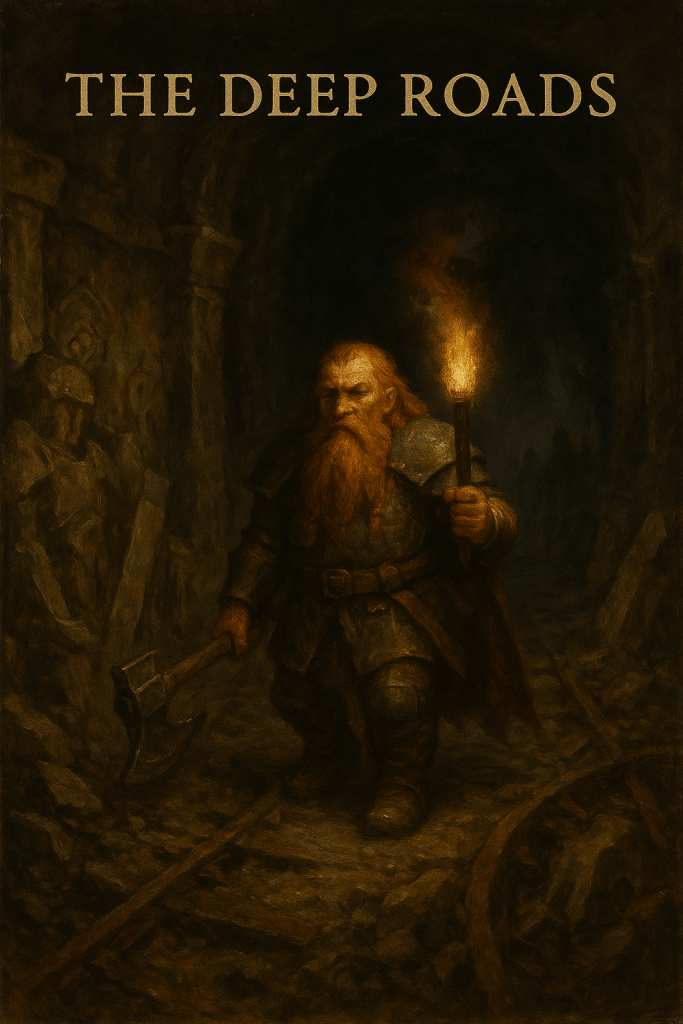


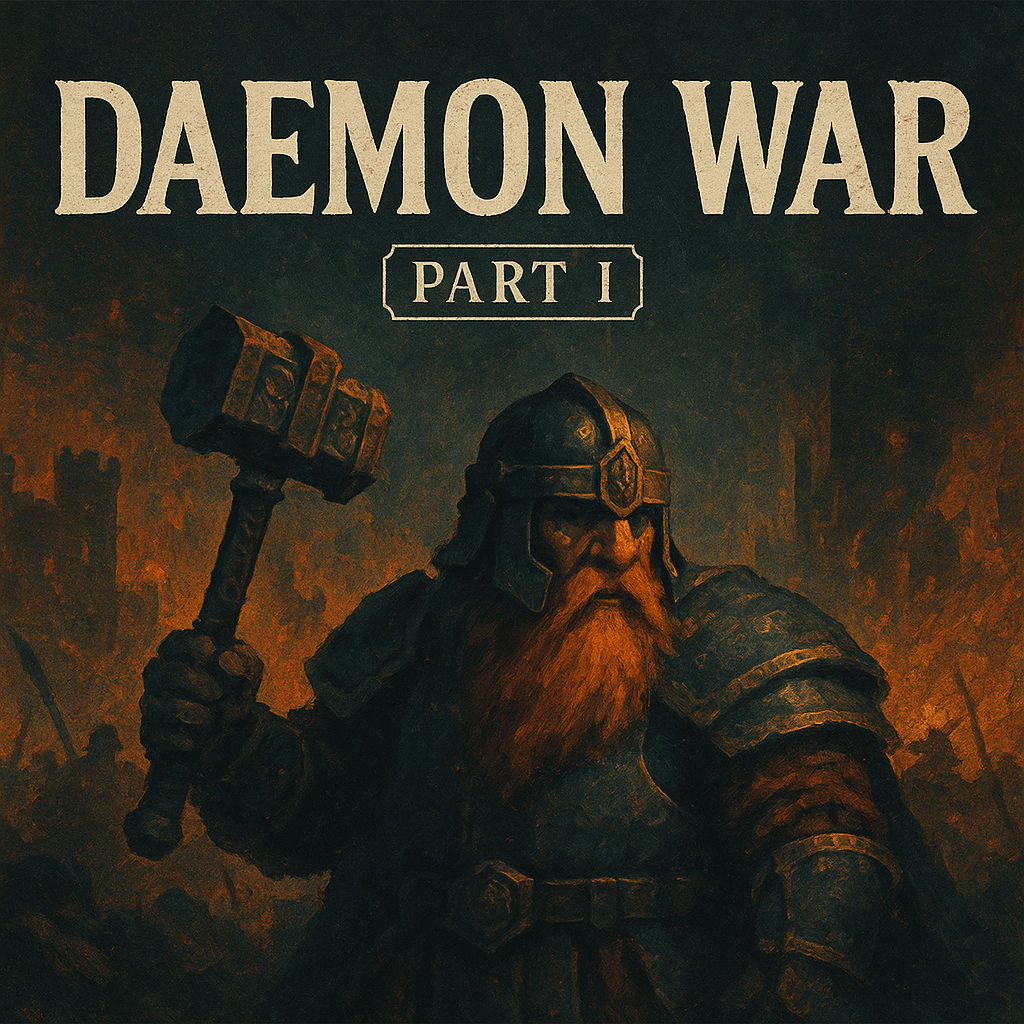
 Chronicles of Astravara
Leave a comment