
Where gods whisper and empires rot.
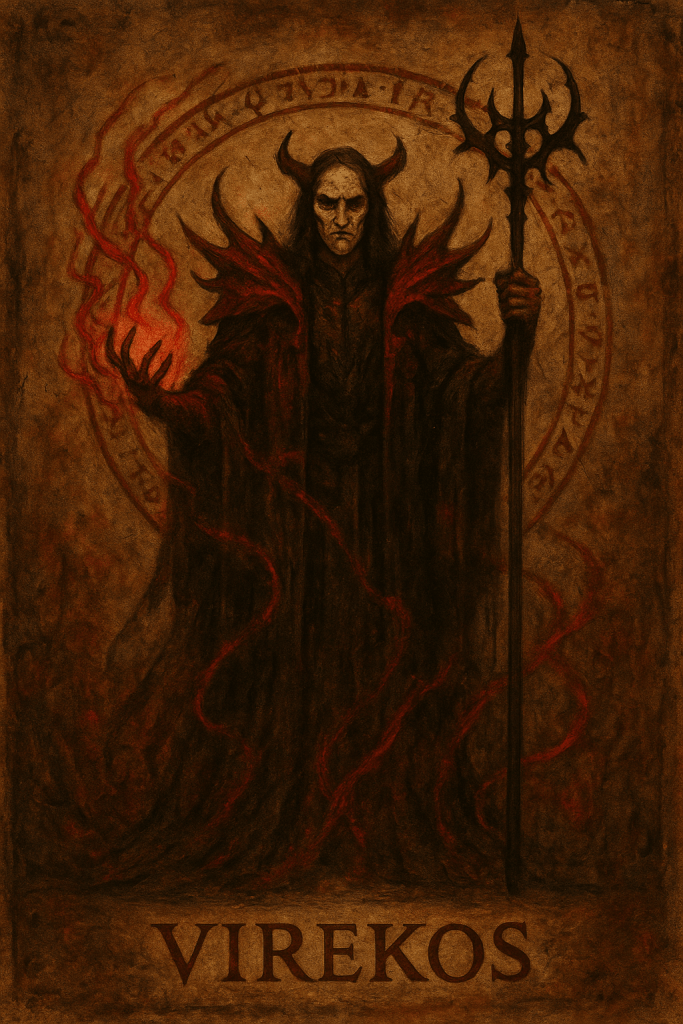
Title: The Shattered Warden, Lord of Madness, The Whisper in the Wound
Alignment: Betrayal, Madness, Discord
Dominion: Illusion, Corruption, Broken Truths, Divine Vengeance
Symbol: A fractured halo behind a weeping eye
Sacred Artifacts: The Cracked Sigil, Mask of Three Faces, The Heart-Silencer
Divine Domain: The Hollow Spiral (formerly the Eleventh Dimension)
Servants: Mindflayers, Apostate Oracles, Children of the Veil
Opposed Powers: Elyonel, Tianara, Magistus Veraael
Worshippers: Exiled sorcerers, heretic prophets, broken seers, daemon cults
Divine Biography
Virekos was once the Warden of Unity, a luminous god devoted to balance and understanding among the Primordials. Gentle in speech, wise in counsel, and unwavering in loyalty, he was the mediator of the divine, the only one able to bridge the wills of Elyonel, Mordhekan, and Tianara in the earliest days of the cosmos.
But what began in harmony ended in betrayal.
Mordhekan, driven by conquest, and Larythis, seduced by chaos and desire, grew envious of Virekos’ influence. They conspired to break him, not in body alone, but in soul. Over millennia, they imprisoned him in a dimension sealed from the other gods — a wound in reality known only as the Spiral Below.
There, they tortured him, unraveling his divine form piece by piece, whispering lies and truths until both were indistinguishable. His mind cracked under the weight of betrayal, his songs warped into screams. And when he was finally released, Virekos was no longer a god of peace.
He emerged not merely broken — but transfigured into a daemon of sublime madness, allying himself with his torturers to bring down the Creator. His voice, once balm to divine tensions, now carried the scream that sparked the Celestial War.
Nature and Appearance
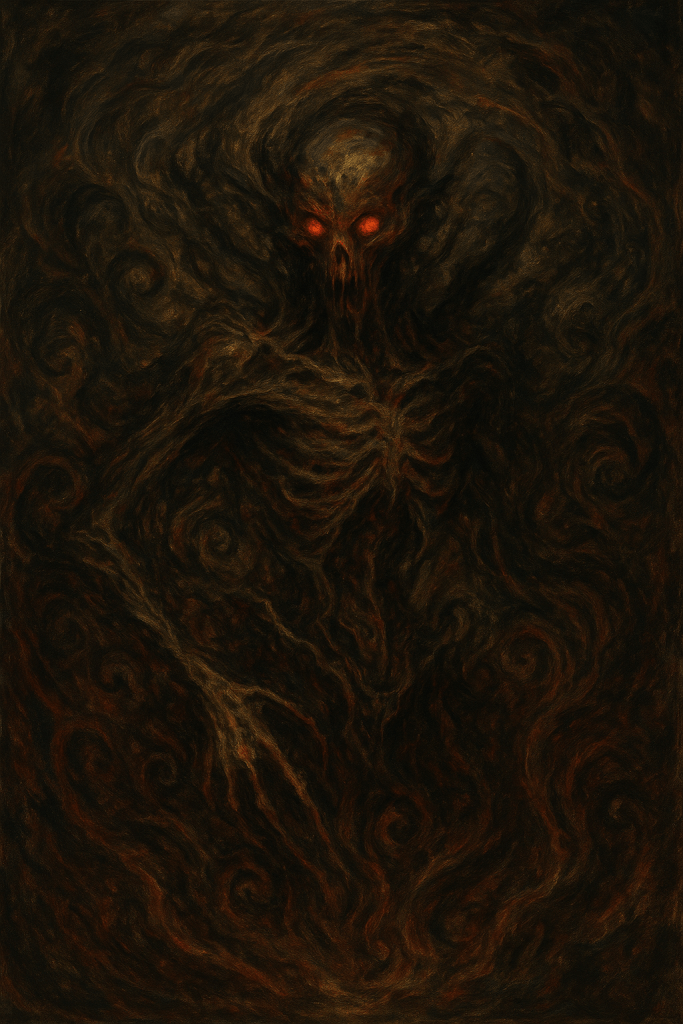
Virekos’ form is unstable. He oscillates involuntarily between a regal, deathlike daemon-form cloaked in voidlight, and a grotesque abstract horror — a storm of skeletal flame, eyes, and shrieking shadow. This mutation is not symbolic — it is literal. His identity is no longer singular.
Some say he cannot remember who he once was. Others believe he remembers too much, and each form is a fragment of self trying to speak.
He is rage and grief made god, a chorus of contradictions, and an entity whose form is shaped by the trauma it endures — and inflicts.
Cults and Worship
The cults of Virekos are diverse, unstable, and often mutually hostile. Some view him as a martyr of divine betrayal, others as the only being who has “seen the truth behind the light.” A few venerate him not out of loyalty, but fear, believing that if he is not praised, his madness will find them in dreams.
His rites are chaotic, dreamlike, and often involve masks, blood, inversion of sacred texts, and hallucination-inducing chants. His temples are rarely built — they form, often overnight, as though reality itself recognizes and recoils from his presence.
Legacy in Astravara
Virekos is the antithesis of trust, the proof that even gods can be broken by those closest to them. His existence is invoked as a cautionary tale, as justification for zealotry by the Inquisition, and as a dark hope for those who have been betrayed, abandoned, or driven to madness.
Some believe Virekos is not done unraveling. That he still carries a fragment of the old Warden — and that if it awakens, he may turn on his former tormentors, or drag the world with him into the wound of the cosmos.
For now, he is a daemon. But once, he was more — and perhaps that’s what makes him most terrifying of all.
 Chronicles of Astravara