Where gods whisper and empires rot.
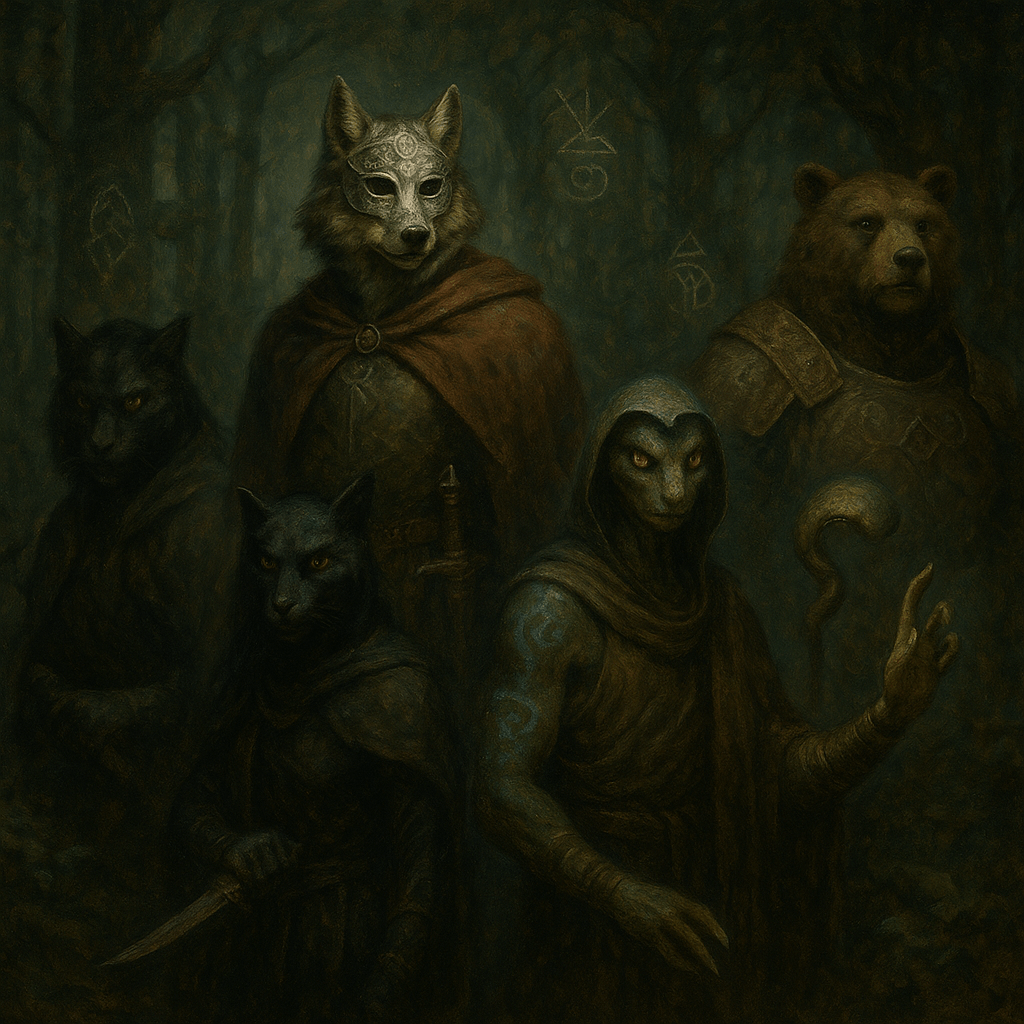
The Beastfolk – Children of the Primal Pact
“When the rivers still sang and the moon knew each name, they walked the forests not as beasts nor men, but something older—kin to thunder and to mourning.”
— Old Sayari chant, recorded in the Temples of Durath’Khar.
Overview
The Ruh’Rashi are one of the oldest sentient species of Astravara — a diverse people marked by their hybrid forms, bridging animal instinct with humanoid reason. To many, they are known simply as beastfolk, yet this term fails to capture the spiritual and ancestral depth of their culture. Their origin is tied to the Primal Pact, an ancient covenant made with the first spirits of land, sky, and blood.
The Ruh’Rashi do not share a singular appearance. Instead, they embody a spectrum of traits drawn from wolves, lions, serpents, birds, and more—each bloodline reflecting a different totemic lineage. This is not mere animal mimicry, but a biological and spiritual inheritance: a living bond between flesh and myth.
Once guardians of the wild domains, the Ruh’Rashi have long since withdrawn from the world of the other races. Memories of betrayal, war, and desecration have driven them into the shadowed groves of forgotten forests and highland sanctuaries. Few are seen in cities; fewer still trust the tongues of men or elves.
Physiology
The Ruh’Rashi are born not of magic, but of ancestral shaping—a convergence of natural evolution and spiritual embodiment. Their bodies are resilient, their senses sharper than any elf, and their instincts deeply tied to the terrain they hail from. Lifespans range from 60 to 130 years, depending on bloodline.
Most bear digitigrade legs, clawed hands, elongated muzzles, and pelts of varying patterns and colors. However, those from the Aerie Kin sport wings; the Serpent-Kin lack fur altogether, bearing scaled hides and hypnotic eyes. Their diversity rivals that of the entire beast-kingdom.
Importantly, each Ruh’Rashi is born into a Totem Line, which dictates their rites, diet, behavior, and even battle style. To deny one’s totem is considered a form of spiritual severance — punishable by exile or ritual silence.
Culture and Totem Orders
The Ruh’Rashi live in loosely connected tribal federations, often nomadic or forest-bound. Oral tradition, runic carvings, and ancestor-bonded dreaming are the foundations of their culture. Songs are considered sacred—each verse not merely poetry, but invocation.
Totem Orders include:
- The Sayari – Wolf-blooded seers and warriors; leaders of many clans during the early Daemon incursions. Known for their oaths and silver masks.
- The Velkha – Panther-born, silent and cunning. Masters of ambush and forest warfare.
- The Kraesh – Raven and crow kin; keepers of ancestral memory, known as the Dream-Callers.
- The Zhan’Ur – Serpent-blooded mystics, feared and revered for their venomous rites and forbidden knowledge.
- The Goru-Van – Bear-blooded guardians; builders of the stone groves and shielders of the sacred springs.
While tensions exist between Totem Orders, they all share one law: Do not forsake the Wild Path, lest you become hollow.
History and Isolation
The Ruh’Rashi fought alongside the free peoples during the first awakenings of daemonkind — especially in the southern front of what would become the Ashen Wastes. Yet their aid was met with suspicion, even betrayal, as human kingdoms desecrated sacred groves and dwarven expansion razed their river-shrines.
Following these events, most Ruh’Rashi retreated into hidden regions. Some now whisper of a Hidden Sanctuary—a vast forested domain protected by illusions and primal wards, where the last Grand Council of the Ruh’Rashi awaits the world’s end or rebirth.
Present Day
With the rise of the Inquisition and the spreading fires of a new war, rumors grow that emissaries of the Ruh’Rashi have once more emerged — cloaked in vines and shadow, their voices low and measured. Whether they come as allies, watchers, or avengers remains uncertain.
In the hearts of the old forests, their drums still echo.
“We are not lost. We are remembering.”
— Ruh’Rashi proverb.
 Chronicles of Astravara