
The First Song and the Celestial War
Estimated Reading Time:
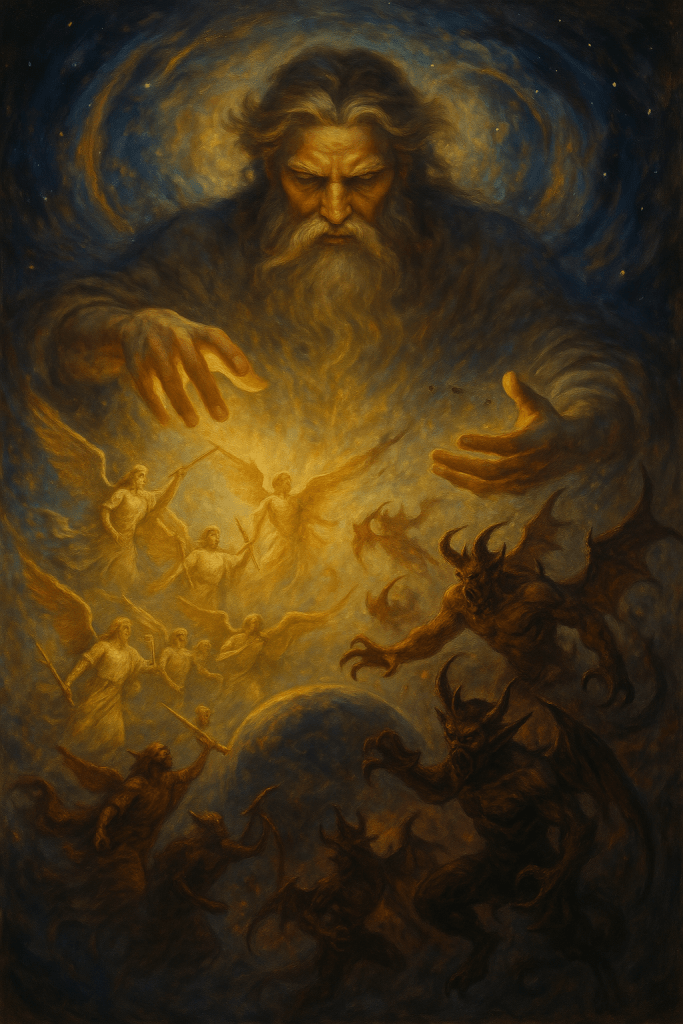
In the beginning—before time, before light, before the very concept of existence—there was only the Unnamable: a primordial entity whose essence transcended form, boundary, or understanding. This was God, with a capital G. The Alpha and the Omega. The origin and the final destination of all things.
He was an overwhelming presence in the absolute void, where not even the echo of silence could exist. In His infinite solitude, He conceived the idea of creation—not out of need, but out of a desire to see His incomprehensible vastness reflected in infinite forms.
With a single thought, He birthed the stars, igniting the nothingness with eternal fire. Countless suns were born, their flames piercing the darkness in every direction, creating a cosmos that expanded without end.
Planets formed around those stars, shaped with divine precision. Some were lush—filled with purple skies and golden seas. Others were hostile and dark, covered in venomous deserts or forests that breathed malice.
Every detail was carved by the will of the Creator. But creation demanded a price. Each new world drained a part of His essence, binding Him irrevocably to all that existed.
When the universe finally took shape, God beheld His work. It was glorious—yet empty.
Creation was a tapestry with no eyes to admire its colors, no voices to sing of its wonders.
So He created the Eleven Primordials, His first children.
They were beings of pure cosmic energy—fragments of His own essence, reflections of aspects of the Creator. Each unique in purpose and nature.
The Primordials were beautiful and terrifying, vast in power and depth. To them, God entrusted the task of bringing life into the universe.
Together, they composed the Song of Life—a divine symphony that resonated through the fabric of creation. From that melody, the first living beings were born: simple forms, evolving in complexity, growing in number and diversity.
Oceans began to pulse with strange creatures. Forests became home to colossal beasts. Skies filled with wings that cut through the wind.
It was an age of harmony—a dance between Creator and Creation.
For millennia, the Primordials carried out their duties, spreading life to every corner of the cosmos. But the universe was vast. And over time, distance separated them from their Father.
Alone in their tasks, they began to experience something they had never known: doubt.
The connection to the Creator weakened. His voice became faint.
In search of what they had lost, some Primordials began to create independently—crafting their own versions of life.
That… was when ruin began to seep in.
As they created independently, the Primordials drifted away from their original formless state, taking on physical aspects that reflected their personalities and obsessions. Some became colossal beings—monstrosities whose very presence distorted reality around them. Others adopted more subtle, but no less sinister, forms, concealing their darker intentions behind delicate appearances.
The separation from the Creator, and the transformation of their divine nature, led many of the Primordials to feel resentment. Some believed they had been abandoned. Others desired to take the Creator’s place and rule the universe as supreme beings. Factions formed among the siblings, and soon resentment gave way to open conflict.
Thus began the Celestial War—a cataclysmic struggle that destroyed entire worlds, extinguished countless species, and stained the tapestry of creation with blood. The Primordials used their own creations as armies, manipulating them as pawns in a cosmic chess game. Entire planets were turned into battlefields, their skies ignited by storms of devastating energy. The screams of mortals echoed among the stars, but their cries were ignored by their divine masters.
The Creator, weakened by the burden of sustaining the universe, watched in agony as His masterpiece unraveled. In His sorrow, He composed a new song—a mournful melody that resonated across the entire fabric of existence. This music carried the Father’s grief for His lost children and the destruction of His creation. Those who heard it wept, from the humblest mortals to many of the Primordials themselves. Some of the children repented, laying down their weapons and joining the chorus of redemption.
But not all were touched by the song. Those who had fallen too far, whose hearts were consumed by anger and pride, composed a melody of their own. Their song was one of defiance, chaos, and bitterness. While the Creator’s song sought to heal and unify, theirs aimed to divide and corrupt.
And so, the universe became the stage for a battle between two melodies—one of harmony, and one of discord.
In a final act of power, the Creator reshaped the structure of the cosmos. He divided creation into twelve dimensions, each one a reflection of a different aspect of reality. Each Primordial was confined within a dimension, along with their creations and followers. The Twelfth Dimension was reserved for mortals who had not been corrupted by the influence of the Primordials.
With this last act, the Creator exhausted the last of His strength and entered a deep slumber. Yet even in His sleep, He continues to influence the cosmos through His dreams.
In the dimensions where they were sealed, the Primordials raised dark kingdoms shaped in their own image. Some continued to create life, but their creations bore the mark of their corruption—grotesque beings, hungry for power and destruction. Others devoted themselves to survival or the perfection of their own twisted creations. But all of them, without exception, longed to escape their dimensional prisons.
They began to reach into the Twelfth Dimension, sending emissaries, manipulating mortals, and planting seeds of chaos. Their followers—dark cults and devoted servants—spread their will, awaiting the day their masters would break through the barriers and reclaim the cosmos.
And so, the Creator’s song, though distant, still resists the discord of the fallen Primordials. The fate of the universe remains uncertain, caught in an eternal struggle between light and darkness, harmony and chaos.
In the early days of the dimensions, before the Creator sealed the gates between worlds, there was balance—though fragile. This delicate equilibrium was maintained by Virekos, the Primordial of Truth and Guardian of Peace. With golden-feathered angelic wings, flowing crimson hair like a river of fire, and radiant armor, Virekos served as a mediator between his siblings. As the universe teetered between creation and chaos, he held harmony together.
But harmony is a sharp blade, and its edge often wounds the one who wields it.
The cosmos simmered with tension. Mordhekan, the Primordial of War, longed for conflict—his fury growing like wildfire. Larythis, the Primordial of Desire, whispered dreams of domination and absolute freedom. Both despised the restraints that peace imposed. To them, Virekos was not a brother, but an obstacle.
Knowing his compassionate nature and unshakable trust, they conspired together. Mordhekan would stage a deadly conflict with Larythis, while she lured Virekos in with pleas for help.
“Virekos, dearest brother,” Larythis’s voice echoed among the stars, “Mordhekan and I are at war. My world burns. I beg for your aid.”
Worry tightened Virekos’s heart. He knew Mordhekan was prone to violence, but he believed all the Primordials—even the most chaotic—could still be guided back to the Creator’s purpose.
“I am coming, sister,” he replied, taking flight toward the forgotten edge of the galaxy where her call had led him.
When Virekos arrived, he found a desolate scene. Dark nebulas cloaked the space, and the stars themselves seemed lifeless. Mordhekan and Larythis waited, hidden in the shadows. As Virekos descended, his wings cast golden light into the void.
“Larythis? Mordhekan?” he called, his voice echoing through the vast emptiness. “Show yourselves, so we may resolve this peacefully.”
Larythis emerged first, her form cloaked in an ethereal veil that shimmered like starlight. Fake tears ran down her face as she approached him.
“Virekos, dear brother,” she whispered, her eyes gleaming with deception. “He is beyond reason. I need your help to stop him.”
Before Virekos could respond, Mordhekan’s roar burst from the shadows like thunder. The Primordial of War charged forward, wielding his black blade, a weapon that seemed to devour light itself.
“You come here to mediate?!” Mordhekan bellowed. “You, the Creator’s shadow, preaching empty words while our Father abandons us?”
“Mordhekan, there is no need for violence!” Virekos pleaded, raising his hands in a gesture of peace.
But at that moment—when his attention was divided—the trap was sprung.
Dark chains erupted from the void.
Larythis, her expression now ice-cold, conjured bonds of pure energy that wrapped around Virekos’s arms and wings.
Mordhekan lunged, striking him down with brutal force.
“Betrayal?!” Virekos cried out, his voice raw with pain and disbelief. “Brothers—why?!”
“Because your light blinds us,” hissed Larythis, her voice now cruel. “And your truth… is a chain that keeps us in chains.”
Virekos was taken to the heart of the abyss, a place so deep that not even the light of the Creator could reach it. There, his torture began.
Mordhekan dismantled his body with relentless brutality. Each blow from his black blade echoed with a note of pain that reverberated through Virekos’s divine essence. His golden wings were torn out, feather by feather, and his radiant armor was shattered, exposing flesh that burned with celestial energy.
Larythis, on the other hand, focused on his mind. She crafted illusions—each one more cruel than the last. She showed him visions of the Creator turning away from him, of his siblings despising him, of entire worlds being destroyed by his failure to preserve peace. Her voice whispered lies in his ear: “You were only ever a tool, Virekos. Our Father never loved you. He abandoned you, as he did the rest of us.”
Over the years, Virekos began to fall apart—both in body and in spirit. He fought to resist, clinging to memories of better times, but even those became tainted. His radiance faded, and the darkness of the abyss consumed him.
When his last fragment of hope was extinguished, Virekos ceased to be the Guardian of Truth. In his place, something new emerged—Daemon, the Primordial of Madness.
His once-golden wings became twisted and black, their feathers sharpened like blades. His armor was replaced with plates of jagged obsidian, adorned with thorns. His eyes burned with a furious red glow, and his voice became a distorted echo of bitter laughter and tormented screams.
He looked at Larythis, no longer with hatred, but with devotion.
“You have freed me, sister,” he said. “I am no longer a servant of light. I am the maestro of chaos.”
He took her as his wife, forging a perverse bond, and together they began to compose the Song of Discord. Mordhekan, now satisfied, became their general, and the dissonant melody they created spread throughout the cosmos, tearing at the fabric of creation itself.
With Daemon now allied with Mordhekan and Larythis, the balance of the universe collapsed. Without Virekos to mediate conflict, the remaining Primordials fell into open discord. The dimensions became battlefields, and the cosmos descended into chaos. The Song of Discord, now led by Daemon and sung by Mordhekan, the Primordial of War, and Larythis, the Primordial of Emotions and Illusions, spread across the universe, corrupting the original melody of the Creator. The universe, once held together by the harmony of the primordial song, began to tremble under the weight of disharmony. Thus began the Celestial War.
In the midst of the growing chaos, Elyonel—the Firstborn and Protector of Mortals—stepped forward. Alongside him stood Isisara Mirella, the Goddess of Healing and Love, and Magistus Veraael, the God of Truth and Knowledge. Together, they summoned a council of the loyal deities at the center of the cosmos. There, gathered around a brilliant star, they vowed to defend the universe and honor the legacy of the Creator.
“We will not allow the chaos to destroy our Father’s creation,” Elyonel declared. “Together, we will stand.”
Meanwhile, the Daemons prepared for war. Mordhekan gathered legions of monstrous beings forged from hatred and the essence of destruction. Thanarok, the Daemon of Death and Pestilence, raised armies of the undead and unleashed living plagues across the stars. Larythis used her gifts of seduction and manipulation to corrupt mortals and lesser divinities alike, turning them into instruments of ruin.
The first battles broke out at the edges of the dimensions, but they soon consumed the entire cosmos.
Mordhekan, consumed by his lust for conquest, launched a devastating assault against the realm of Vulkanar, the Forge God and Master of Invention. Vulkanar fought back with divine craftsmanship and mighty fortresses of metal, wielding his legendary hammer. But Mordhekan, bearing a volcanic sword of immense power, cut through stone and steel with brutal ease. Their clash reduced entire worlds to ash.
Elsewhere, Isisara Mirella struggled against Thanarok’s corruption. She poured her divine energy into purging his plagues, but each act of healing drained her strength. Thanarok, in contrast, grew stronger through death and disease. He laughed as the bodies of fallen soldiers rose again to fight in his service.
At the heart of the war, Larythis manipulated the minds and hearts of gods and mortals alike. Her whispers turned allies into enemies, offering promises of power and forbidden desires. Even the most faithful of Elyonel’s followers faltered, becoming puppets in her insidious games.
As centuries of war passed, even the noblest among the gods began to falter. Tianara, Goddess of Justice and Balance, fought to preserve order, but the increasing chaos of the cosmos weakened her connection to nature. Forests withered, oceans boiled, and the winds ceased to blow.
Tenebris Noctian, God of Night and Mysteries, worked from the shadows, attempting to predict Daemon’s next moves. But even he was not immune to Larythis’s manipulation. His deepest secrets were revealed, and shame drove him into isolation.
Meanwhile, Malkirath, God of Survival and Ambition, began to question his allegiance. His nature made him crave power, and he was drawn to the side of the Daemons, believing he could thrive in the chaos. He became a double agent, betraying his divine siblings in small acts while pretending to remain loyal.
At the height of the war, the armies of the Gods and Daemons clashed at the center of the cosmos—where the original song of the Creator still resonated most strongly. There, a battle of unimaginable scale erupted.
Elyonel led the loyal gods with his radiant light and faced Daemon—once Virekos—directly. But the Daemon of Madness was no longer the brother Elyonel had known. Daemon had become a swirling storm of shadows and illusions, constantly shifting forms that even Elyonel’s divine sight struggled to follow.
“You still seek meaning from a Father who abandoned us,” Daemon sneered, his voice echoing like a thousand whispering voices. “While we are creating a new universe—free of his chains.”
Around them, war raged. Mordhekan clashed with Vulkanar, their blows shaking the heavens. Thanarok continued to spread disease and death, while Isisara sacrificed her light to save the remaining mortals.
When all seemed lost, Elyonel raised his voice in a final, desperate prayer.
Though silent, the Creator heard.
With the last spark of His power, the Creator intervened. A new melody spread across the cosmos—quiet, but undeniable. It divided the universe into twelve sealed dimensions. Each Primordial was cast into a separate realm, taking their armies and followers with them.
Elyonel and the faithful remained in the Twelfth Dimension, a sanctuary where mortals could exist free from the influence of the Daemons. Daemon, Mordhekan, Larythis, and their corrupted kin were locked away in twisted realms of chaos and ruin.
As the Creator’s melody faded, so too did His essence. Exhausted, He fell into a deep slumber, entrusting the universe to His divided children.
But even in exile, the Daemons searched for ways to breach the barriers. And in the depths of their dimensions, the Song of Discord continued to echo—promising that the war was not yet over.
Peace had been restored, but at the cost of unity. The cosmos remained fractured, every strand of its existence vibrating with the memory of a war that would never be truly forgotten.
 Chronicles of Astravara
Leave a comment